
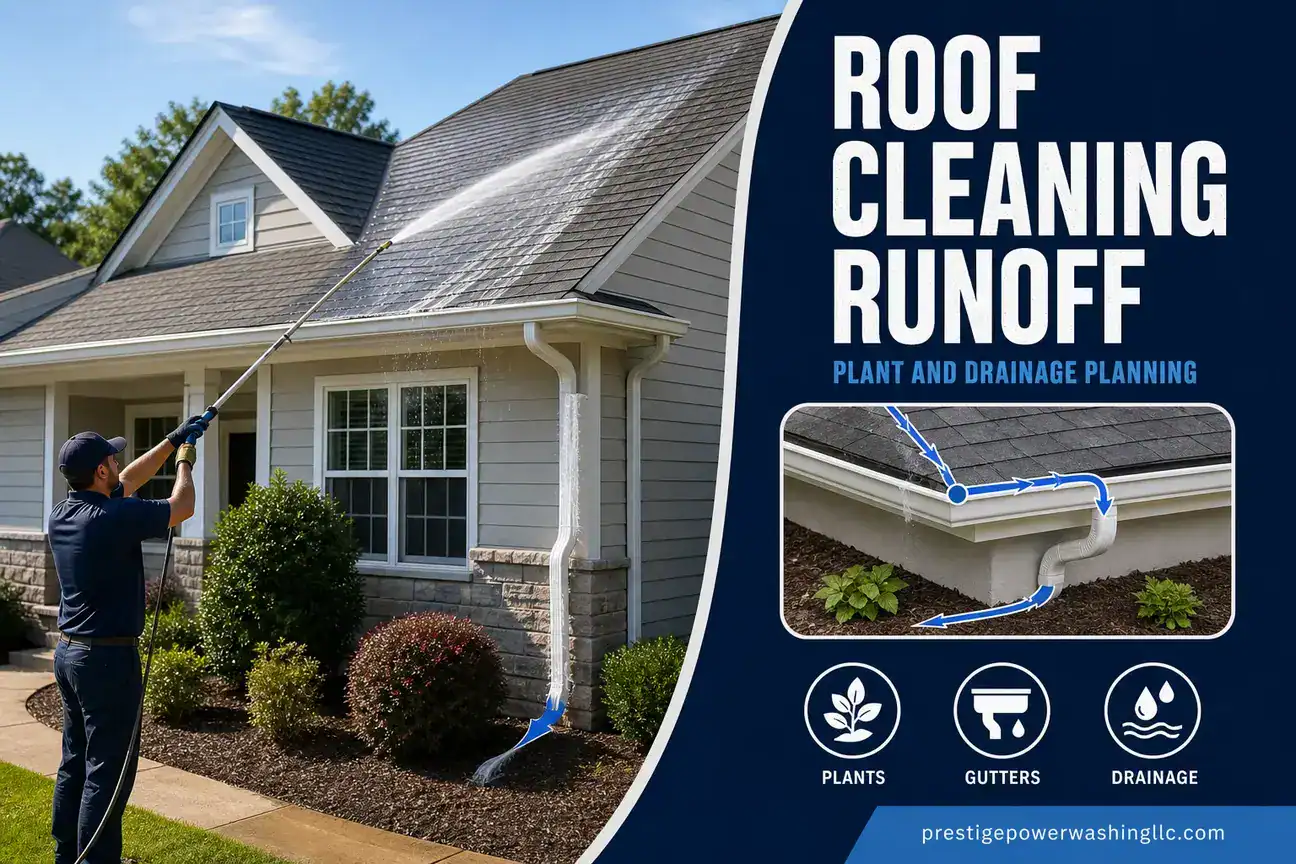
Roof Cleaning Runoff: Planning for Plants and Drainage
Quick Answer: roof cleaning runoff is the water and cleaning solution that leaves the roof during and after a roof wash. Before booking, homeowners should ask how the contractor plans around plants, gutters, downspouts, mulch beds, hardscape, and nearby drains. Soft washing is commonly used for roof cleaning because it relies on lower pressure than pressure washing, but low pressure does not remove the need for runoff awareness. A good conversation should cover site conditions, drainage paths, and realistic limits rather than promises that every plant, drain, or environmental concern is automatically protected.
For homeowners in Cary, Raleigh, and nearby Triangle service areas, the main question is practical: “What happens to the roof wash water once it comes off the shingles?” The answer depends on roof shape, gutter condition, slope, downspout location, landscape layout, weather, and the cleaning method. That is why planning matters more than blanket claims.
If you are comparing options, Prestige Power Washing LLC offers roof cleaning using a surface-specific approach for roofs and other exterior surfaces. You can also request a free estimate to discuss your roof, landscaping, and drainage layout before deciding whether service is a fit.
How roof cleaning runoff moves around the property
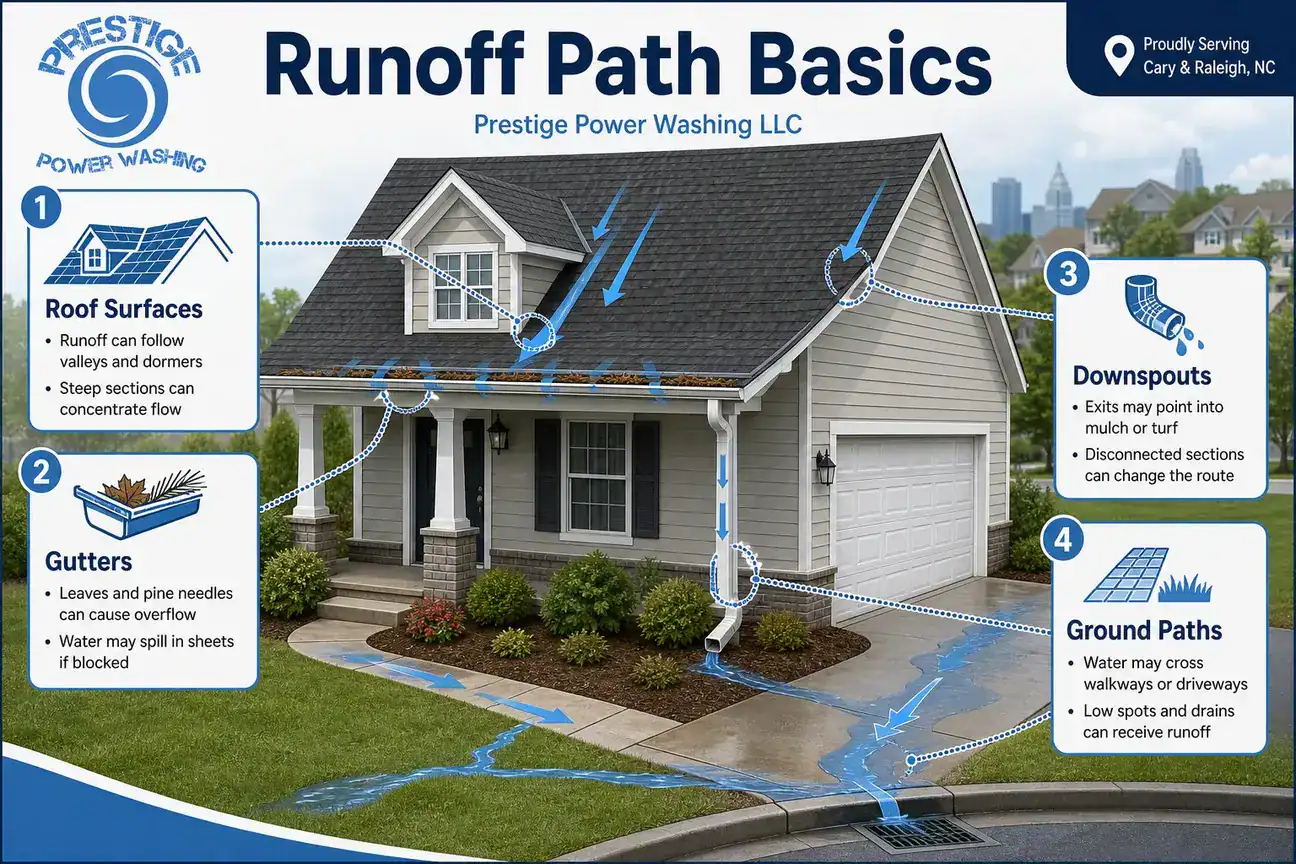
Roof cleaning runoff usually follows the same general path as rainwater, but it may carry loosened organic growth, roof debris, and cleaning solution residue. It can run into gutters, down downspouts, across splash blocks, into mulch beds, over walkways, along driveways, or toward low spots in the yard. On some homes, a downspout empties directly beside foundation plantings. On others, it points toward a driveway, patio, or storm drain inlet.
The roof itself is only one part of the runoff picture. Valleys, dormers, steep sections, clogged gutters, and disconnected downspouts can all change where roof wash water goes. If gutters are full of leaves or pine needles, water may overflow in sheets instead of traveling through the downspout. If a downspout extension has been moved, runoff may land somewhere different from where the homeowner expects.
That is why a roof-specific conversation should happen before the work begins. The contractor should be able to look at the property and talk through likely flow paths. They do not need to overpromise, but they should be willing to explain the plan in plain language.
Roof wash water can also behave differently from light rainfall because roof cleaning may involve purposeful rinsing, targeted application, and loosened buildup. A small amount of water at one downspout may be manageable, while concentrated flow into a delicate bed may require more planning. The goal is not to create fear; it is to avoid treating drainage as an afterthought.
Stormwater basics for Cary and Raleigh homeowners
Stormwater basics start with a simple idea: water that runs across roofs, driveways, parking areas, and yards can move toward drainage systems and local waterways. The EPA NPDES Stormwater Program frames stormwater as a managed regulatory subject, especially where runoff can enter municipal systems, construction sites, industrial sites, or other regulated pathways.
For homeowners, stormwater basics do not mean every roof cleaning conversation turns into a legal seminar. They do mean runoff should be discussed thoughtfully. In North Carolina, NC DEQ stormwater technical guidance is one of the appropriate places to understand that stormwater is treated as a managed environmental topic, not just “water going downhill.”
When reading NC runoff rules or stormwater guidance, keep the scope in mind. Rules and permits can vary by activity, location, property type, discharge type, and local requirements. A residential roof wash in Cary is not the same as a construction site, an industrial facility, or a municipal stormwater system. Still, the larger point is useful: drainage pathways deserve attention before exterior cleaning begins.
For property managers, HOAs, apartment communities, and commercial exterior decision-makers, stormwater basics may need a more formal internal review. Large roofs, long gutter runs, parking-lot drains, courtyard drains, and landscaped common areas can create more complicated flow patterns than a single-family home. That does not mean a cleaning contractor can promise regulatory compliance. It means the property team should ask better questions and involve qualified parties when needed.
Why landscaping needs a roof-specific plan
Landscaping is often the first concern homeowners raise. Foundation shrubs, annuals, perennials, newly planted beds, ornamental trees, turf edges, and mulch can sit directly below rooflines. If roof wash water concentrates in one place, those areas may receive more exposure than the rest of the yard.
There is no responsible way to say that any roof cleaning method is automatically harmless to every plant. Plant sensitivity varies, site conditions vary, and product-specific details matter. Some plants are more delicate than others. Newly installed landscaping may be more vulnerable than established shrubs. Dry soil, heat, drainage problems, or previous plant stress can also affect how a bed responds.
A practical landscape plan starts with observation. Where are the valuable plantings? Which beds sit below valleys or downspouts? Are there raised planters, containers, or delicate seasonal flowers? Are there pond features, edible gardens, or newly installed sod? A contractor should not need to guess after equipment is already set up.
Homeowners can help by pointing out anything that matters: new plantings, irrigation heads, landscape lighting, loose edging, low-voltage wires, decorative stone, or areas that already struggle with drainage. That information helps the cleaning conversation stay specific to the property instead of relying on generic assumptions.
How to protect landscaping before roof work
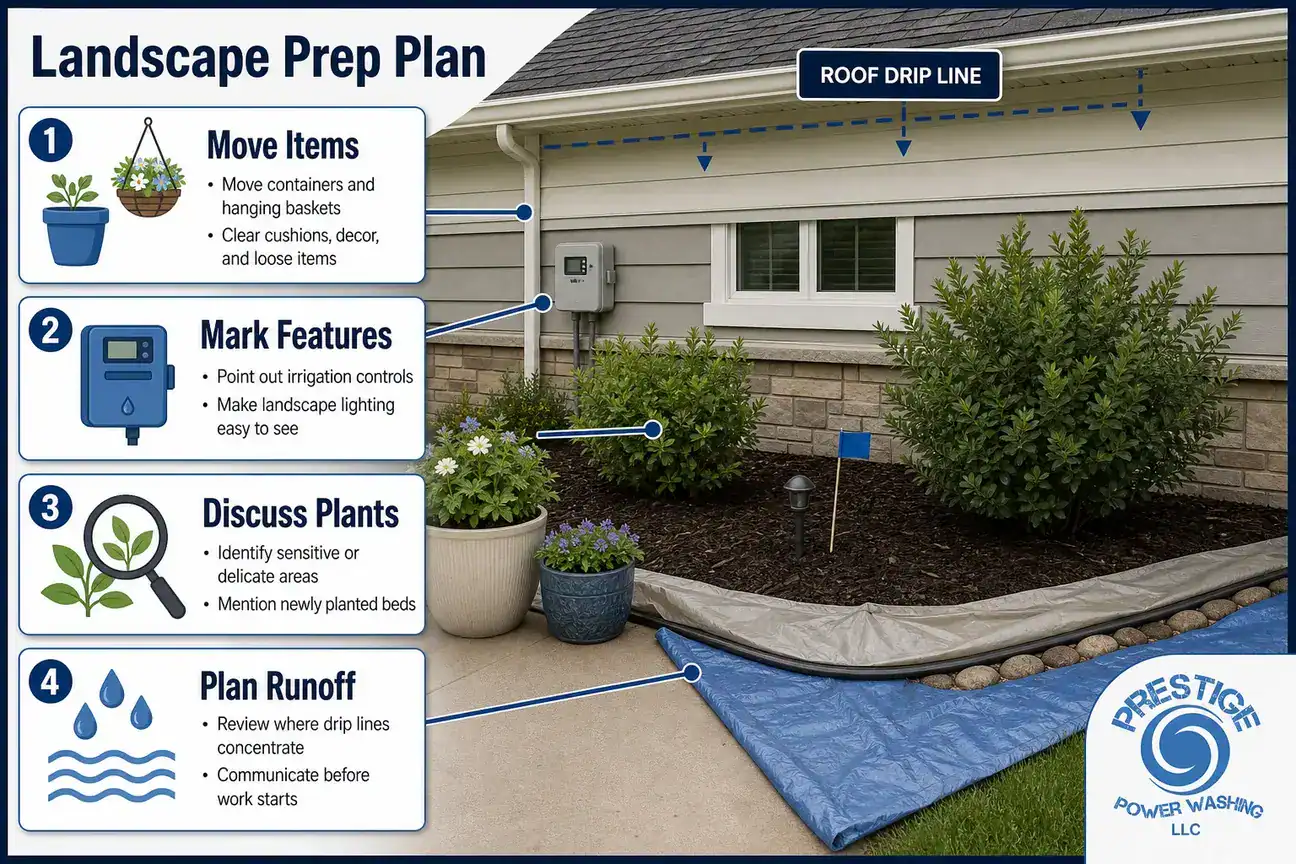
To protect landscaping, start before the cleaning appointment. Move lightweight containers, hanging baskets, cushions, small decor, and loose items away from roof drip lines when practical. If irrigation controls, landscape lighting, or delicate planters are easy to identify, make sure they are visible and mentioned during the walkthrough.
The phrase protect landscaping should not be treated as a promise that no plant can ever react. It should mean there is a plan: identify sensitive areas, discuss runoff paths, avoid unnecessary concentration where possible, and communicate before work starts. If a contractor uses broad claims about being universally harmless to plants without explaining site conditions or product details, that is a reason to ask follow-up questions.
Mulch beds deserve special attention because they often sit directly under eaves and downspouts. Mulch can slow visible flow, but it can also hold moisture and residue near roots. Decorative stone beds may move water quickly along hidden channels. Sloped beds can carry roof wash water toward sidewalks, driveways, or drains.
Covering shrubs is sometimes discussed, but it is not a universal answer. Covers can trap heat, block airflow, or cause other problems if used incorrectly or left too long. The better question is not simply “Will you cover plants?” It is “How will you decide what needs attention on this property?” That keeps the conversation grounded in conditions rather than a one-size-fits-all checklist.
To protect landscaping around a Cary or Raleigh home, homeowners should also avoid last-minute surprises. If a bed was recently planted, if irrigation is broken, or if a drainage area already floods, tell the contractor. Existing plant stress matters when evaluating what roof wash water might do once it reaches the ground.
Soft washing and roof cleaning: lower pressure, still runoff-aware
Soft washing is often the appropriate method for roof cleaning because roofs are not the same as concrete driveways or other hard surfaces. Asphalt shingle roofs, in particular, need caution because aggressive pressure can disturb roofing materials. The Asphalt Roofing Manufacturers Association guidance on algae and moss cleaning discusses low-pressure cleaning approaches and warns against pressure washing asphalt shingles.
That lower-pressure approach is one reason many homeowners ask about soft washing. However, soft washing does not make runoff disappear. It changes the cleaning conversation from “How much pressure?” to “What solution is being used, where will rinse water go, and what site conditions need attention?”
ARMA guidance says to “rinse thoroughly with low pressure water.” That instruction supports the importance of low-pressure rinsing, but it does not give homeowners permission to ignore gutters, plants, or drains. A responsible roof cleaning discussion should pair method selection with runoff planning.
For homeowners comparing services, it can help to separate three different issues:
- Roof surface protection: choosing a method appropriate for the roofing material.
- Landscape awareness: planning around plantings, beds, and soil conditions below the roofline.
- Drainage awareness: understanding where roof wash water will likely move after it leaves the roof.
Prestige Power Washing LLC also provides other exterior cleaning services, but the appropriate method should be matched to the surface. A roof, driveway, patio, gutter exterior, and building wall should not all be treated as if they have the same cleaning needs.
Seven practical ways to plan for roof wash water
The following seven planning points are not guarantees. They are practical discussion topics that help homeowners, HOAs, and property managers understand how roof wash water may move around the property.
- Walk the roofline from the ground. Look for areas where water naturally drips, overflows, or concentrates during rain.
- Find the downspout exits. Note whether they discharge into mulch, turf, hardscape, drains, or splash blocks.
- Identify sensitive landscaping. Point out new plantings, container gardens, delicate shrubs, ornamental beds, or stressed areas.
- Check for visible gutter issues. Overflow stains, sagging sections, and debris can change the runoff route.
- Move portable items. Planters, patio furniture, and decor are easier to relocate before the appointment than during service.
- Ask about the cleaning method. For roofs, ask how the contractor approaches low-pressure cleaning and rinsing.
- Discuss drains and low spots. Make sure the contractor knows about yard drains, storm drain inlets, or areas that already pond.
This is where protect landscaping becomes more than a slogan. It becomes a property-specific discussion. A homeowner in Cary with mature foundation shrubs may have different concerns than an HOA with long townhome gutter runs in a Raleigh-area community.
Roof wash water planning also helps prevent confusion after the work. If everyone understands the expected flow path, downspout locations, and plant concerns beforehand, the service conversation is clearer. Clear communication is part of a more pain-free service experience, especially when the job involves both the roof and the landscaping below it.
Gutters, downspouts, and drainage paths matter
Gutters and downspouts are the traffic lanes for roof runoff. If they are clear and properly connected, water is more likely to move where the drainage layout intends. If they are blocked, loose, disconnected, or overflowing, roof wash water may spill over the front edge, behind the gutter, or into unexpected beds.
ARMA guidance says, “Keep gutters, downspouts and roof surfaces clear of fallen leaves, pine needles, twigs and other debris so that water will drain freely.” That guidance is especially relevant before roof cleaning because debris can redirect runoff before it ever reaches the downspout.
Homeowners do not need to diagnose every gutter issue themselves. They can simply look for visible clues: plants growing in the gutter, water marks on fascia, loose downspout elbows, missing extensions, or piles of shingle grit and leaves near outlets. These signs are worth mentioning before a roof wash.
Prestige Power Washing LLC offers gutter cleaning as a confirmed service. If gutters are a concern, ask whether gutter cleaning should be discussed separately from roof cleaning for your property. Do not assume one service automatically includes the other unless it is clearly included in the estimate.
Drainage also extends beyond the gutter. Some homes have buried downspout lines, French drains, yard drains, or driveway channels. Others discharge onto sloped turf or toward sidewalks. If you know a drain is slow, clogged, or connected to a sensitive area, say so during the estimate conversation.
NC runoff rules: what to ask, not assume
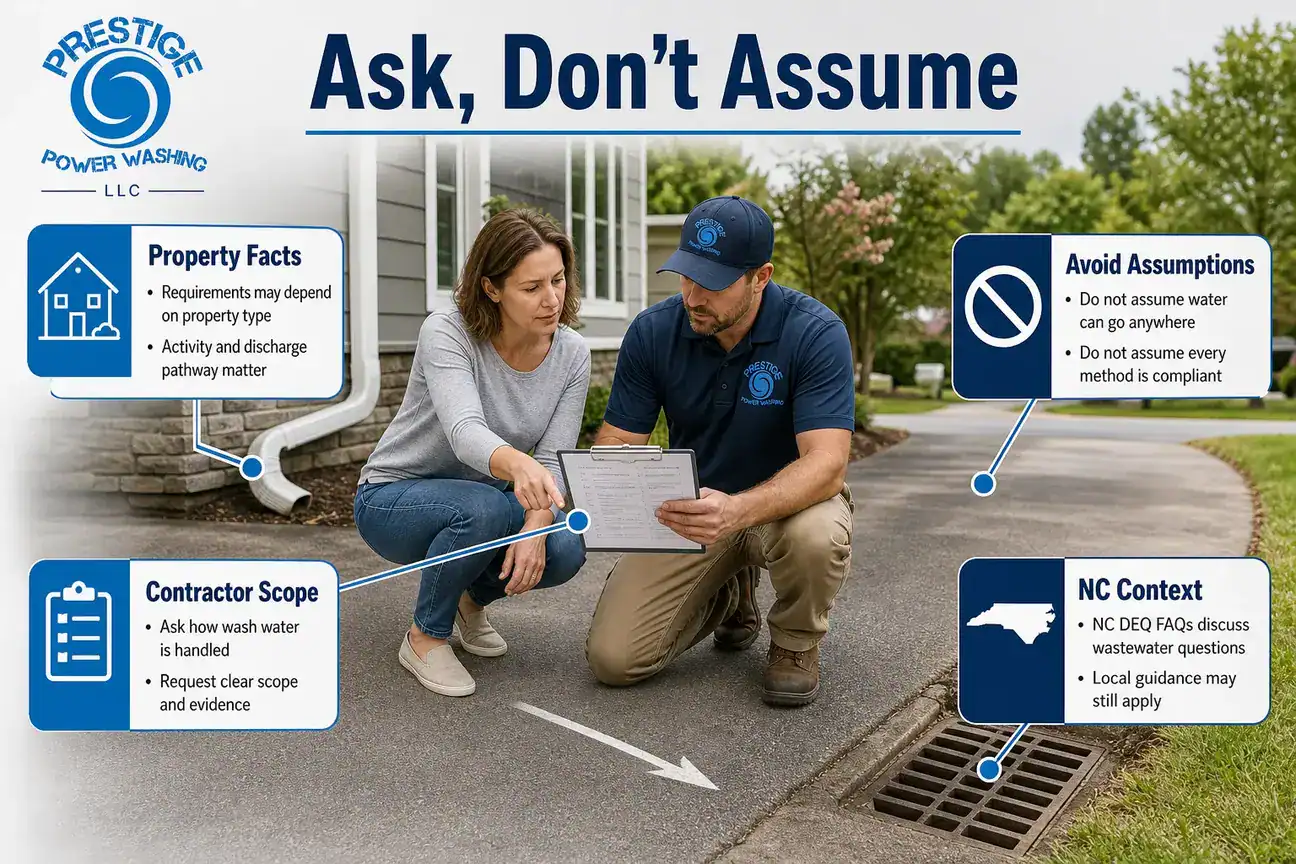
NC runoff rules can be difficult for a homeowner to interpret because requirements may depend on the property type, activity, discharge pathway, local ordinances, and other facts. The practical takeaway is to avoid casual assumptions. Do not assume roof wash water can go anywhere. Do not assume every method is automatically compliant. Do not assume a contractor has a documented compliance program unless they can explain the relevant scope and evidence.
The NC DEQ NPDES wastewater FAQs provide useful context for how North Carolina discusses wastewater permitting questions. For a homeowner, this does not replace local guidance or legal advice. It simply reinforces that wastewater and stormwater are regulated topics in North Carolina, and property-specific questions may need qualified review.
When asking about NC runoff rules, keep the question practical: “Where do you expect the runoff to go on my property, and what should we discuss before work begins?” That is a better question than asking for a broad promise that every possible rule is satisfied. A careful contractor should be willing to discuss the site without overstating legal conclusions.
For HOAs, apartment communities, and commercial properties, NC runoff rules may also intersect with property management policies, tenant communication, and site maintenance responsibilities. That can include confirming access, identifying drains, planning around parking areas, and documenting questions before work. Exterior cleaning can improve appearance, but it should not be described as regulatory compliance, inspection approval, or a substitute for professional environmental advice.
Questions to ask about roof wash water
Before booking, ask direct questions about roof wash water. You are not looking for a scripted sales answer. You are looking for clear communication about your roof, landscaping, and drainage layout.
- Which roof areas are most likely to shed water onto landscaping?
- Where do my downspouts discharge?
- Do any gutters or downspouts appear blocked, disconnected, or likely to overflow?
- How will you decide which plants or beds need extra attention?
- What should I move before the appointment?
- Are there drains, ponds, edible gardens, or newly planted areas I should point out?
- What is included in the estimate, and what is not included?
- If a condition changes on the day of service, how will you communicate that?
These questions apply to homeowners and property managers. A townhome HOA may need to ask about multiple downspouts and shared beds. A restaurant or retail property may need to ask about scheduling and customer access. A homeowner in Apex, Morrisville, or Holly Springs may simply want to know how the roofline and foundation shrubs will be handled. In each case, the answer should be specific to the property.
Cary is the published business address of record for Prestige Power Washing LLC. Raleigh and other Triangle communities are service areas, not branch office locations. Availability and scope should be confirmed for the specific property and service being discussed.
What a contractor should not promise
A responsible contractor should avoid absolute runoff promises. No one should guarantee that every stain, algae streak, moss condition, plant concern, drainage issue, or runoff pathway will behave a certain way. Site conditions, weather, roof design, plant health, product labels, and drainage layout all matter.
Be cautious with claims such as “safe for every plant,” “fully compliant in every situation,” “no runoff concern,” or “no chance of plant reaction.” Current approved sources do not support that kind of universal claim. A better answer is conditional and specific: the contractor should explain what they can observe, what they plan to do, and what limitations remain.
The same caution applies to environmental language. Without current product-level evidence, it is not appropriate to describe a cleaning solution as green, harmless to pets, universally harmless to plants, or government-approved. Homeowners can ask what product information is available and what steps are taken on the property, but no article or sales conversation should replace product labels, safety data sheets, local requirements, or qualified professional guidance.
This matters because the goal is not just a cleaner-looking roof. The goal is a clearer decision before work begins. Honest limits build trust. Overstatements create confusion and may leave homeowners with unrealistic expectations.
Roof algae, moisture, and realistic expectations
Many homeowners start researching runoff because they are already concerned about black streaks, algae, moss, mildew-like staining, or moisture-related appearance issues. Roof cleaning may help remove visible organic staining and buildup, but results can vary by roof age, material, condition, shade, tree cover, and maintenance history.
ARMA guidance says to “trim tree branches back to allow more sunlight to reach the roof and minimize debris accumulation.” That recommendation is useful because shade and debris can contribute to recurring roof appearance problems. It does not mean trimming trees will prevent every future issue, and tree work itself should be handled by qualified parties when needed.
Mold and moisture guidance is broader than roof cleaning, but the moisture-control concept is relevant around buildings. The CDC mold clean up guidance emphasizes addressing moisture and drying wet items during mold cleanup. For exterior maintenance, that reinforces the value of paying attention to water paths, not just surface appearance.
Do not treat roof cleaning as roof repair, leak repair, or manufacturer warranty service. Prestige Power Washing LLC provides roof cleaning and roof soft washing, not roofing repair or replacement. If you suspect damaged shingles, active leaks, rot, or structural concerns, speak with an appropriate roofing professional before cleaning.
Simple homeowner preparation checklist
A little preparation can make the estimate and service conversation easier. This checklist is not a substitute for the contractor’s instructions, but it gives you a practical starting point.
| Area to check | What to look for | Why it matters |
|---|---|---|
| Foundation beds | New shrubs, annuals, delicate plants, mulch depth | Helps identify areas where runoff may concentrate |
| Gutters | Leaves, pine needles, visible overflow marks | Clogged gutters can redirect roof wash water |
| Downspouts | Missing elbows, short extensions, buried lines | Downspouts control where roof runoff exits |
| Hardscape | Patios, driveways, walkways, low spots | Water can travel across surfaces toward drains or beds |
| Special features | Ponds, edible gardens, lighting, irrigation | These should be discussed before work begins |
Use this checklist during your own walkthrough, then bring up anything important during the estimate. If you manage a multi-unit property, consider doing the same with a site map or maintenance notes. Protect landscaping by sharing what you know before the contractor has to make decisions on-site.
Where roof cleaning fits with other exterior maintenance
Roof runoff planning often reveals related maintenance needs. A roof may need cleaning, but gutters may also need attention. A home may have clean shingles but clogged downspout extensions. A commercial building may have roof staining along with drainage concerns near walkways or parking areas.
That does not mean every service should be bundled together automatically. It means the property should be evaluated as a system: roof, gutters, downspouts, landscaping, hardscape, and drains. Surface-specific cleaning helps match the method to the material instead of using one approach everywhere.
Prestige Power Washing LLC is a family-owned and locally operated exterior cleaning business based in Cary, North Carolina, founded in February 2017. The company provides pressure washing, power washing, and soft washing for residential and commercial properties in Cary, Raleigh, and verified Triangle-area service communities. Availability and scope should be confirmed for the specific property and service.
If you are planning a roof wash alongside other exterior work, ask what should happen first. In some cases, homeowners also discuss house washing, exterior gutter cleaning, or hardscape cleaning. In other cases, roof cleaning alone is the focus. Clear scope prevents misunderstandings about what is included.
Bringing stormwater basics into the estimate conversation
Stormwater basics are most useful when they lead to better questions. You do not need to become a drainage engineer to book roof cleaning, but you should know enough to ask where runoff is expected to travel. That is especially important if the property has storm drain inlets, shared HOA landscaping, steep slopes, or drainage systems you do not fully understand.
For a residential property, point out low spots, drains, or areas where water already stands after rain. For a commercial or multi-unit property, identify site access, parking areas, tenant pathways, and known drainage features. If there are written property rules or local requirements, make sure the appropriate property decision-maker is involved.
NC runoff rules and stormwater guidance should be treated as context, not marketing language. A cleaning contractor should not use them to make unsupported compliance promises. Homeowners should not ignore them either. The practical middle ground is to ask specific site questions and avoid broad assumptions.
Roof wash water is part of the same property water story as rainwater, gutter overflow, and downspout discharge. Understanding that story before cleaning helps everyone communicate better.
Final thoughts before scheduling
Roof cleaning runoff deserves attention because it connects the roof to everything below it: shrubs, mulch, gutters, downspouts, driveways, patios, drains, and soil. The right conversation is not based on fear or guarantees. It is based on observation, clear communication, and realistic limits.
When comparing roof cleaning options, ask how the contractor approaches soft washing, how roof wash water is expected to move, how they discuss plants, and what they do not promise. Use stormwater basics as a reminder that runoff should not be treated casually, and use NC runoff rules as a reason to ask careful questions rather than accept vague assurances.
If you are in Cary, Raleigh, or a nearby Triangle service area, Prestige Power Washing LLC can discuss roof cleaning as part of a surface-specific exterior cleaning estimate. Call 919-810-5215 or get a free estimate to talk through your roof, landscaping, and drainage concerns without assuming a one-size-fits-all answer.
Frequently Asked Questions
Will roof cleaning runoff hurt my plants?
It depends on the plants, site conditions, cleaning method, product details, soil moisture, and where the runoff goes. No contractor should promise that every plant will be unaffected. Point out delicate, new, or stressed landscaping before service so those areas can be discussed.
Is soft washing better for landscaping than pressure washing?
Soft washing uses lower pressure, which is why it is commonly discussed for roof cleaning. Lower pressure does not remove runoff concerns, though. Homeowners should still ask how plants, gutters, downspouts, and drainage paths will be handled.
Should I cover shrubs before roof cleaning?
Do not assume covers are always the right answer. Covers may help in some situations, but they can also trap heat or create other concerns if used incorrectly. Ask the contractor how they decide what landscaping needs attention on your specific property.
Do gutters and downspouts matter for runoff?
Yes. Gutters and downspouts strongly influence where water leaves the roof. Clogged gutters, missing downspout extensions, or overflow areas can redirect runoff into beds, hardscape, or low spots.
Can roof cleaning runoff go into storm drains?
Do not assume roof wash water can enter a storm drain. Requirements can depend on the property, discharge path, local rules, and what is in the water. Identify nearby storm drain inlets before work begins and ask how runoff will be discussed for your specific site.
What should I ask about drains before booking?
Ask where roof wash water is expected to go, whether any downspouts connect to buried drains, and whether nearby yard drains or storm drain inlets need to be identified before work begins. Share anything you know about slow drains or areas that pond after rain.
Do NC runoff rules affect residential roof cleaning?
North Carolina stormwater and wastewater rules are context-specific. A homeowner should not assume every rule applies the same way to every project, but runoff should still be discussed carefully. For unusual drainage conditions, commercial sites, or HOA properties, involve the appropriate property decision-maker or qualified professional.
How do I prepare my yard before a roof wash?
Move portable planters, furniture, cushions, and decor away from the roofline when practical. Point out new landscaping, delicate plants, irrigation components, landscape lighting, ponds, edible gardens, and any drainage areas that already cause concern.
Sources
- EPA — NPDES Stormwater Program
- North Carolina Department of Environmental Quality — NPDES Industrial Program Technical Guidance
- North Carolina Department of Environmental Quality — NPDES Wastewater FAQs
- Asphalt Roofing Manufacturers Association — Algae & Moss Prevention and Cleaning for Asphalt Roofing Systems
- CDC — Mold Clean Up Guidelines and Recommendations