
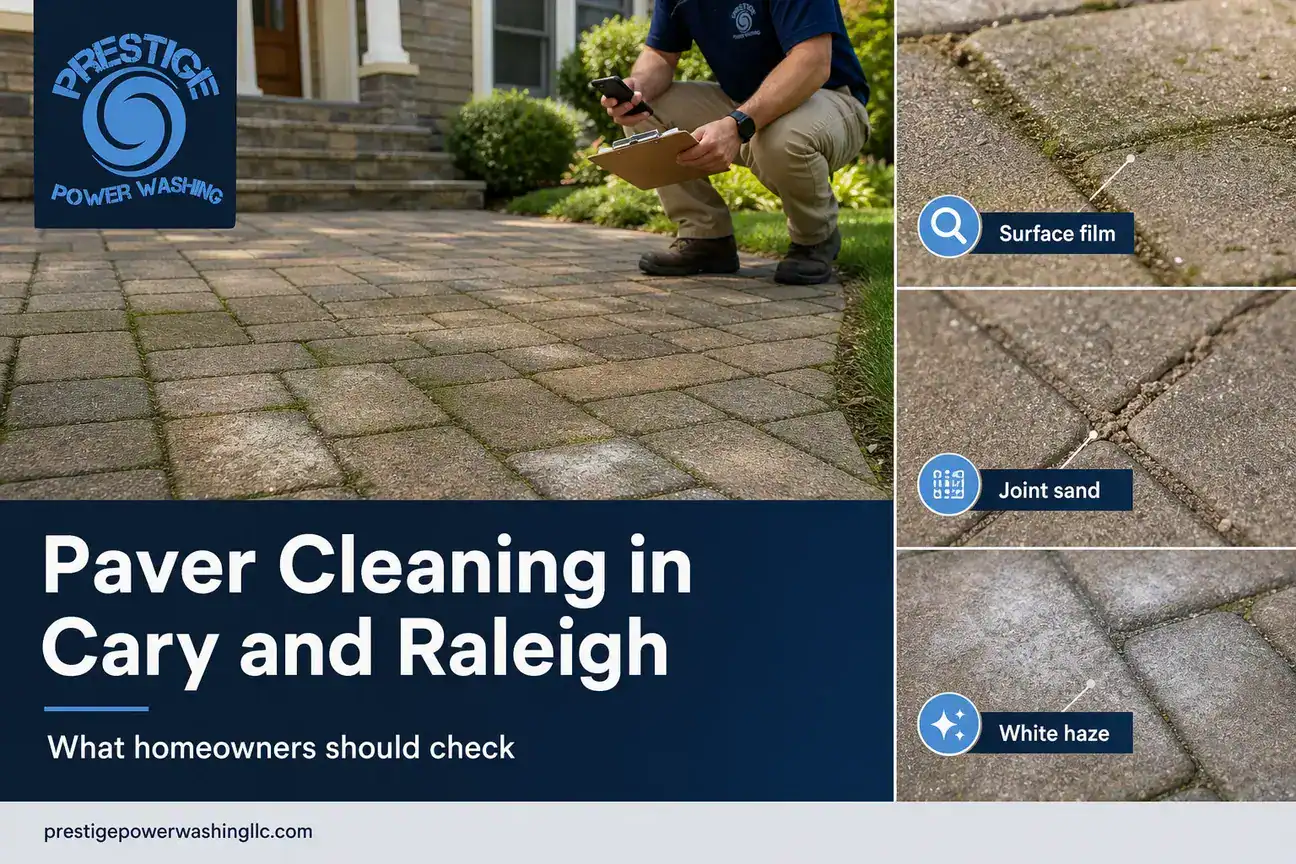
Paver cleaning Cary NC and Raleigh: Avoid 5 Mistakes
Quick Answer: If you are comparing paver cleaning Cary NC options, start by separating surface buildup from hardscape problems. Dirty, mossy, or algae-covered pavers may benefit from surface-specific cleaning, but rocking units, sunken areas, missing joint sand, recurring weeds, or drainage issues may need a hardscape contractor instead. Pavers are not the same as poured concrete, so the right plan should inspect the individual units, joints, stains, runoff paths, and realistic appearance goals before cleaning begins.
The five mistakes this guide helps you avoid are treating pavers like poured concrete, washing over depleted joint sand, confusing efflorescence with ordinary dirt, overlooking runoff paths, and expecting cleaning to solve settlement or deep stains.
For homeowners in Cary, Raleigh, and nearby Triangle communities, paver surfaces often sit in shaded yards, under trees, near downspouts, or beside driveways where moisture and debris collect. That makes it easy to assume every patio or walkway needs the same wash. In practice, patio pressure washing may be a good fit for surface dirt and organic buildup, while settlement, missing sand, edge movement, and damaged units call for a different conversation.
Prestige Power Washing LLC provides exterior cleaning services for residential and commercial properties in the Cary and Raleigh area. For pavers, the practical first step is a clear description of what you are seeing: dirt, weeds, moss, algae, white haze, stains, loose units, or water pooling. If you are unsure which category your surface falls into, you can request a free estimate and share photos or notes about the paver material, joint condition, staining, and any movement you have noticed.
paver cleaning Cary NC: where cleaning fits and where it does not
Cleaning is most useful when the main issue is on the surface: soil, leaf tannins, pollen film, mildew-like discoloration, algae, moss, or general weathering. A surface-specific cleaning approach can improve the look of patios, walkways, pool surrounds, and paver driveway borders, especially when the pavers are stable and the joints are in reasonable condition.
Cleaning is not the same as repair. It will not lift and reset sunken pavers, rebuild a failing base, redesign drainage, replace missing joint sand, or correct edge restraints that are allowing the paver field to spread. It can, however, make those conditions easier to see. Many homeowners discover after cleaning that the surface was not just dirty; it also had low spots, open joints, or cracked units that were hidden under buildup.
That distinction matters because pavers are individual units. Each unit can move, settle, chip, or loosen. A poured concrete slab can crack or stain, but it does not have the same pattern of sand-filled joints between every unit. That is why a plan for driveway pressure washing or slab cleaning should not automatically be copied onto a paver patio or walkway without checking the surface first.
Pavers versus poured concrete: why the surface changes the plan
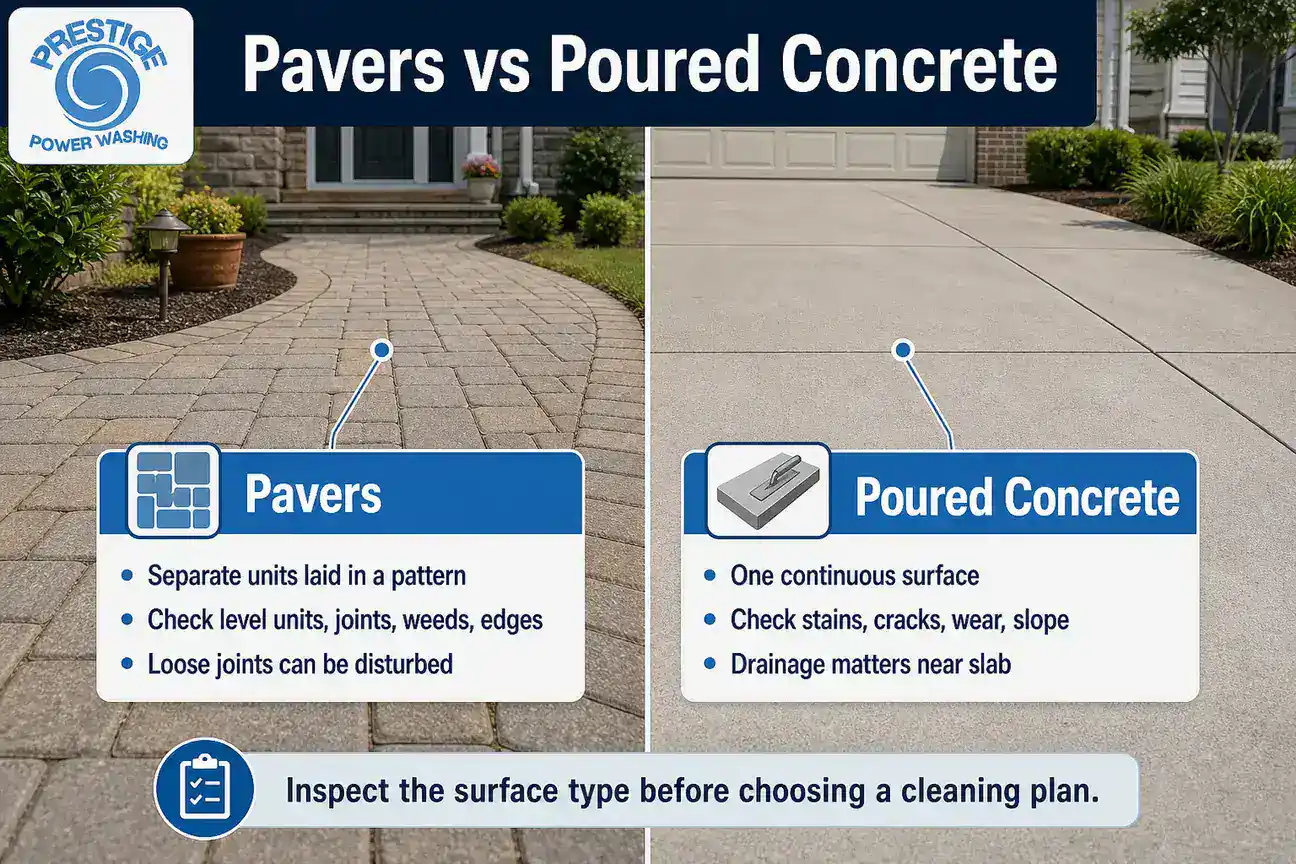
Poured concrete is one continuous surface. Pavers are separate pieces laid in a pattern, often with sand in the joints and restraints at the edges. This creates a flexible hardscape, but it also means cleaning pressure, rinsing, and vegetation removal can disturb loose joints if the surface is already depleted or unstable.
For poured concrete, the main inspection questions often involve stains, cracking, surface wear, slope, and nearby drainage. For pavers, the list is longer: Are the units level? Are they rocking underfoot? Is joint sand still present? Are the joints widened or recessed? Are weeds rooted deeply in the joints? Are edge restraints holding? Is the surface sealed, unsealed, faded, chipped, or previously treated?
This is also why the words “pressure washing” can be too broad by themselves. Paver pressure washing should not mean simply turning up pressure and treating every hardscape like a slab. The appropriate method depends on material, age, stability, joint condition, stains, access, and where the rinse water can travel.
If your property has both pavers and poured concrete, the cleaning plan may need separate expectations for each area. Prestige Power Washing LLC has approved pages for patio cleaning, driveway cleaning, and concrete and asphalt cleaning, but paver-specific repair, resetting, sand replacement, stabilization, or sealing should be confirmed separately before assuming those items are included.
What condition are you seeing on your pavers?
A good paver conversation starts with what is actually visible. The same patio can have more than one issue: surface dirt, algae in shaded areas, weeds in open joints, white mineral haze, and a few settled units near a downspout. Use the table below as a practical way to sort cleaning needs from repair questions.
| What you notice | Cleaning may help | Ask about hardscape work |
|---|---|---|
| Dirt, pollen, leaf residue, or organic surface film | Yes, depending on surface condition and staining depth | Usually not unless cleaning reveals damage or movement |
| Moss or algae on the surface | May reduce visible buildup and improve appearance | Check shade, moisture, drainage, and recurrence patterns |
| Weeds growing from joints | May remove visible growth | Open joints, depleted joint sand, or repair needs may remain |
| White haze or powder | Needs efflorescence-specific assessment | Persistent or recurring haze may need hardscape or product guidance |
| Missing or recessed joint sand | Cleaning does not replace the missing material | Ask whether replenishment, stabilization, or repair is needed |
| Rocking, sunken, or uneven units | Cleaning will not correct settlement | Resetting, base correction, edge repair, or drainage evaluation may be needed |
| Oil, rust, paint, or deep stains | May improve, but results vary by material and stain depth | Specialized treatment, replacement, or contractor input may be considered |
When paver pressure washing is a reasonable first step
Paver pressure washing may be a reasonable first step when the pavers are stable, the joints are not badly depleted, and the main concern is visible surface buildup. Examples include a patio that looks dark after a wet spring, a walkway with green film, or a paver border that has collected soil splash from nearby landscaping.
In these cases, cleaning can improve appearance, help reduce visible moss or algae, and make the surface look more consistent. The result still depends on age, paver porosity, stain type, previous treatments, and existing wear. Weathered, faded, chipped, or etched pavers may look cleaner without looking new.
Before paver pressure washing begins, it is worth noting where the joints are vulnerable. If sand is already low, aggressive cleaning can expose the issue further. If individual units move when walked on, cleaning may not be the right first step. A hardscape contractor may need to evaluate whether the base, edge restraints, or drainage conditions are causing movement.
For HOAs, apartment communities, retail properties, and office entries, the same principle applies on a larger scale. Cleaning may support appearance and maintenance goals, but it should not be presented as structural repair, code compliance, or a cure for recurring drainage problems. Property managers can discuss exterior surface needs through commercial exterior cleaning while keeping repair scope separate.
brick paver cleaning and material-specific expectations
Brick paver cleaning can involve different expectations from cleaning concrete pavers or natural stone. The term “brick” is sometimes used loosely by homeowners to describe red or rectangular pavers, even when the actual material may be concrete. That is why the first question should be the material, not just the color.
Brick paver cleaning should account for the age of the surface, whether the units are clay or concrete, whether previous sealer is present, and whether the face of the paver is already worn. Older pavers may have softened edges, color variation, chips, or embedded staining that cleaning can improve but not erase. If a prior coating is peeling or uneven, that is not the same as ordinary dirt.
Efflorescence also needs a separate conversation. A white haze or powdery film is not automatically mold, algae, or general grime. It may be mineral-related and may need product-specific treatment or time. Cleaning may improve visible haze, but recurrence can happen, especially when moisture continues to move through the surface or base.
For homeowners comparing brick paver cleaning with slab cleaning, the key takeaway is simple: pavers require a joint and stability inspection, not just a stain assessment. A cleaner appearance is a realistic goal; permanent restoration or complete stain removal should not be promised.
patio paver cleaning for weeds, moss, and algae
Patio paver cleaning often starts with a familiar Cary or Raleigh problem: a shaded backyard patio that stays damp after rain. Moss or algae on the surface may respond to cleaning, especially where the buildup is mostly on top of the paver face. But weeds in the joints tell a slightly different story.
Weeds may grow where soil, seed, and organic debris accumulate between pavers. If the joints are open or joint sand is missing, cleaning can remove visible growth while leaving the underlying opening behind. That does not mean cleaning was ineffective; it means the patio may also need sand replacement, stabilization, or repair by a qualified hardscape contractor.
Moisture is a major factor in recurring biological growth. The EPA’s mold information explains the basic relationship between moisture and mold growth, and the same practical idea helps homeowners think about outdoor surfaces: shaded, damp, debris-filled areas are more likely to show recurring organic buildup. This should not be interpreted as a health or disinfection claim for paver cleaning. It is simply a reminder that water, shade, and organic material influence what appears on exterior surfaces.
Patio paver cleaning may also reveal where water is collecting. Low spots near downspouts, outdoor kitchens, retaining walls, or steps can stay damp longer than the rest of the patio. If those areas repeatedly collect moss or weeds, the long-term issue may involve grading, drainage, or base settlement rather than cleaning alone.
If you are planning broader exterior maintenance, it can be helpful to evaluate nearby siding, walkways, steps, driveway edges, and gutter discharge at the same time. Prestige Power Washing LLC offers a range of exterior cleaning services, and homeowners can ask which surfaces are appropriate for cleaning and which should be evaluated by a hardscape professional.
joint sand: the detail that changes the scope
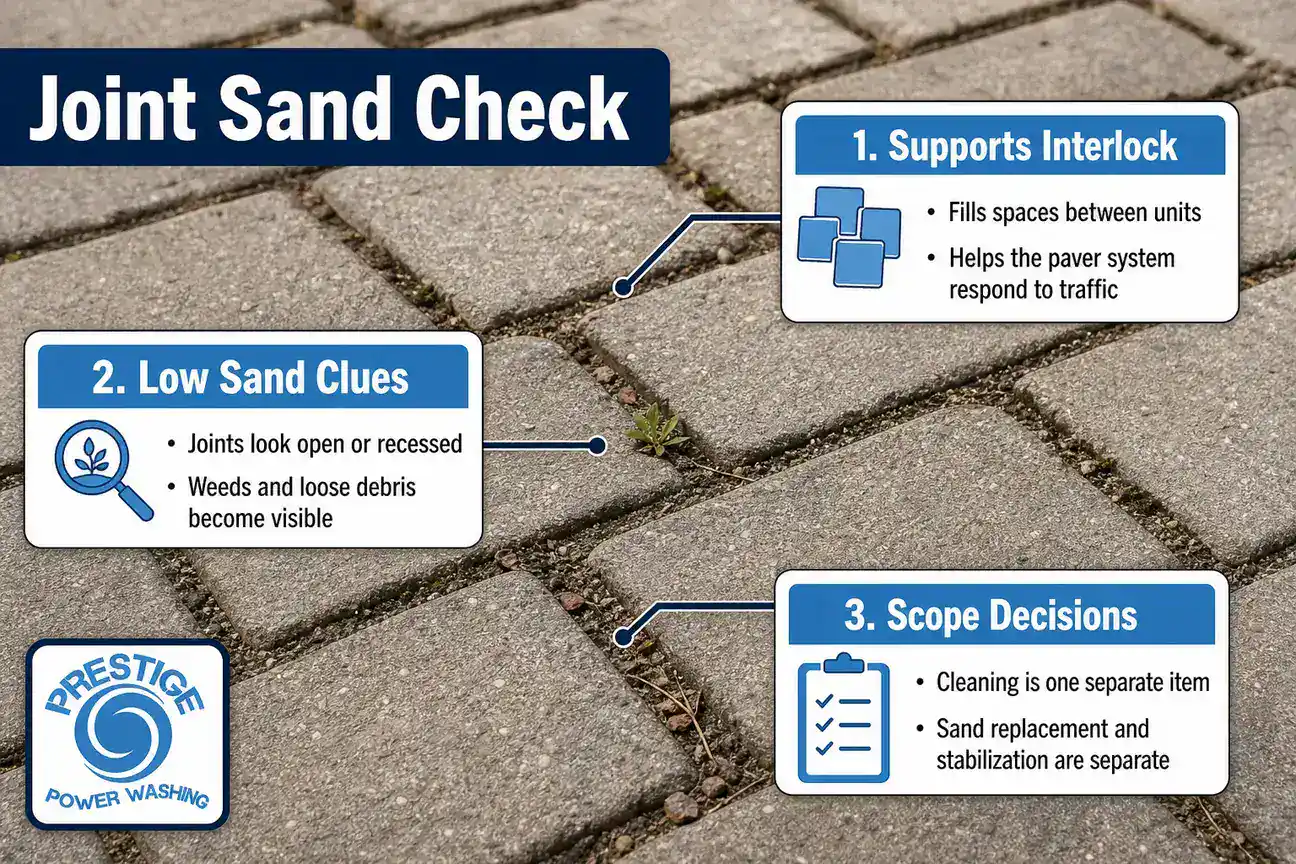
Joint sand is one of the biggest differences between pavers and poured concrete. It helps fill the spaces between units, supports interlock, and affects how the surface responds to traffic and cleaning. When joint sand is low, pavers may look more open, weeds may become more visible, and loose debris can collect in the gaps.
Concrete Masonry & Hardscapes Association technical guidance for interlocking concrete pavements treats joint sand as part of the paver system, not just a cosmetic detail. That supports a cautious scope: when sand is missing or unstable, cleaning, joint-sand replacement, stabilization, and sealing decisions should be discussed as separate items rather than assumed to be part of a wash-only project.
Cleaning does not automatically replace joint sand. If a contractor’s scope is cleaning only, sand replacement, stabilization, repair, and sealing should not be assumed. Ask directly whether joint sand work is included, excluded, or referred to a hardscape contractor. For Prestige Power Washing LLC, paver cleaning should be discussed as an exterior cleaning need unless a separate hardscape scope is confirmed.
Before cleaning, look for joints that are recessed far below the paver surface, widened, washed out, or filled with soil rather than sand. Also check whether weeds are rooted in the joints and whether pavers shift when walked or driven over. These details influence whether cleaning is appropriate now or whether repairs should come first.
After cleaning, missing joint sand may be more obvious. That can be useful, because a clean surface lets a hardscape contractor better see joint depth, edge movement, paver damage, and settlement. The tradeoff is that cleaning may expose a condition that was already present rather than solving it.
If sealing or stabilization is being considered, confirm the paver material, existing coatings, moisture conditions, product requirements, and who is responsible for that service. CMHA cleaning and sealing guidance separates stain treatment, efflorescence and dirt cleaning, and sealer-related decisions; it does not support assuming that every exterior wash includes stabilizing sand or applying sealer. Do not assume sealing is necessary after every cleaning, and do not assume every exterior cleaning contractor provides it.
paver cleaning Raleigh considerations for runoff and storm drains
Paver cleaning Raleigh homeowners and property managers should think about more than the surface. Cleaning water can carry sand, sediment, organic debris, detergents, and loosened material. In neighborhoods, townhome communities, and commercial properties, that runoff may move toward driveways, curbs, storm drains, drainage swales, or nearby surface waters.
North Carolina guidance is especially relevant here. NC DEQ’s Technical Guidance states that vehicle pressure washing wash water is wastewater and that discharge to surface waters through storm drains is not authorized by any NPDES stormwater permit. While that quoted example concerns vehicle pressure washing, it is useful for understanding why property owners should ask questions about wash water and storm drains during exterior cleaning projects.
The EPA’s NPDES Stormwater Program explains the broader federal stormwater permitting framework, and NC DEQ’s NPDES wastewater FAQs provide North Carolina context for wastewater permitting questions. These sources should not be turned into a claim that any individual contractor has a documented water-recovery program or permit unless that has been verified.
For a homeowner, the practical step is to ask how sand, sludge, debris, and cleaning water will be managed on the property. For a property manager, it is also reasonable to identify nearby storm drains, landscaped areas, tenant entrances, low spots, and pedestrian routes before work is scheduled. Clear communication helps set expectations without promising a regulatory outcome.
Efflorescence, stains, and the limits of cleaning
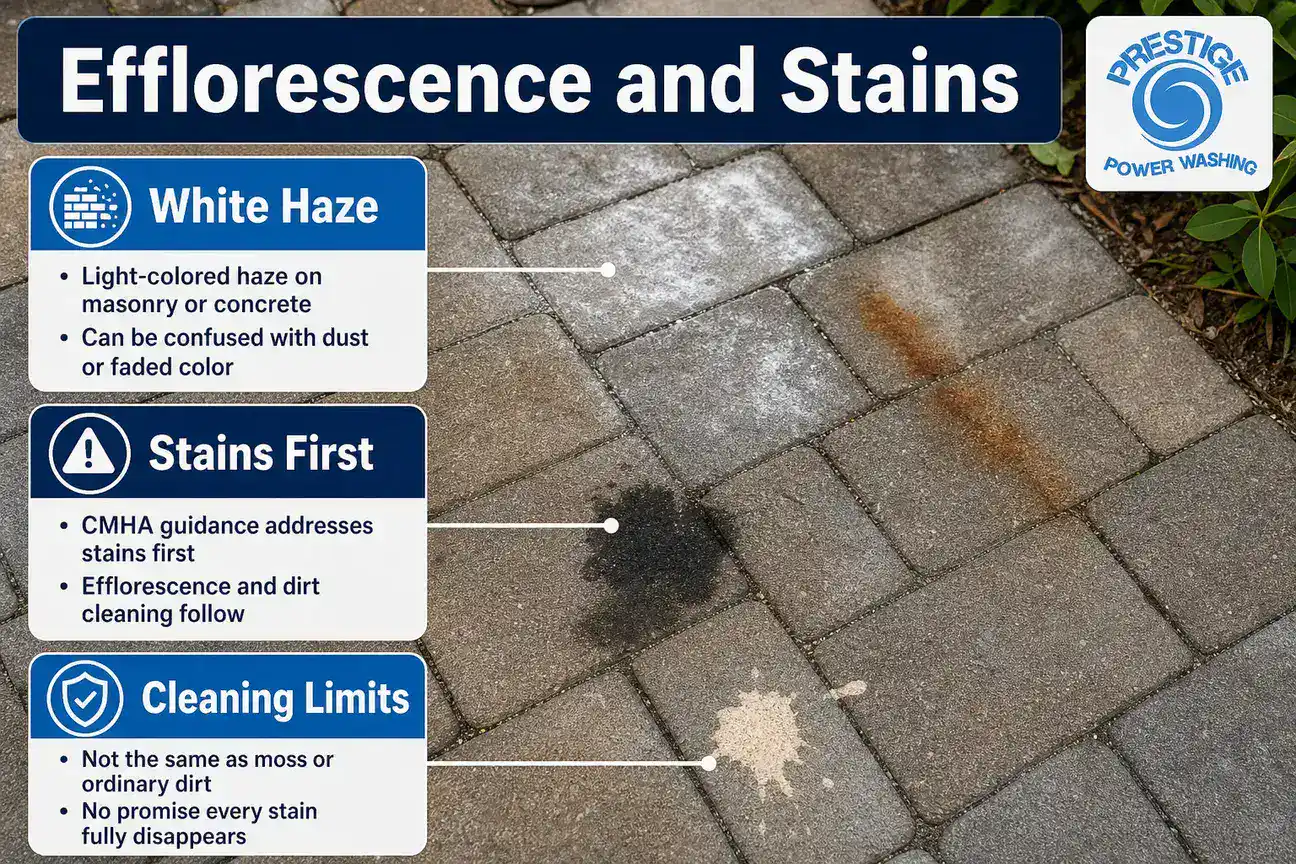
Efflorescence is commonly described as a white or light-colored haze on masonry or concrete products. On pavers, it can be confused with dust, faded color, or residue from previous treatments. It is not the same as moss, algae, or ordinary dirt, so it should not be approached with the same expectations.
CMHA guidance for cleaning and sealing interlocking concrete pavement recommends that stains be addressed first; efflorescence and dirt cleaning follow. That sequence is useful because it keeps a stain-specific concern from being treated as ordinary soil, but it should not be read as a promise that every stain or haze will be completely removed.
A paver surface can also have oil, rust, paint, irrigation staining, leaf tannins, or deep organic discoloration. Some stains may improve with cleaning, while others remain visible because they have penetrated the material, reacted with the surface, or been present for a long time. A careful assessment should identify the likely stain type rather than promising a uniform outcome.
For oil or hydraulic staining on nearby concrete or asphalt, Prestige Power Washing LLC has a separate page for oil stain removal. Paver surfaces may still require a different evaluation because oil can move into joints and porous units. If the stained pavers are badly saturated, cracked, or loose, a hardscape contractor may need to discuss replacement options.
Deep stains and efflorescence are also reasons to be cautious about “like new” expectations. Cleaning can improve the surface and make the color more consistent, but paver age, porosity, previous sealer, and wear affect the result. If a surface has faded from years of sun exposure or has chipped edges, cleaning will not create a new paver.
When to call a hardscape contractor before cleaning
Call a hardscape contractor before cleaning when pavers rock underfoot, dip noticeably, hold standing water, spread at the edges, or show wide open joints. These conditions point to movement, base issues, drainage concerns, or edge restraint problems rather than surface buildup alone.
Hardscape input is also important when the patio or walkway has trip hazards, when settlement occurs near drains or downspouts, when vehicle traffic has created ruts, or when individual units are cracked, broken, or missing. Cleaning can improve appearance, but it does not reset units or correct the base below them.
Major joint sand replacement, polymeric sand decisions, stabilization, and sealing should also be scoped clearly. Some projects may need cleaning first so the surface can be inspected. Others may need repair first so unstable areas are not disturbed further. The right order depends on condition and the professional responsible for each part of the work.
If you are not sure whether your pavers need cleaning, repair, or both, gather a few details before contacting anyone: photos from several angles, closeups of joints, notes about where water collects, whether any units move, and what stains are most visible. Then contact Prestige Power Washing with those details so the cleaning conversation starts with the right surface information.
How to prepare for an exterior cleaning assessment
A helpful assessment does not need to be complicated. Walk the surface in dry conditions if possible and look at the pavers from multiple angles. Notice color changes, shaded areas, open joints, weed growth, white haze, stains, and any units that feel unstable.
For paver pressure washing questions, take photos of both the overall area and the details. A wide photo shows access, slope, landscaping, nearby doors, and drainage paths. A close photo shows joint sand depth, staining, paver texture, and whether vegetation is rooted in the joints. If the area is in Cary, Raleigh, Apex, Morrisville, or another Triangle service area, mention the community as a service-area detail, not as a separate office location.
For brick paver cleaning, include whether the surface has ever been sealed or treated if you know. If you do not know, say that. Unknown previous treatments can affect expectations and may need in-person evaluation.
For patio paver cleaning, move loose furniture, planters, toys, and lightweight decor if you can do so safely. If heavy grills, outdoor kitchens, or built-in features are present, mention them in advance. The goal is not to promise a particular process; it is to help the cleaning provider understand access and scope.
For joint sand concerns, be specific. Say whether the sand is missing in small areas, throughout the patio, around the edges, or mainly where water runs. This helps separate cleaning from possible hardscape work.
What realistic results may look like after cleaning
Realistic paver cleaning results depend on paver age, material, porosity, staining, joint condition, shade, drainage, access, and previous maintenance. A good outcome may be a cleaner, brighter, more uniform surface with less visible organic buildup. It may also be a surface that clearly shows which pavers need repair or which joints need attention.
Paver cleaning Raleigh and Cary projects can vary widely from one home to the next. A newer patio with surface film may show a noticeable improvement. An older walkway with recessed joints, efflorescence, deep rust, and settled units may improve visually while still needing additional hardscape work.
It is also realistic for moss, algae, and weeds to return over time when shade, moisture, soil, and organic debris persist. Cleaning is part of maintenance, not a permanent barrier against outdoor growth. Keeping leaves, soil, and debris from accumulating can help maintain the appearance longer, but no exterior cleaning should be described as permanent prevention.
Putting paver cleaning into a Cary and Raleigh maintenance plan
Pavers are often only one part of the exterior picture. A property may have a paver patio, poured concrete driveway, brick steps, retaining walls, siding, gutters, and walkways that all weather differently. Grouping related exterior cleaning questions can help you make a practical plan without treating every surface the same.
For homeowners, that might mean asking about patio paver cleaning along with driveway edges, front walks, and house washing. For HOAs and property managers, it may mean separating cleaning scope from repair scope across common walkways, breezeways, dumpster areas, or retail entrances. Cleaning can support curb appeal and maintenance, but it should not be used as a substitute for hardscape repair where movement or settlement exists.
Prestige Power Washing LLC is family-owned and locally operated in Cary and serves Raleigh and other verified Triangle-area communities as service areas. To discuss paver cleaning Cary NC needs, call 919-520-4521 or request a free estimate with photos and notes about stains, joint sand, weeds, uneven areas, and runoff concerns. The more clearly the surface condition is described, the easier it is to decide whether cleaning is the appropriate method for the surface or whether a hardscape contractor should be involved first.
Frequently Asked Questions
Can pressure washing damage pavers?
It can disturb joint sand or worsen problems when pavers are already unstable, joints are depleted, or the method is not matched to the material. The appropriate approach depends on paver type, surface condition, joint sand, and drainage. Ask for a paver-specific assessment rather than assuming a concrete-cleaning process is suitable.
Should pavers be cleaned before joint sand is replaced?
Sometimes, but not always. Cleaning may make the joints easier to inspect, but badly unstable pavers or major settlement may need hardscape evaluation first. Whether sand replacement is needed, and who performs it, should be confirmed in the written scope rather than assumed.
Can cleaning remove weeds between pavers?
Cleaning may remove visible weed growth and debris, but it does not necessarily correct missing joint sand, open joints, settlement, drainage issues, or recurring moisture. If weeds return quickly or the joints are wide and recessed, a hardscape contractor may need to evaluate the underlying condition.
What is the white haze on my pavers?
A white haze may be efflorescence or another mineral-related deposit, not ordinary dirt or algae. It may require a different assessment from general cleaning and can recur depending on moisture movement, material, and prior treatments. Complete removal should not be promised without evaluating the surface.
Can cleaning fix uneven or sunken pavers?
No. Cleaning may make uneven areas easier to see, but it does not reset pavers, rebuild the base, repair edge restraints, or redesign drainage. Rocking, sunken, or widely separated pavers should be evaluated by a qualified hardscape contractor.
Do pavers need to be sealed after cleaning?
Not automatically. Sealing should be considered only after confirming the paver material, existing coatings, moisture conditions, product requirements, appearance expectations, and whether the contractor actually offers that service. Do not assume sealing is included with cleaning unless it is specifically stated in the scope.
How should Cary and Raleigh property owners think about runoff during paver cleaning?
Ask how removed dirt, sand, cleaning water, and debris will be managed so they do not create problems around storm drains, drainage paths, landscaping, or neighboring surfaces. This is especially important for paver areas near curbs, driveways, slopes, and commercial pedestrian routes.