
How to Choose the Right Exterior Cleaning Method
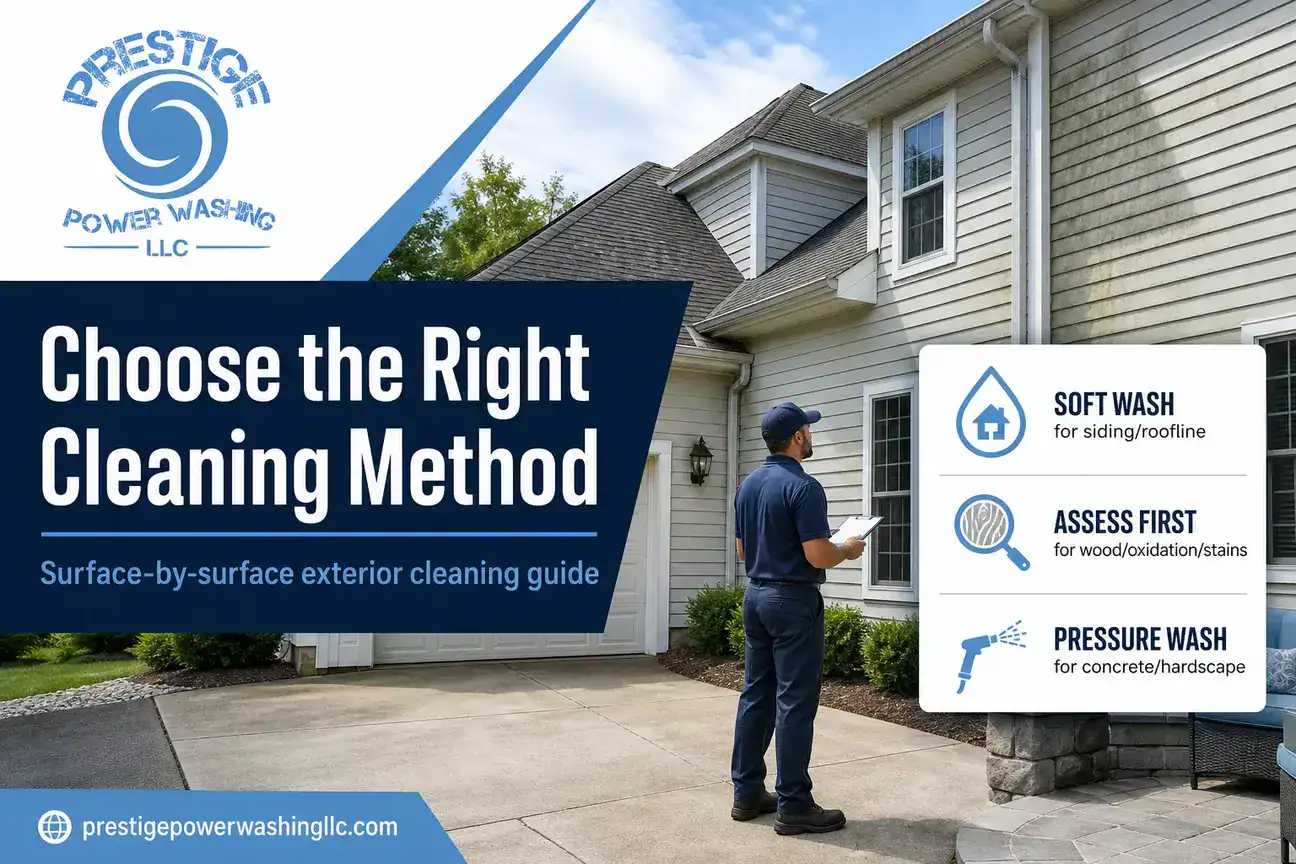
Quick Answer: The simplest way to decide how to choose the right exterior cleaning method is to match the method to the surface, the soil or staining, and the condition of the material. Soft washing is often the first look for more delicate exterior materials, pressure washing is commonly considered for durable hard surfaces, and power washing may be useful on certain tough exterior surfaces when heat is appropriate. Roofs, painted surfaces, oxidized siding, soft wood, loose mortar, and severe staining all deserve a per-project assessment before anyone chooses a method.
For homeowners, HOAs, and property managers in Cary, Raleigh, and nearby Triangle communities, choosing an exterior cleaning method is rarely about using the most force. It is about using surface-specific cleaning so siding, roofs, driveways, patios, decks, fences, gutters, and commercial exteriors get an approach that fits the material. Prestige Power Washing LLC provides exterior cleaning services for residential and commercial properties, and this guide can help you ask clearer questions before you request service.
In practice, selecting the right cleaning approach comes down to a few repeatable decisions: identify the surface, look for fragile or damaged areas, name the main type of buildup, and avoid assuming one machine setting fits every part of the property.
How to choose the right exterior cleaning method by surface
When comparing soft washing, pressure washing, and power washing, start with the surface rather than the equipment. A driveway can usually tolerate a different approach than painted siding. Asphalt shingles call for a different discussion than a concrete walkway. A stained wood deck needs a different level of caution than a masonry retaining wall.
The table below gives a practical starting point for matching the method to the surface. It is not a substitute for seeing the property, because oxidation, cracks, failing sealers, loose paint, and age can change the recommendation.
| Surface or situation | Method usually considered first | Why that method may fit | Assessment flags |
|---|---|---|---|
| Vinyl, painted, or fiber-cement-style siding | Soft washing or low-pressure house washing | Helps remove general exterior buildup without relying mainly on force | Oxidation, loose paint, gaps, failing caulk, older materials |
| Asphalt shingle roofs | Low-pressure roof soft washing | Roofing guidance strongly cautions against pressure washing asphalt shingles | Fragile shingles, heavy moss, roof access, manufacturer guidance |
| Concrete driveways and walks | Pressure washing or power washing, depending on conditions | Hard surfaces may tolerate a more direct cleaning approach | Oil stains, cracks, spalling, old concrete, failing sealer |
| Patios and pool-area hardscapes | Pressure washing or surface-specific power washing | Can improve the appearance of many durable hardscape surfaces | Natural stone, sanded joints, coatings, drainage concerns |
| Wood decks and fences | Gentler pressure or soft-wash-style process as appropriate | Wood condition and finish matter more than force | Soft wood, splintering, old stain, loose boards, rot concerns |
| Exterior gutters and downspouts | Debris removal plus careful exterior cleaning | Focus is often drainage function and exterior buildup, not heavy force | Loose gutters, clogged downspouts, staining, ladder access |
| Commercial exteriors | Surface-specific mix of soft washing, pressure washing, or power washing | Buildings often combine masonry, siding, concrete, glass, and high-traffic areas | Tenant activity, access, runoff, scheduling, signage, fragile finishes |
For a typical request, choosing a method should begin with this surface-by-surface view rather than a single broad label. If you are unsure where your surface fits, review Prestige Power Washing LLC’s exterior cleaning services or request a free estimate with photos and surface details. A practical estimate conversation can help narrow the method before work is scheduled.
Soft washing vs pressure washing: what the terms mean
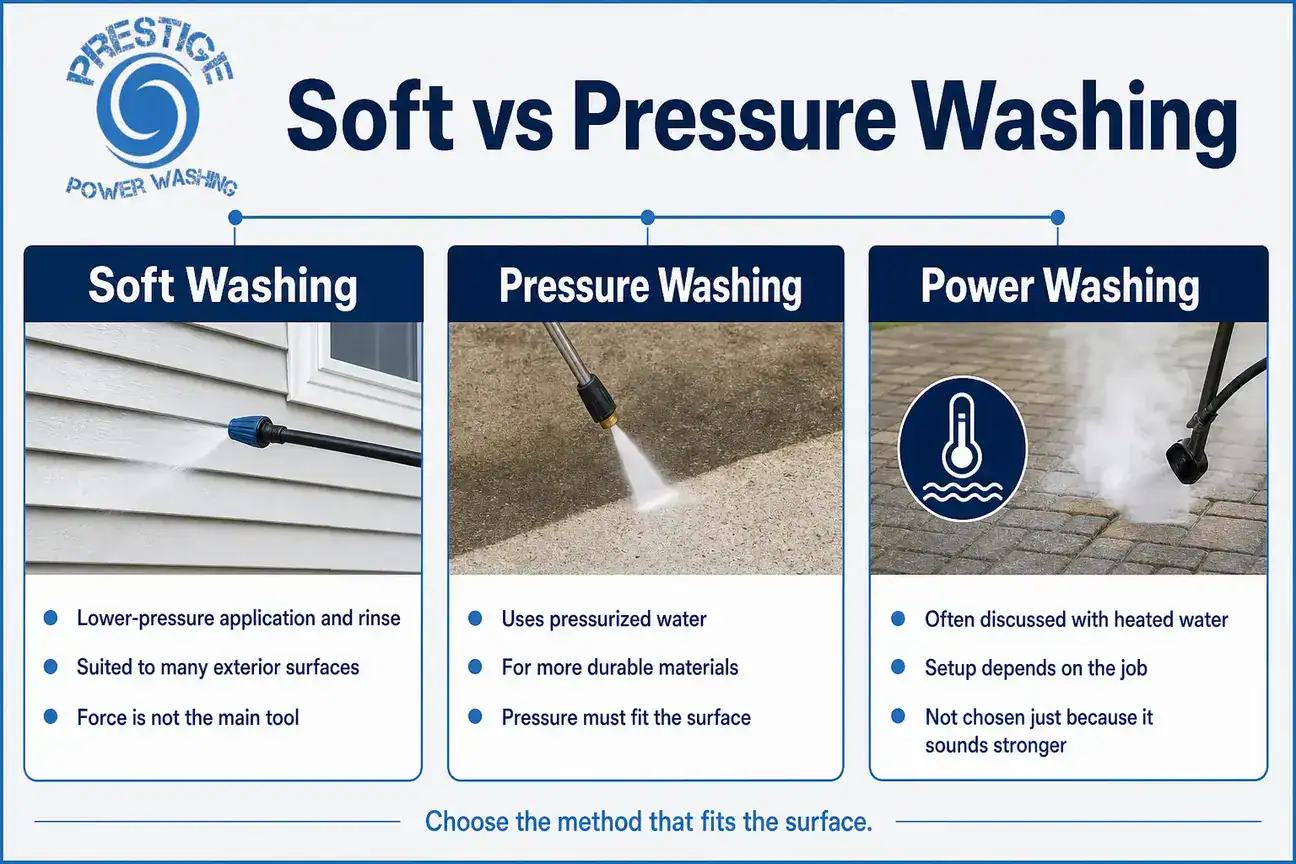
The phrase soft washing vs pressure washing comes up often because both can improve exterior appearance, but they rely on different ideas. Soft washing uses a lower-pressure application and rinse process suited to many exterior surfaces where force is not the main tool. Pressure washing uses pressurized water to remove buildup from more durable materials. Power washing is often discussed as pressure washing with heat, although the exact setup depends on the job and provider.
For property owners learning how to choose the right exterior cleaning method, the important question is not which method sounds stronger. The important question is which method fits the surface. A method that is appropriate for concrete may be too aggressive for asphalt shingles. A method that works well for siding may not be enough for a stained commercial dumpster pad or high-traffic concrete entry.
Exterior cleaning can help remove dirt, algae-like discoloration, mildew-like surface buildup, pollen, cobwebs, and some stains. It should not be described as a universal fix for every stain, every organic growth issue, or every damaged surface. Some marks are embedded, some surfaces are worn, and some problems are tied to moisture, drainage, or material failure rather than simple surface buildup.
How to think about the best cleaning method for siding
The phrase best cleaning method for siding is most useful when it means the most appropriate method for that siding material and its current condition, not a one-size-fits-all promise. Vinyl siding, painted siding, fiber-cement-style exteriors, trim, shutters, and soffits can all respond differently. In many residential situations, a soft-wash-style house washing approach is a cautious first look because it focuses on surface-specific cleaning rather than heavy force.
For siding, choosing a cleaning method means looking beyond the visible dirt. Siding often collects pollen, dust, algae-like staining, spider webs, and mildew-like buildup. In the Triangle, shade, humidity, trees, and seasonal pollen can all affect how quickly a home exterior looks dirty again. Cleaning can improve appearance, but it does not correct causes such as poor drainage, landscape contact, failing paint, or gaps where water may be entering.
Why siding should not be treated like concrete
Concrete and siding are not the same kind of surface. Siding has seams, laps, trim transitions, electrical penetrations, vents, and sometimes areas of oxidation. Using too much force in the wrong place can push water where it does not belong or disturb weakened finishes. That is why a responsible siding conversation should include material type, age, visible damage, oxidation, and whether the home has loose paint or failing caulk.
Oxidation deserves special attention. It can look like chalky residue on older siding or painted surfaces. Washing may remove dirt around oxidation, but oxidation itself can respond unevenly. If you are wondering which approach suits older siding, a per-project assessment helps set expectations before cleaning begins.
Roof cleaning vs pressure washing: asphalt shingles need caution
Roof cleaning vs pressure washing is one of the clearest method decisions for many homes. For asphalt shingle roofs, pressure washing is not the recommended path. The Asphalt Roofing Manufacturers Association states, “Never use a pressure washer to clean an asphalt shingle roof”, explaining that it can cause granule loss and premature failure.
That is why roof cleaning is typically discussed as a low-pressure process, especially for asphalt shingles. Prestige Power Washing LLC offers roof cleaning and roof soft washing, but the exact approach should account for roof material, roof pitch, access, visible condition, staining, and manufacturer guidance.
Algae discoloration on asphalt roofing is common in many humid climates. ARMA explains that algae discoloration may be lightened with a bleach-and-water solution, and also notes that cleaning “may be temporary” and that other cleaning chemicals or methods should not be used without shingle-manufacturer approval. That wording matters because roof cleaning can improve appearance, but it should not be framed as a permanent cure or a roof repair.
What roof cleaning can and cannot solve
Roof cleaning can help address visible organic discoloration and surface buildup when the roof is a good candidate for cleaning. It does not replace roofing repair, roof replacement, leak diagnosis, or manufacturer warranty service. If shingles are brittle, missing, curling, heavily moss-covered, or otherwise compromised, the cleaning method may need to be adjusted or deferred.
Roof work also raises access and footing concerns. ARMA notes that the cleaning process may make roofs slippery, so homeowners should avoid treating roof cleaning as a simple DIY pressure-washing project. For anyone deciding how a roof should be cleaned, the conversation should include roof material, degree of growth, nearby landscaping, gutter conditions, and safe access limitations.
What surfaces can be pressure washed with a practical assessment?
The question what surfaces can be pressure washed is more useful when answered in categories, not absolutes. Durable concrete, many driveways, some patios, certain masonry surfaces, and selected commercial hardscapes are often considered for pressure washing. But condition matters. Cracked concrete, loose mortar, spalling, old coatings, delicate stone, and failing sealers can change the recommendation.
For residential concrete, driveway pressure washing may help remove general grime, tire marks, algae-like buildup, and some surface stains. Oil, rust, hydraulic fluid, fertilizer staining, and deeply embedded discoloration may need a more specific evaluation, and complete removal should not be promised before the surface is assessed.
Patios can be more complicated than driveways because the materials vary. Poured concrete, pavers, natural stone, brick, and coated surfaces can all respond differently. If your patio has sanded joints, loose pavers, a failing sealer, or nearby drainage concerns, the cleaning method should be chosen carefully. Prestige Power Washing LLC provides patio pressure washing, with the method depending on the specific surface and condition.
Power washing and heat: useful in some situations, not every situation
Power washing is often associated with heated water. Heat may be helpful for some exterior cleaning situations, especially where greasy or stubborn buildup is present on durable surfaces. That does not mean heat belongs on every surface. Painted finishes, certain sealers, soft materials, and fragile surfaces may call for a different approach.
For homeowners, the takeaway is simple: do not choose power washing just because it sounds stronger. Choose it only when the surface, soil type, and project conditions support it. For property managers, matching the method to each surface is especially important around storefronts, breezeways, dumpster pads, drive lanes, and building entrances, where multiple materials may meet in one cleaning area.
Decks and fences need a different level of care
Wood decks and fences often benefit from a gentler mindset than concrete. Wood species, age, moisture, previous stain, failing finish, nail or screw condition, and soft or splintering boards can all affect the method. A deck that looks dirty may also have coating failure or weathering that cleaning alone will not correct.
For wood, more force is not automatically better. A surface-specific approach may help lift dirt and organic buildup while reducing unnecessary abrasion. However, cleaning cannot replace carpentry repairs, sanding, staining, sealing, or structural work. If boards are soft, loose, cracked, or rotted, those issues should be addressed separately.
Fences share similar concerns. A newer vinyl fence may call for a different approach than an older wood fence. A painted fence with peeling areas may need a careful conversation about expectations because cleaning can reveal pre-existing coating failure rather than fix it. When selecting a cleaning process for wood or fencing, condition and finish matter as much as visible buildup.
Gutters and downspouts are about buildup, drainage, and exterior staining
Gutter cleaning is not just a pressure question. It may involve removing debris, checking downspout flow, and addressing exterior staining or streaking. Heavy force is not always the right answer because gutters can be loose, dented, poorly pitched, or attached to older fascia.
Prestige Power Washing LLC offers gutter cleaning for Raleigh and Cary-area properties. For homeowners deciding how to clean around the roofline, the estimate conversation should include whether the issue is debris inside the gutter, exterior black streaking, overflowing downspouts, staining on siding below the gutter line, or a combination of those concerns.
Cleaning can improve appearance and help address visible buildup, but it should not be described as a guarantee against future overflow or water issues. Trees, roof valleys, storm intensity, gutter pitch, and underground drainage can all affect performance after cleaning.
Commercial exteriors require scheduling and surface planning
Commercial properties often combine several cleaning needs in one project: building walls, sidewalks, breezeways, curbs, dumpster pads, drive lanes, awnings, and entry areas. The right method may change from one area to the next. For a commercial property, determining the appropriate cleaning method usually means dividing the site into surface zones rather than treating the entire exterior as one material.
For HOAs, apartment communities, offices, restaurants, and retail centers, surface planning should also consider tenant activity, customer traffic, access points, signage, nearby vehicles, and hours when cleaning would create less disruption. Prestige Power Washing LLC provides commercial pressure washing, but commercial cleaning should not be framed as regulatory, health-inspection, or fire-code compliance unless a separate qualified authority provides that direction.
Commercial properties should also think about water flow. The EPA NPDES stormwater program explains stormwater permitting at a broad level, and requirements can depend on the activity and location. In North Carolina, property managers can also review NC DEQ stormwater technical guidance when a project raises site-specific runoff questions. This article is educational and does not claim that any specific property or provider has a documented compliance program.
If you manage a commercial exterior in Cary, Raleigh, or another verified Triangle-area service community, request a free estimate and describe the surfaces, traffic patterns, and timing concerns. Clear information upfront helps match the appropriate method to each area without assuming one process fits the whole property.
How soil type changes the cleaning decision
The surface is only half the decision. The other half is what you are trying to remove. Dirt, pollen, algae-like growth, mold-like staining, grease, oil, rust, efflorescence, paint, and oxidation are different problems. Some are surface-level. Some are embedded. Some point to moisture, drainage, coating failure, or material aging.
Mold and moisture deserve careful wording. The EPA says, “The key to mold control is moisture control”. Its general cleanup guidance also says, “Scrub mold off hard surfaces with detergent and water, and dry completely,” while absorbent or porous materials such as ceiling tiles and carpet “may have to be thrown away” if they become moldy. Exterior washing may improve visible surfaces, but it should not be described as solving an underlying moisture problem.
The CDC provides cleanup guidance for mold-related situations, including protective gear in certain cleanup contexts. For routine exterior cleaning, the important takeaway is not to overpromise. Cleaning visible exterior buildup is different from claiming medical-grade disinfection, indoor remediation, or health protection.
Soil type also affects the choice of method because the same surface may need a different conversation depending on what is present. A concrete sidewalk with pollen and dirt is not the same project as a concrete pad with oil or hydraulic-fluid staining.
Why severe stains need realistic expectations
Some stains respond well to an appropriate exterior cleaning method. Others lighten but remain visible. Oil, rust, fertilizer marks, irrigation staining, battery acid marks, old paint, and deeply embedded discoloration may need a more specific process, and even then results depend on the surface and how long the stain has been present.
For concrete and asphalt cleaning, a professional estimate should separate general cleaning from stain-focused work. A driveway covered in pollen and surface dirt is not the same as a driveway with old oil stains and damaged concrete. When choosing a method for concrete or asphalt, the stain type matters almost as much as the surface material.
When a per-project assessment matters most
A per-project assessment is most important when the surface is fragile, aged, coated, damaged, or unknown. Photos can help, but in-person or project-specific review may still be needed when surface condition is unclear. This is especially true for roofs, wood, older siding, commercial buildings, and surfaces with stains that may be embedded.
Ask for an assessment when you see any of the following:
- Oxidized siding or chalky painted surfaces
- Loose paint, cracked caulk, open seams, or visible water entry points
- Brittle, curling, missing, or heavily moss-covered roof materials
- Soft, splintered, rotted, or loose wood on decks and fences
- Cracked concrete, spalling, old coatings, or failing sealers
- Loose mortar, delicate stone, or older brickwork
- Severe oil, rust, fertilizer, irrigation, or hydraulic-fluid staining
- Commercial areas with heavy foot traffic, vehicles, tenants, or access limits
These conditions do not always mean the surface cannot be cleaned. They mean the method and expectations should be discussed before work begins. A careful conversation can also clarify what cleaning includes and what may require another trade, such as roofing repair, painting, carpentry, plumbing, drainage work, or masonry repair.
This is where choosing a cleaning method becomes a practical risk-screening question. The goal is to avoid applying force, heat, or chemistry in a way that does not fit the condition of the surface.
Choosing a method in Cary and Raleigh’s climate
Triangle-area properties see a mix of heat, humidity, shade, storms, tree cover, and pollen. That combination can make exterior surfaces look dirty faster than many property owners expect. North-facing walls, shaded roof slopes, wooded lots, and damp hardscapes may show buildup sooner than sunnier, open areas.
That does not mean every property needs the same maintenance schedule. A shaded Cary home with trees close to the siding may need a different plan than a Raleigh townhome with more sun exposure. A commercial sidewalk with daily foot traffic may need attention at different times than a residential patio used mostly on weekends.
Local climate is another reason the choice of method should stay flexible. Shade, roof slope, tree cover, drainage, and surface material can all change the cleaning conversation even within the same neighborhood.
Prestige Power Washing LLC is family-owned and locally operated, with a published business address in Cary and service areas that include Raleigh and other verified Triangle communities. Cary is the confirmed address of record; other communities are service areas, not branch offices. Service availability should be confirmed for the specific property and service requested.
Questions to ask before requesting exterior cleaning
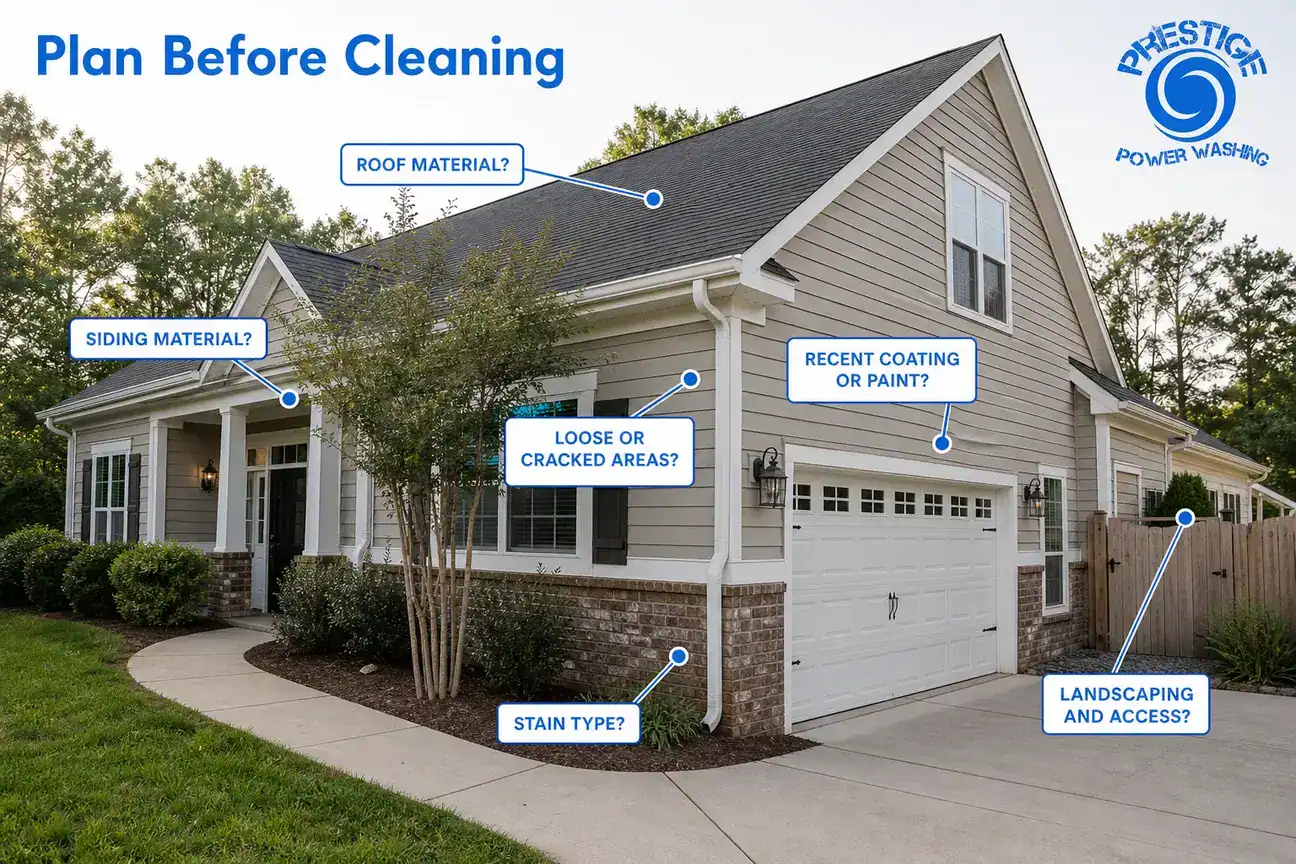
Before you request service, gather a few details. You do not need to diagnose the surface yourself, but useful information helps the contractor recommend a method more responsibly. Photos, approximate age, surface material, stain type, and access concerns are all helpful.
Good questions include:
- What material is being cleaned?
- Is the issue general dirt, organic discoloration, oil, rust, oxidation, or something else?
- Are there loose, cracked, painted, coated, or fragile areas?
- Has the surface been sealed, painted, stained, or repaired recently?
- Are there landscaping, drainage, vehicles, tenants, or customer access concerns nearby?
- For roofs, what roofing material is present, and are there visible damaged areas?
- For commercial properties, what time windows reduce disruption without implying emergency availability?
The more specific you can be, the easier it is to choose between soft washing, pressure washing, and power washing. These questions also make the decision less confusing because they separate surface condition from equipment preference.
Clear information helps set realistic expectations about what cleaning can improve and what may remain after the service. It also helps identify when another type of contractor may be needed for repairs, coating issues, drainage problems, or structural concerns.
A simple decision path for homeowners and property managers
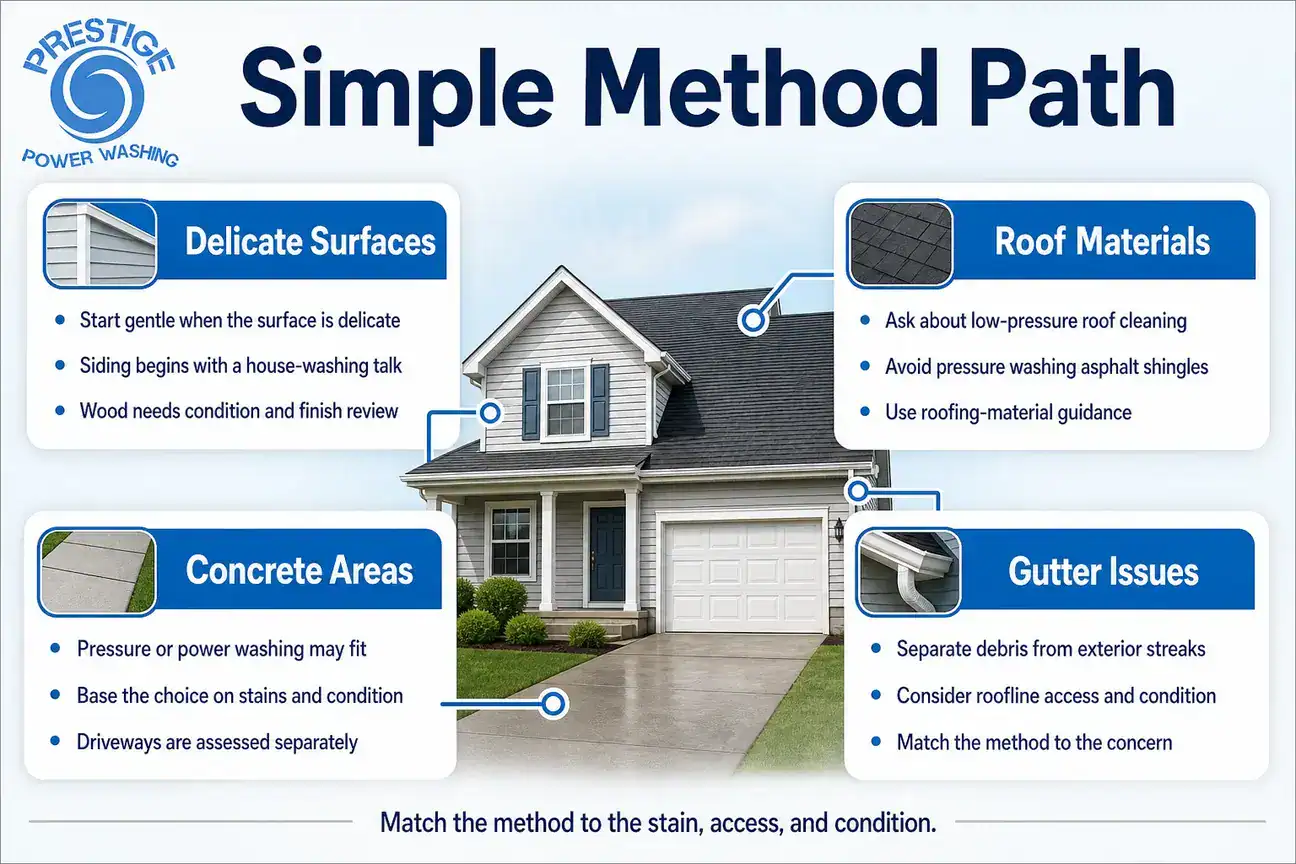
If you remember only one thing about how to choose the right exterior cleaning method, remember this: start gentle when the surface is delicate, use more direct pressure only when the material and condition support it, and avoid pressure washing asphalt shingle roofs. From there, match the method to the stain, access, and condition.
For siding, begin with a house-washing conversation. For roofs, ask about low-pressure roof cleaning and roofing-material guidance. For driveways and many concrete surfaces, ask whether pressure washing or power washing is appropriate based on stains and condition. For decks and fences, discuss wood condition and finish. For gutters, separate debris removal from exterior staining. For commercial exteriors, discuss scheduling, surface zones, traffic, and runoff considerations.
Exterior cleaning is not about forcing one method onto every surface. It is about clear communication, a practical assessment, and choosing the appropriate method for the surface. That approach gives homeowners, HOAs, and property managers a better path toward a Prestige Clean without relying on unrealistic promises.
When you are comparing options, return to the same core question: which cleaning method fits this specific surface, in this specific condition, with these specific stains or access concerns. That is a more useful approach than choosing by pressure level alone.
Frequently Asked Questions
What is the difference between soft washing, pressure washing, and power washing?
Soft washing generally uses lower pressure and a surface-specific cleaning process. Pressure washing relies on pressurized water for more durable exterior surfaces. Power washing is often associated with heated water, which may fit some tough exterior cleaning situations but is not appropriate for every material.
Which method is usually used on a roof?
For asphalt shingle roofs, a low-pressure roof cleaning or roof soft washing approach is typically the starting point. Roof material, condition, pitch, access, and manufacturer guidance should be considered before the cleaning method is chosen.
Is pressure washing safe for asphalt shingles?
Pressure washing should not be used on asphalt shingle roofs. Asphalt roofing guidance warns against using a pressure washer on asphalt shingles because it can contribute to granule loss and premature roof problems.
Can siding be pressure washed?
Some siding may tolerate carefully controlled cleaning, but siding should not be treated like concrete. Material type, oxidation, age, seams, paint condition, and openings around trim or fixtures should be assessed before deciding on the method.
What surface issues mean a project needs an assessment first?
Oxidized siding, loose paint, damaged shingles, soft wood, failing sealers, cracked concrete, loose mortar, delicate stone, and severe oil or rust staining all call for a project-specific assessment before choosing a cleaning method.
Does exterior cleaning remove all stains or growth?
No. Exterior cleaning can improve many surfaces and help remove visible buildup, but complete stain or growth removal should not be promised. Results depend on the surface, the stain type, age of the stain, and underlying material condition.
How should commercial properties decide between methods?
Commercial properties should separate the project into surface zones, such as sidewalks, building walls, breezeways, dumpster pads, and entries. The method should account for building materials, tenant activity, access, scheduling, drainage, and realistic appearance goals.
When should a property manager request a service-specific estimate?
A property manager should request a service-specific estimate when multiple surfaces are involved, staining is severe, tenant access matters, runoff questions exist, or the property has fragile finishes, high-traffic areas, or scheduling constraints.
Sources
- EPA — Mold
- CDC — Cleaning Up Mold
- Asphalt Roofing Manufacturers Association — Algae Discoloration of Roofs
- Asphalt Roofing Manufacturers Association — Algae & Moss Prevention and Cleaning for Asphalt Roofing Systems
- EPA — NPDES Stormwater Program
- North Carolina DEQ — NPDES Industrial Program Technical Guidance