
HOA Exterior Cleaning Planning Guide for Cary and Raleigh
HOA exterior cleaning works well when the board or community manager treats the project as a written scope, not a vague request to “wash the neighborhood.” A useful request lists every shared surface, explains access and resident-impact issues, identifies storm drains and landscaping, and asks each contractor to describe the appropriate method for each surface. That makes proposals easier to compare and helps avoid misunderstandings about sidewalks, breezeways, roofs, dumpster pads, gutters, parking, notices, and exclusions.
Quick Answer: What should an HOA include in the request?
A strong request for proposal should include a surface inventory, site map, access notes, resident-notice expectations, parking needs, pet and landscaping concerns, doors and sensitive fixtures, storm-drain locations, and a clear one-time or recurring designation. It should also ask for method-by-surface recommendations, written exclusions, runoff assumptions, and a communication plan for weather or inaccessible areas.
If your Cary, Raleigh, or Triangle-area community is preparing an exterior-cleaning project, you can request a free estimate from Prestige Power Washing LLC for a property-specific review. The estimate conversation should confirm the community, the requested services, and whether the scope fits the property conditions.
Planning HOA exterior cleaning around real property conditions
For HOA boards, community managers, and property managers, the hard part is rarely deciding that the property needs attention. The harder part is defining exactly what “clean the community” means. A townhome neighborhood may have vinyl or fiber-cement siding, painted trim, shared sidewalks, private patios, breezeways, asphalt drives, gutters, roofs, mail kiosks, dumpster enclosures, retaining walls, pet stations, pool-adjacent areas, and drainage features that all behave differently.
That is why HOA pressure washing should be scoped surface by surface. Durable concrete may be a reasonable pressure-washing candidate after condition is reviewed, while roofs and some building-envelope surfaces may call for soft washing or another lower-pressure approach. Painted, cracked, sealed, repaired, aged, or deteriorated surfaces need more cautious review. The goal is not to force one method across the entire property; it is to match the appropriate method to the surface.
Prestige Power Washing LLC is a family-owned, locally operated exterior-cleaning business based in Cary, North Carolina, and founded in February 2017. Cary is the confirmed business-address location. Raleigh and other Triangle communities are service areas, not branch locations. For any HOA or managed property, service and location availability should be confirmed for the specific property and requested scope.
Start with an HOA cleaning checklist for every shared surface
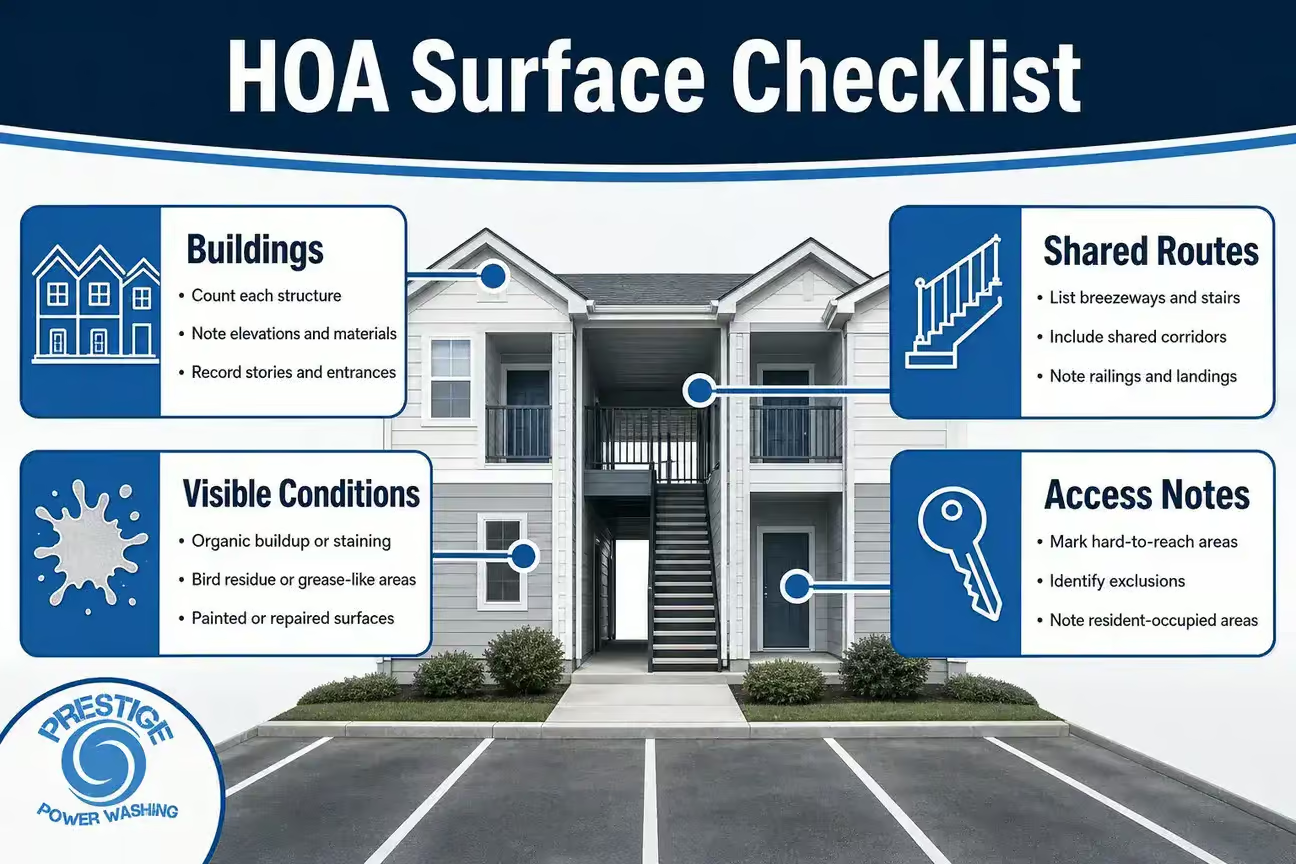
An HOA cleaning checklist helps the board avoid missing surfaces that residents see every day but proposals often overlook. It also gives vendors the same baseline, which can reduce apples-to-oranges comparisons. The checklist should be practical: count buildings, identify surfaces, mark access constraints, and note areas that may be excluded or require another trade.
For buildings, list each structure, elevation, material, number of stories, entrance type, trim, fixtures, and any hard-to-reach areas. Note visible organic buildup, staining, bird residue, grease-like areas, previous repairs, painted surfaces, and resident-occupied areas. Avoid assuming that one building represents the whole community; shade, irrigation, tree cover, and traffic patterns can make two similar buildings age differently.
For breezeways, common corridors, and stairs, include floors, walls, ceilings, railings, landings, light fixtures, utility closets, elevator approaches, door thresholds, and drainage paths. Building and breezeway cleaning can involve resident access, alternate walking routes, and temporary wet surfaces, so those details belong in the scope before the proposal is written. Prestige’s building and breezeway cleaning page is a relevant service reference for multi-unit and commercial properties.
For sidewalks, patios, and common areas, record dimensions or approximate square footage, cracks, pavers, trip-hazard areas, expansion joints, sealed surfaces, furniture, grills, screens, planters, and resident-owned items. Common area cleaning should not be treated as one generic line item if it includes multiple materials and different access needs.
For dumpster pads and service areas, identify the pad, surrounding walls, gates, drainage, stains, and access needs for waste haulers. Dumpster-pad cleaning should not be bundled with waste hauling, pest control, plumbing, or indoor janitorial work unless those services are separately verified with the appropriate provider. Prestige lists dumpster pad power washing as an exterior cleaning service, but the proposal should still define the pad, enclosure, exclusions, and access assumptions.
For gutters and downspouts, separate exterior gutter cleaning from repair, replacement, interior inspection, or drainage correction. For roofs, record roof material, pitch, access route, visible algae or moss-like growth, skylights, rooftop equipment, gutters, and areas that may need a roofing professional. Roof cleaning is not roofing repair, roof replacement, or manufacturer warranty service.
HOA pressure washing is not one method for every material
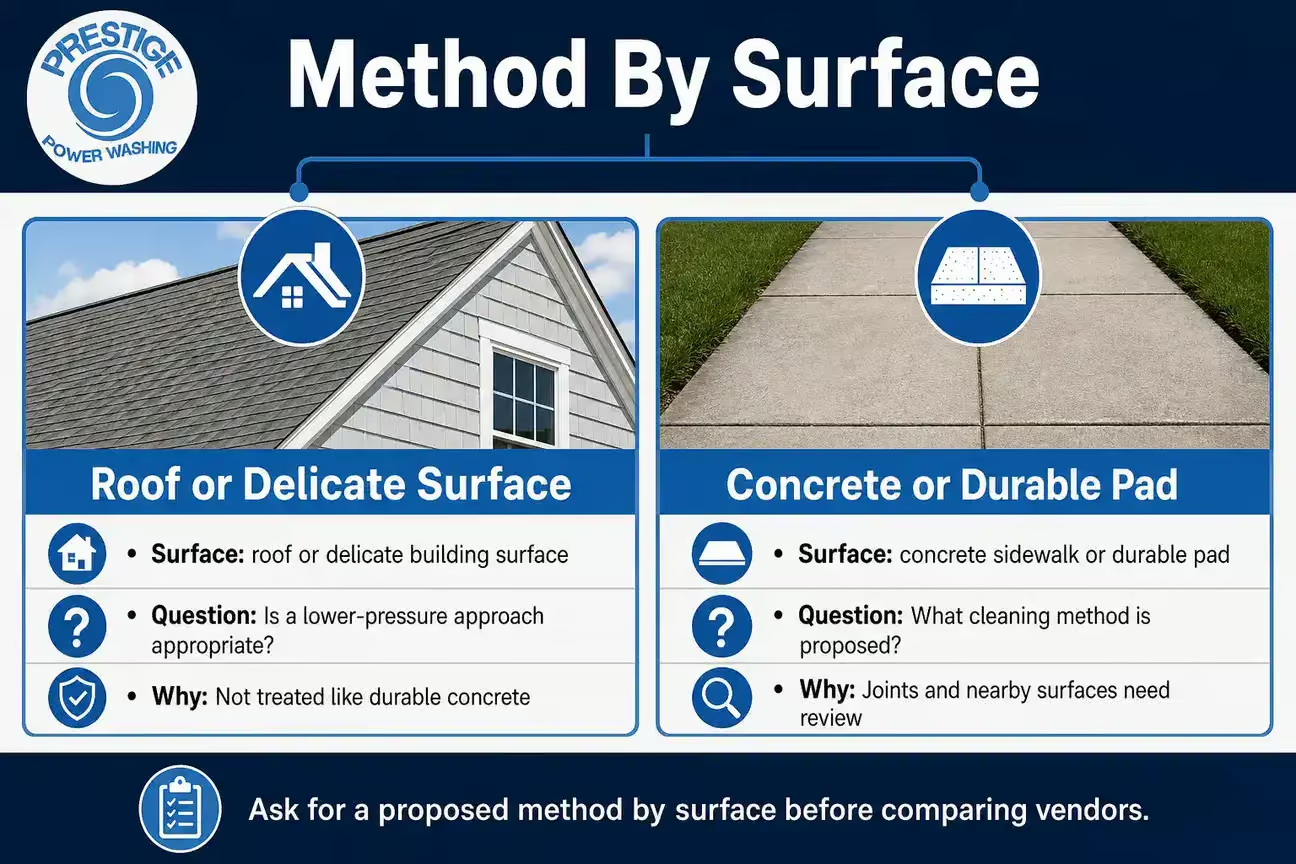
HOA pressure washing is often used as shorthand for exterior cleaning, but that phrase can hide important surface differences. A proposal should state the proposed method by surface rather than implying that every surface will be handled the same way. That protects the community from unclear expectations and gives the manager a better way to compare vendors.
| Surface or condition | Proposal question to ask | Why it matters |
|---|---|---|
| Roof or delicate building surface | Is soft washing or another lower-pressure approach appropriate for this material and condition? | Some surfaces should not be treated like durable concrete. |
| Concrete sidewalk or durable pad | What cleaning method is proposed, and how will joints, cracks, coatings, and adjacent areas be handled? | Durable does not mean every condition is the same. |
| Asphalt | Is the scope ordinary surface cleaning, or does it include separately identified oil or hydraulic-fluid treatment? | Oil-like staining may need separate expectations and may not fully disappear. |
| Painted, sealed, aged, or damaged surface | What limitations, test areas, or exclusions apply? | Coatings, repairs, and deterioration can affect the appropriate method. |
| Breezeway or entry area | How will pedestrian access, doors, fixtures, and drying-related access concerns be addressed? | Residents still need clear communication and access-routing decisions by the community. |
For concrete, asphalt, and other durable shared surfaces, concrete and asphalt cleaning may be part of a broader HOA pressure washing scope. Still, the proposal should identify damaged areas, patched surfaces, adjacent landscaping, drainage paths, and stains that may have limited results.
For roofs, boards should ask about roof material and condition before assuming a method. For asphalt roofing in particular, the Asphalt Roofing Manufacturers Association publishes algae and moss prevention and cleaning guidance, which is a reminder that roof questions should be material-specific and condition-dependent. HOA boards should not treat roof cleaning as roof repair, warranty service, or a substitute for a roofing professional when damage or deterioration is present.
Townhome community cleaning needs access and resident planning
Townhome community cleaning usually involves occupied homes, private vehicles, pets, resident belongings, landscaping, and shared infrastructure. Even if the cleaning scope is exterior-only, the work affects daily routines. A good proposal should make those assumptions visible before the job begins.
Start with access. Identify gates, keys, access codes, loading areas, hose routes, water access, roof access, elevator access where relevant, locked enclosures, low clearances, narrow drive lanes, and potential staging locations. If the contractor’s proposal assumes access to every building, elevation, breezeway, and utility area, the HOA should know that before approving the work.
Parking deserves its own line in the plan. Identify which spaces must be clear, who sends resident notices, who coordinates any towing policy, where visitor parking moves, and whether vehicles may remain near work areas. For townhome community cleaning, the board should also decide whether work will be phased by street, building, or amenity area so residents receive clear instructions.
Resident communication should be specific, calm, and early enough for people to act. Notices can explain expected noise, water, temporary access changes, parking restrictions, furniture movement, pet considerations, and weather-related rescheduling. One community contact should be named for day-of decisions so crews are not receiving conflicting instructions from multiple residents.
Pets and landscaping are also planning items, not afterthoughts. Ask residents to secure pets and move loose items where needed. Map planting beds, low vegetation, irrigation heads, decorative stone, planters, outdoor furniture, flags, seasonal decorations, grills, and screens. Avoid relying on broad animal-safety or landscaping-safety assurances without product-specific evidence and procedure details. The proposal should state what the contractor assumes residents or the HOA will move or protect.
Sidewalk cleaning and common area cleaning should be mapped together
Sidewalk cleaning is often one of the most visible parts of an HOA project because residents, guests, delivery drivers, and vendors use those routes every day. It is also one of the easiest areas to underscope. A proposal that simply says “sidewalks included” may not identify which walkways, crosswalks, curb ramps, common stairs, amenity paths, pool approaches, or mail-kiosk areas are actually included.
Map sidewalk cleaning by route. Mark main pedestrian routes, building approaches, curb lines, mail areas, amenity connections, dumpster approaches, pet-station areas, and any sidewalks adjacent to public right-of-way. Note cracks, lifted slabs, repaired sections, decorative concrete, expansion joints, pavers, sealers, and adjoining turf or beds. Cleaning can improve appearance, but it is not concrete repair or trip-hazard correction.
Common area cleaning should include the same level of clarity. A community pool deck, clubhouse patio, grilling area, playground-adjacent walkway, mail shelter, dog-walk station, bench area, or pavilion may have different materials and use patterns. If the HOA wants those included, list them individually. If resident-owned patios are excluded, say so. If shared patios are included but private furniture must be moved by residents, write that into the notice plan.
Sidewalk cleaning and common area cleaning also require pedestrian routing. The board or manager should decide whether routes can be temporarily closed, whether an alternate path exists, and who communicates that change. A contractor proposal can describe cleaning methods and work areas, but community decisions about resident access should be assigned clearly.
Stormwater and runoff questions belong in the scope
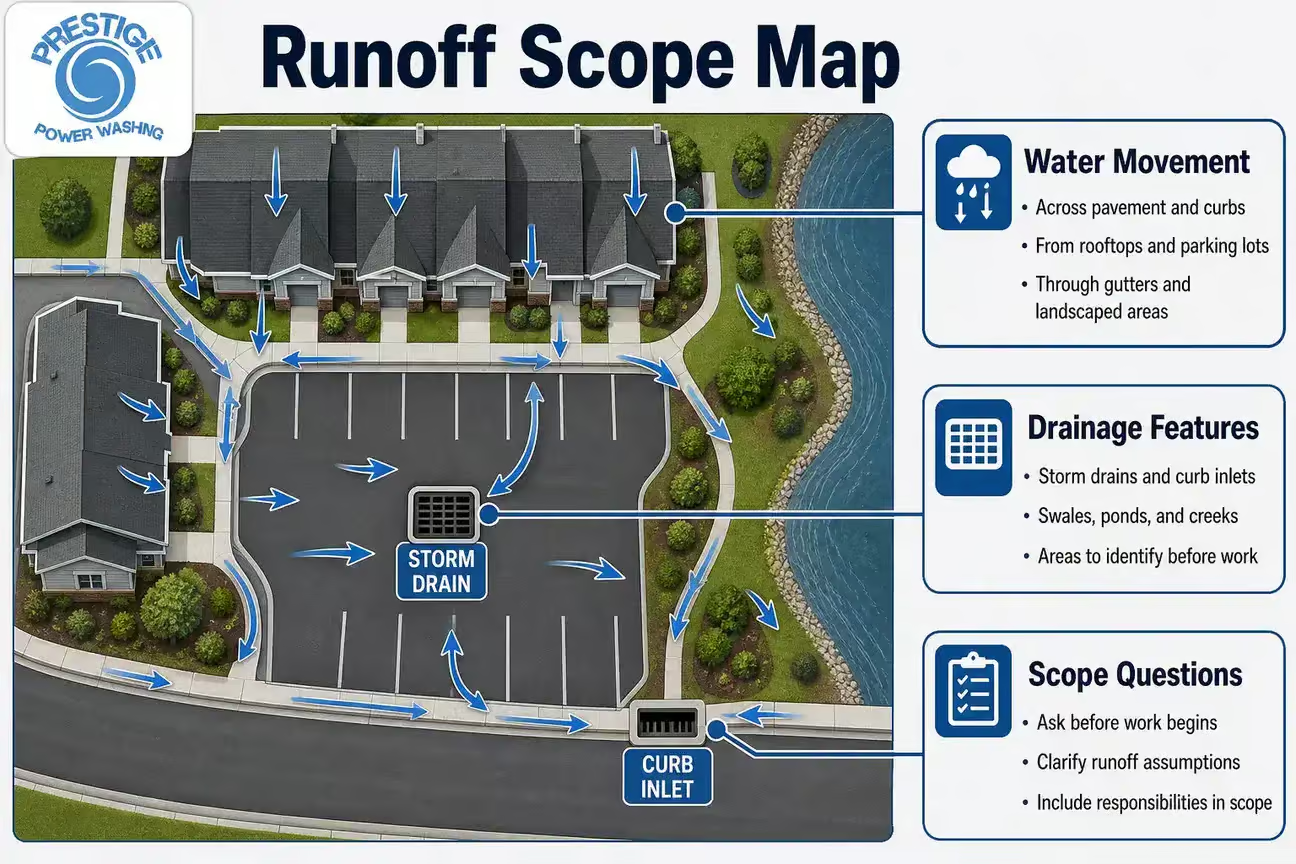
Exterior cleaning projects can move water across pavement, curbs, gutters, and landscaped areas. For HOAs in Cary, Raleigh, and the Triangle, that makes drainage planning part of proposal planning. The point is not to turn the board into a regulator; it is to ask the right questions before work begins.
The U.S. EPA explains that stormwater runoff flows over impervious surfaces such as streets, parking lots, and rooftops and can pick up trash, chemicals, oils, dirt, and sediment. The same EPA stormwater program page says stormwater controls are used to filter pollutants or prevent pollution at the source. In a practical HOA scope, that means storm drains, curb inlets, swales, ponds, creeks, detention areas, and drainage routes should be identified on the site plan.
North Carolina guidance is also relevant when wash water may be involved. NC DEQ’s technical guidance states that vehicle pressure washing wash water is wastewater, and discharge to surface waters through storm drains is not authorized by any NPDES stormwater permit. That statement is specific to vehicle pressure washing, but it shows why property managers should not ignore wash-water routing when planning exterior cleaning around pavement, parking areas, and storm drains.
NC DEQ’s NPDES FAQs also state that if a facility discharges wastewater into a municipal storm sewer system, it may need a permit, depending on the type of wastewater discharged. Do not read that as a blanket statement that every HOA exterior cleaning project requires a permit, and do not treat proposal language as proof of regulatory compliance. Instead, ask who is responsible for identifying stormwater or wastewater requirements for the property-specific scope.
Good runoff planning questions include: Where is wash water expected to travel? Which storm drains or receiving areas are nearby? Are oils, sediment, detergents, or other pollutants part of the concern? What controls are proposed? Who will decide whether an authorization, permit, or additional environmental guidance is needed? Are any areas excluded because runoff conditions cannot be addressed within the requested scope?
Boards should be cautious with unsupported phrases such as “environmentally friendly,” “EPA approved,” or broad safety and compliance claims for people, animals, landscaping, or stormwater. Without current product-level evidence and a property-specific plan, those phrases do not answer the practical question: what will happen to water, sediment, and residues on this property?
Compare proposals line by line, not just by total price
For proposal review, the most useful document is the one that explains exactly what is included, what is assumed, and what is excluded. A lower total can become confusing if it leaves out breezeways, roofs, gutters, dumpster pads, resident notices, access constraints, or storm-drain planning. A higher total may be more complete, but only if the written scope proves it.
Start with scope. Does the proposal list buildings, elevations, breezeways, stairwells, sidewalks, patios, dumpster pads, gutters, roofs, and other common areas separately? Does it include approximate quantities, number of buildings, expected mobilizations, and areas that are excluded? If sidewalk cleaning is listed, does it define which sidewalks? If common area cleaning is included, does it name the amenity areas?
Next, review method. Does the proposal identify soft washing, pressure washing, power washing, hand work, or special review by surface? Does it address aged, damaged, painted, sealed, cracked, or repaired surfaces? Does it avoid unsupported promises of complete stain, algae, moss, oil, grease, or odor removal? Surface-specific cleaning should leave room for condition-based limitations.
Then review exclusions. Common exclusions may include repairs, painting, sealing, roof replacement, gutter repair, waste hauling, pest control, indoor janitorial work, plumbing, electrical work, and removal of resident belongings. Dumpster-pad cleaning should not imply waste hauling. Roof cleaning should not imply roof repair. Exterior gutter cleaning should not imply drainage-system correction unless specifically verified.
Access assumptions matter as much as the work itself. Does the proposal assume water availability, power availability, gate access, roof access, elevator access, clear parking, and moved furniture? Who is responsible if residents do not move vehicles or patio items? What happens if a locked gate, blocked breezeway, or parked car prevents access?
Finally, compare communication. Does the proposal identify the community contact? Does it explain notice responsibilities, weather delays, inaccessible areas, incomplete sections, and follow-up questions? Clear communication is especially important for HOA pressure washing because the work may affect many households at once.
Prestige Power Washing LLC provides commercial pressure washing for commercial and managed exterior surfaces. Community managers can also call 919-520-4521 or use the estimate page to discuss the property-specific scope, without assuming a same-day appointment or any promised result.
One-time project planning is different from a recurring arrangement
A one-time project should define a fixed property-wide scope, work window, access plan, resident-notice process, exclusions, and incomplete-area documentation. If future cleaning is discussed, treat it as a separate decision unless the written proposal expressly describes what is included.
A recurring arrangement, if available and agreed to, should not be assumed to include the same surfaces, pricing, frequency, response time, priority, renewal terms, cancellation terms, documentation, or weather policy. No recurring-plan terms should be treated as automatic unless they appear in the proposal and are approved by the HOA. If a community wants routine sidewalk cleaning, common area cleaning, or seasonal building washing, the board should ask for those details in writing.
This distinction helps protect the board and the contractor. A one-time townhome community cleaning project may focus on buildings, breezeways, and sidewalks before a community event or annual meeting. A future scope might focus on dumpster pads, gutters, or roof sections. Those are different decisions, and they should be priced, scheduled, and documented separately unless the agreement says otherwise.
Commercial roof, gutter, and specialty areas need clear boundaries
HOA properties often include roofs, gutters, downspouts, dumpster enclosures, and other areas that require careful boundary-setting. The proposal should define what is being cleaned and what is not being repaired, inspected, certified, or replaced. That is especially important when the board is comparing exterior-cleaning proposals with roofing, plumbing, landscaping, or janitorial proposals.
For roof areas, ask whether the scope includes a visual inventory of roof sections, access points, gutters, visible growth, rooftop equipment, and exclusions. Prestige offers commercial roof cleaning, but roof cleaning should remain condition-dependent and does not include roofing repair, replacement, or manufacturer warranty work.
For gutters and downspouts, specify whether the HOA is asking for exterior cleaning only or some other service. Prestige lists exterior gutter cleaning as a service, but the scope should not imply gutter repair, replacement, or drainage correction unless separately verified.
For dumpster pads, grease-like staining, oil-like staining, or hydraulic-fluid concerns, ask whether the proposal treats those as ordinary cleaning or a separately identified stain-removal effort. Results can vary by surface age, material, staining depth, previous treatments, and drainage conditions. Avoid any proposal that promises complete removal or a permanent result.
Applying the plan in Cary, Raleigh, and nearby Triangle communities
Cary is the confirmed business-address location for Prestige Power Washing LLC. Raleigh, Apex, Morrisville, Holly Springs, Garner, Wake Forest, Durham, Chapel Hill, Fuquay-Varina, Knightdale, Clayton, Rolesville, Zebulon, and Research Triangle Park are service areas, not branch offices. For HOA exterior cleaning, the practical next step is to confirm availability for the specific community, city, and requested service.
A Cary community manager and a Raleigh community manager can use the same planning structure: inventory surfaces, map access, identify storm drains, assign resident notices, define exclusions, and compare proposals line by line. The local difference is not a different checklist; it is the property layout, drainage, resident density, parking pattern, and requested scope.
Avoid keyword-stuffed city lists in resident notices or board packets. The proposal should be about the property, not a generic regional claim. If the community has unusual access, sensitive landscaping, private patios, narrow alleys, shared courtyards, or limited parking, those details matter more than broad location language.
HOA cleaning checklist for proposal review
Use this HOA cleaning checklist before sending the request and again before approving a proposal:
- Have all buildings, elevations, and entrances been counted?
- Are breezeways, stairs, shared corridors, railings, and landings listed separately?
- Are sidewalk cleaning areas mapped by route rather than described generally?
- Are patios, mail areas, pool-adjacent areas, and other common area cleaning locations identified?
- Are dumpster pads, enclosures, gates, and service-area access points included or excluded?
- Are gutters, downspouts, and roof sections described separately from repairs or replacement?
- Is each surface matched to a proposed cleaning method?
- Are damaged, painted, sealed, fragile, aged, or repaired surfaces documented?
- Are parking restrictions, resident notices, and community contacts assigned?
- Are pets, landscaping, irrigation, doors, windows, cameras, intercoms, outlets, and mailboxes addressed?
- Are storm drains, curb inlets, swales, ponds, creeks, and detention features mapped?
- Are runoff assumptions and exclusions written clearly?
- Is the project defined as one-time, or are recurring terms written out separately?
- Is service availability confirmed for the specific property and city?
What a useful exterior-cleaning proposal should contain
A useful proposal should identify the property address, named decision-maker, proposal date, validity period if any, surface inventory, approximate quantities, method by surface, access assumptions, resident and parking responsibilities, landscaping and door-protection assumptions, stormwater and runoff responsibilities, exclusions, weather language, and one-time versus recurring designation.
It should also make realistic expectations clear. Exterior cleaning can improve appearance and help remove buildup, staining, and residue depending on the surface and condition. It is not repair work, painting, sealing, pest control, plumbing, roof replacement, regulatory certification, or an inspection sign-off. Actual results depend on material, age, condition, previous treatments, staining type, access, drainage, and weather.
When the board has a complete HOA cleaning checklist, the proposal process becomes calmer. Vendors receive the same information, residents receive clearer notices, and the board can compare scope, exclusions, access, runoff planning, and communication instead of relying on a single total price.
For HOA exterior cleaning in Cary, Raleigh, or a nearby Triangle service area, Prestige Power Washing LLC can discuss a property-specific estimate for confirmed exterior-cleaning services. The strongest starting point is a written surface inventory, a clear site plan, and a realistic conversation about what the community wants included.
Frequently Asked Questions
Should an HOA request one price for the entire community?
An HOA can request a property-wide proposal, but the proposal should still break the work into buildings, breezeways, sidewalks, common areas, dumpster pads, gutters, roofs, and other surfaces. A single total is easier to evaluate when the board can see exactly what is included and excluded.
What is the difference between HOA pressure washing and soft washing?
HOA pressure washing is often used as a general phrase for exterior cleaning, but pressure washing is not appropriate for every surface. Soft washing or another lower-pressure method may be more suitable for roofs and some building-envelope surfaces, while durable concrete or selected masonry may support a different approach after condition is reviewed.
How should a board prepare residents before townhome community cleaning?
The board or manager should send clear notices about parking, pets, patio items, access changes, noise, water, and possible weather delays. It also helps to name one community contact for questions and day-of decisions so residents and crews receive consistent information.
Should sidewalk cleaning be scoped separately from other common area cleaning?
Yes. Sidewalk cleaning should identify the exact routes, curb ramps, mail-area approaches, amenity paths, and building entrances included. Common area cleaning may include patios, pool-adjacent areas, pavilions, benches, or other shared spaces, so those areas should be listed separately.
What runoff questions should an HOA ask before exterior cleaning?
Ask where wash water is expected to travel, which storm drains or drainage features are nearby, what controls are proposed, who is responsible for identifying property-specific requirements, and whether any areas are excluded because runoff conditions are unclear. Do not treat broad compliance language as proof of regulatory approval.
Can an exterior-cleaning proposal include roofs and gutters?
It can, if those services are confirmed for the property and written into the scope. The proposal should separate roof cleaning from roof repair or replacement, and exterior gutter cleaning from gutter repair, replacement, or drainage correction.
Is a one-time cleaning project the same as a recurring maintenance plan?
No. A one-time project should have a fixed scope, access plan, resident-notice plan, and exclusions. A recurring arrangement should only be treated as included if the proposal clearly states the schedule, surfaces, terms, pricing assumptions, weather policy, and other details.
Sources
- U.S. Environmental Protection Agency, “NPDES Stormwater Program”
- North Carolina Department of Environmental Quality, “Technical Guidance”
- North Carolina Department of Environmental Quality, “NPDES FAQs”
- Asphalt Roofing Manufacturers Association, “Algae & Moss Prevention and Cleaning for Asphalt Roofing Systems”