
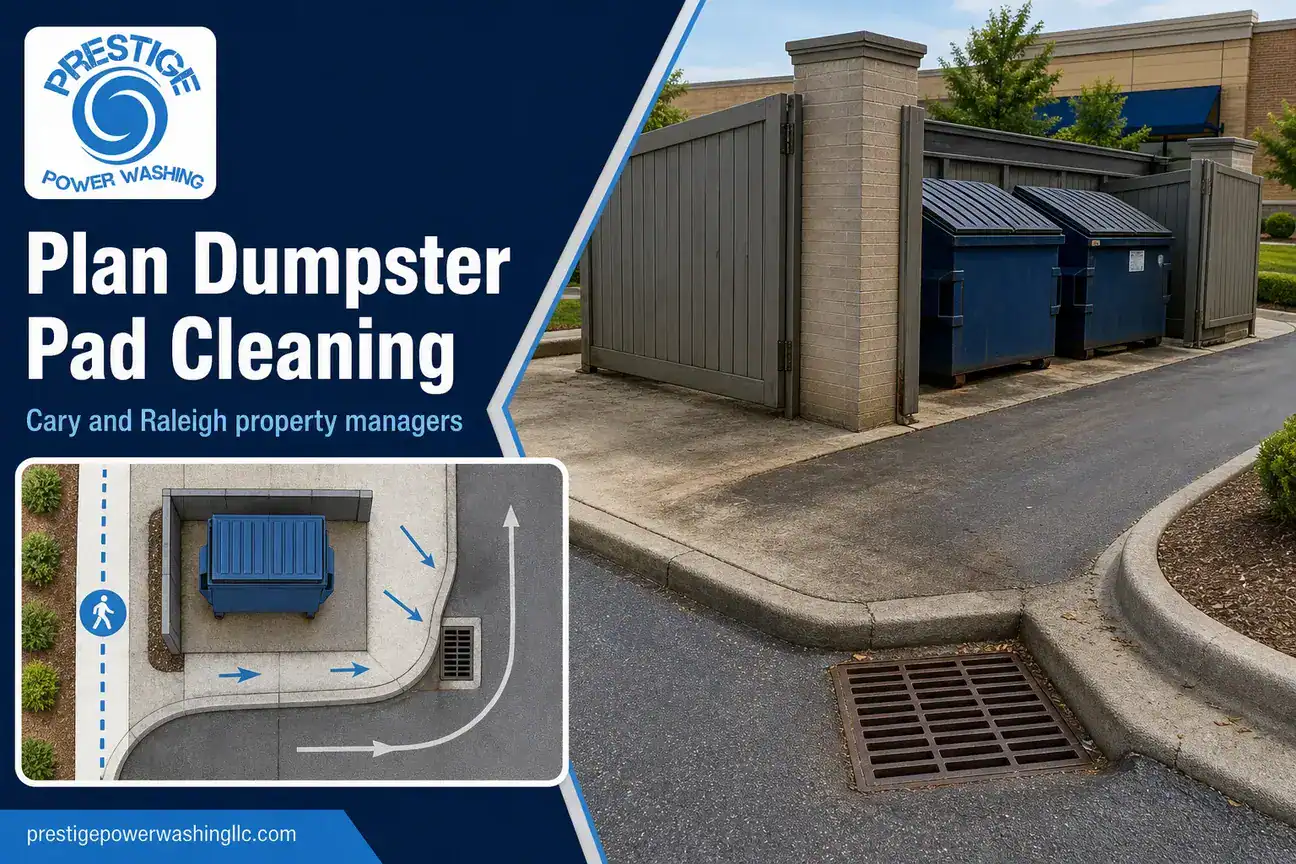
Dumpster Pad Cleaning Near Storm Drains: 7 Practical Checks to Avoid Risk
Effective dumpster pad cleaning near a storm drain starts with planning the site before anyone begins washing. Property managers, restaurant operators, HOA boards, and commercial-site owners should identify drainage routes, nearby inlets, curb lines, tenant access, waste-hauler schedules, and unusual residues before requesting service. The goal is to make the appointment easier to evaluate and coordinate, not to make a job-specific regulatory determination.
Quick Answer
Before scheduling, walk the dumpster area and note where water could travel from the pad. Provide photos, access details, pad dimensions, visible residue information, and any property restrictions. Ask direct questions about wash water pathways, include dumpster pad preparation notes, and use a practical commercial cleaning checklist when a drain destination, sewer connection, or property rule is uncertain.
For commercial properties in Cary, Raleigh, and nearby Triangle-area service communities, Prestige Power Washing LLC offers dumpster pad power washing as part of its exterior cleaning services. If you are preparing to request an estimate, the seven planning checks below can help you gather the right information without assuming that every site has the same drainage, residue, or access conditions.
Why planning matters at a commercial dumpster pad
A dumpster enclosure is usually a busy, hard-surface area. It may sit on concrete or asphalt, slope toward a curb, connect to a parking lot, or share space with delivery drivers and waste-hauling vehicles. That makes pre-service planning different from a simple open-area wash. The pad may be small, but the surrounding site can affect access, runoff direction, traffic flow, and the questions a contractor needs answered before the work is discussed.
For property managers, the first issue is usually coordination. A restaurant may need the enclosure accessible after closing or before a delivery window. An apartment community may need to keep residents away from the enclosure area while still preserving vehicle access. A retail center may need to avoid blocking a loading lane. Planning cannot promise a delay-free appointment, but it can reduce obvious conflicts before the schedule is set.
The second issue is the surface itself. Dumpster pads can collect ordinary dirt, food debris, grease, leaking-bin residue, tire marks, oil staining, and unknown material. Some stains can improve with surface-specific cleaning, but no responsible contractor should promise complete removal of every stain, odor, grease mark, or residue. The more clearly the property manager describes what is present, the easier it is to discuss the appropriate method for the surface and the realistic scope of the work.
The third issue is drainage. Nearby storm drains, trench drains, curb inlets, landscaped areas, and pavement low spots all influence how the work should be planned. North Carolina property managers should treat storm-drain questions carefully because state environmental guidance treats stormwater and wastewater pathways as important planning issues. NC DEQ’s vehicle pressure-washing guidance, available through its technical guidance resources, treats wash water from vehicle pressure washing as wastewater and says operators should check with local government when applicable. That is analogous educational guidance for dumpster-pad planning, not a dumpster-pad-specific rule for every property.
Early dumpster pad preparation helps the site contact explain whether the pad is next to a public inlet, a private drainage structure, or an unknown grate. When wash water pathways are noted before the estimate conversation, the contractor and property manager can discuss the setting with fewer assumptions.
The 7 dumpster pad cleaning checks to complete before scheduling
The following seven checks are not a substitute for legal, environmental, plumbing, or municipal guidance. They are practical planning items for property managers who want to discuss exterior cleaning clearly. If a local requirement, sanitary-sewer question, lease condition, or owner rule may apply, confirm it with the appropriate authority or property decision-maker before relying on a cleaning plan.
Check 1: Use storm drain cleaning context to map nearby structures
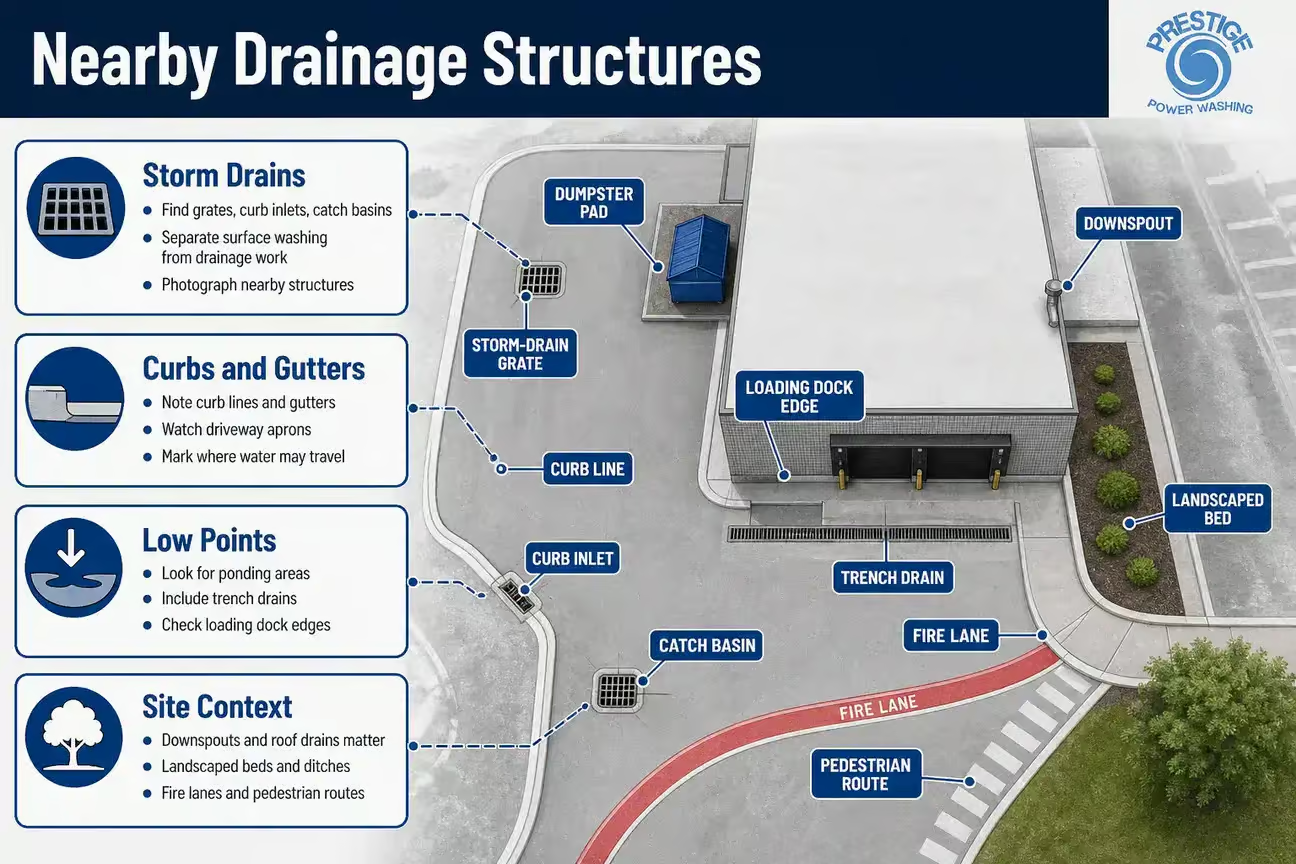
In this article, storm drain cleaning is used as planning context: it means identifying nearby storm-drain structures and understanding how they affect a dumpster-pad project. It does not mean that Prestige Power Washing LLC is providing municipal drainage work, sewer service, or stormwater-system maintenance. Property managers should separate exterior surface washing from drainage maintenance and regulatory review.
Walk the site and identify storm drains, curb inlets, catch basins, trench drains, drainage grates, curbs, gutters, and low points where water may pond. Also look for downspouts, roof-drain discharge points, landscaped beds, nearby ditches, loading docks, fire lanes, and pedestrian routes. A close photo of a drain grate is helpful, but a wide photo showing the drain’s relationship to the dumpster pad is often more useful.
Do not assume the nearest grate is a sanitary drain. A grate may be a storm drain, a private drainage structure, a trench drain, or something whose destination is unknown to the site contact. If the destination is not known, mark it as unknown rather than guessing. This keeps storm drain cleaning notes from becoming an unsupported assumption about where water may go.
If the site has a private stormwater system, ask the owner, association, or management company whether site-specific rules apply. A shopping center, apartment community, HOA, or restaurant pad may be subject to lease requirements, maintenance standards, or owner approval procedures that are separate from public rules.
Check 2: Trace wash water pathways from the pad to low points
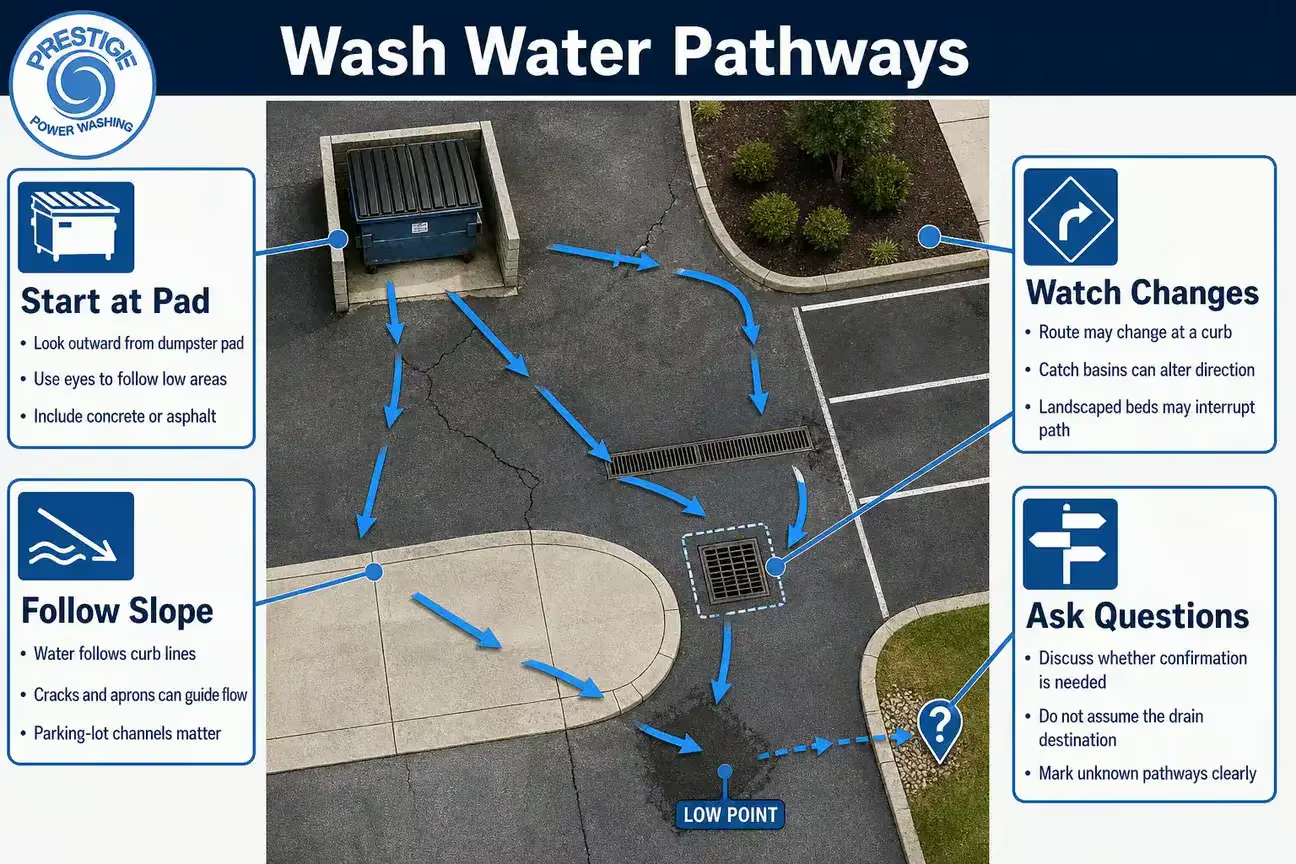
Wash water pathways are the practical routes water may take from the pad to nearby surfaces, drains, landscaped areas, or low points. A property manager does not need to solve every technical detail alone, but should be ready to ask clear questions. The more visible the route is before scheduling, the easier it is to discuss whether local confirmation is needed.
Start at the dumpster pad and look outward. Follow the slope of the concrete or asphalt with your eyes. Water usually follows low points, curb lines, cracks, driveway aprons, and parking-lot channels. A drainage path that looks obvious from one angle may change when it reaches a curb, catch basin, landscaped bed, or loading lane.
For a simple site sketch, note the dumpster enclosure, pad boundaries, curbs, drive aisles, downspouts, trench drains, catch basins, landscaped beds, low spots, and nearby building entrances. Include tenant doors, loading docks, pedestrian routes, and the path used by the waste hauler. This does not need to be a formal engineering drawing. A marked-up photo or simple map can still help the contractor understand the setting.
NC DEQ’s vehicle-washing guidance should be used as educational context rather than a one-size-fits-all legal answer. The useful planning principle is that wash water from pressure washing can be treated as wastewater, and operators may need to check with local government when applicable. For broader background on wastewater permitting questions, NC DEQ also provides NPDES wastewater permit FAQs.
Record wash water pathways in plain language. For example, “pad slopes toward the curb inlet at the south corner” is more useful than “water goes away.” If the route is unclear, write “unknown” and confirm what should happen before relying on that path.
Check 3: Gather dumpster pad preparation details before the estimate
Good dumpster pad preparation gives the contractor a practical picture of the site before the estimate conversation. It also helps the property manager think through access, timing, surface condition, and residue concerns. The information does not need to be complicated, but it should be specific enough to avoid vague descriptions like “behind the building” or “near the drain.”
Start with the property address, the primary on-site contact, and the easiest way to reach that contact during normal scheduling communication. Then describe the dumpster area. Note whether the enclosure has one dumpster, multiple dumpsters, compacting equipment, gates, locks, bollards, walls, or a shared loading area. If the pad is behind a restaurant, retail center, apartment building, office property, or HOA facility, explain who controls access.
Photos are usually the most efficient way to support dumpster pad preparation. Send wide photos of the full enclosure, close photos of stains or residue, images of nearby drains and curbs, and photos of gates or access points. Include the route used by the waste-hauling truck if it affects staging or access.
Useful site details include pad dimensions or a rough size estimate, surface type, visible cracks, uneven pavement, broken curbing, damaged enclosure features, dumpster pickup schedule, container movement responsibility, nearby storm drains, known grease, food waste, oil stains, hydraulic-fluid stains, unknown residues, quiet-hour restrictions, delivery windows, and traffic concerns.
This is also a good time to consider related exterior areas. A retail center may be evaluating commercial pressure washing beyond the dumpster enclosure. A multi-unit property may also need building and breezeway cleaning. Keep the dumpster-pad discussion specific, but mention adjacent exterior cleaning needs if they affect access or scheduling.
If you have photos and site details ready, you can request a free estimate and include the drainage, access, and residue information that helps frame the conversation. Avoid assuming that an estimate request creates an instant booking or same-day appointment; the practical goal is clear communication before the work is evaluated.
Check 4: Coordinate tenants, waste haulers, and active access points
Access coordination is one of the easiest parts to overlook. A dumpster pad may be physically small, but it often sits at the intersection of deliveries, waste pickup, employee breaks, tenant exits, customer parking, and maintenance routes. Planning helps everyone understand when the enclosure should be available and who needs to know about the work.
For restaurants, think about opening and closing tasks, grease-handling areas, food deliveries, and staff traffic. For apartment communities, consider resident foot traffic, pet areas, mailrooms, and parking circulation. For retail centers, loading docks and delivery windows may matter more than customer-facing hours. For HOAs, communicate with the property manager, board contact, or maintenance representative before the appointment is finalized.
Waste-hauler coordination deserves special attention. Ask whether dumpsters need to be emptied before the appointment, moved by the hauler, or kept in place. If containers can be moved, confirm who is authorized to move them and where they may be staged. Do not assume a cleaning contractor, tenant, or property manager can safely or lawfully move heavy waste equipment. If the hauler controls container movement, coordinate with that company directly.
Also identify locks, gate codes, security procedures, and restricted areas. If an enclosure is behind a controlled gate or in a secured service corridor, the site contact should know how access will be provided. If a delivery lane, fire lane, or residential parking route cannot be blocked, make that clear before the appointment is discussed. These details do not guarantee a perfect schedule, but they can prevent avoidable misunderstandings.
For active commercial properties, add access notes to the commercial cleaning checklist instead of leaving them in separate emails. Strong dumpster pad preparation connects the waste-hauler schedule, tenant notifications, gates, and traffic routes in one place.
Check 5: Disclose grease, oil, and unknown residues
Not every mark on a dumpster pad is ordinary dirt. Some sites have food debris, cooking-oil residue, leachate from containers, hydraulic-fluid marks, motor oil, solvents, paint, pesticides, fertilizer, broken glass, sharps, or material from a leaking container. Other sites may have a strong odor or dark staining with no clear source. Those details should be disclosed before scheduling.
Ordinary exterior cleaning should not be treated as hazardous-material remediation. If a material is unidentified, potentially hazardous, or outside normal exterior surface cleaning, the property owner or manager may need separate guidance before work proceeds. This is especially important when residues are oily, chemical, sharp, medical, or connected to a spill. A cleaning contractor should not be expected to diagnose every unknown substance based on appearance alone.
Restaurants should mention grease, cooking oils, leaking bags, compactors, food-waste buildup, and the timing of waste pickup. Auto-related sites should mention motor oil, hydraulic fluid, fuel, or solvent concerns. Apartment and HOA properties should mention bulky trash, broken glass, pet-related waste, or tenant dumping issues when present. None of those disclosures guarantee complete removal, but they help set realistic expectations.
If oil or hydraulic-fluid stains are part of a broader commercial concern, ask whether the area should be evaluated in relation to oil and hydraulic fluid removal. Keep in mind that stain improvement depends on the surface, the material, how long it has been present, and the surrounding conditions. Avoid turning an unknown residue into a routine washing task until the material is better understood.
Residue notes belong in both the dumpster pad preparation summary and the commercial cleaning checklist. They also affect wash water pathways because oily, greasy, or unknown material may raise different questions than ordinary dirt on concrete.
Check 6: Confirm local requirements when drainage is uncertain
Local confirmation is not always a dramatic step. It may simply mean asking the municipality, sewer-system owner, property owner, HOA, landlord, or environmental authority what applies to that site and that proposed pathway. State and federal stormwater resources support a cautious planning approach rather than a blanket statement that a permit is always required or never required.
Confirm applicable requirements when a storm drain is nearby, the drainage destination is unknown, the site has a private stormwater system, wash water may be directed to a sanitary sewer, or residues may include oil, grease, chemicals, or unusual materials. Also confirm when the property is part of a managed development, shopping center, HOA, commercial lease, or restaurant operation with owner-specific rules.
No specific Cary or Raleigh outdoor-washing requirement is being stated here. If a current municipal rule, property-standard document, sewer-authority instruction, or site-specific permit condition applies to your property, the property manager should verify it directly with the responsible authority or owner. That cautious approach is more appropriate than inventing a local rule or assuming that one property’s drainage setup applies to another.
The broader NPDES stormwater program exists because stormwater discharges can carry pollutants into surface waters, and the EPA NPDES Stormwater Program provides federal background on stormwater permitting. That does not turn a cleaning contractor into a permitting authority, and it does not answer every local question. It simply reinforces why property managers should not treat storm drains as ordinary disposal points.
If a sanitary sewer is being considered as a receiving pathway, do not assume permission exists just because a drain is nearby. The property owner or manager should confirm with the sewer-system owner or applicable authority. If the property manager cannot determine the drain destination, label it unknown and resolve that question before relying on it in a cleaning plan.
This is where storm drain cleaning notes and wash water pathways notes work together. One identifies the nearby drainage structures; the other describes where water may travel across the actual property surface.
Check 7: Build a commercial cleaning checklist before scheduling
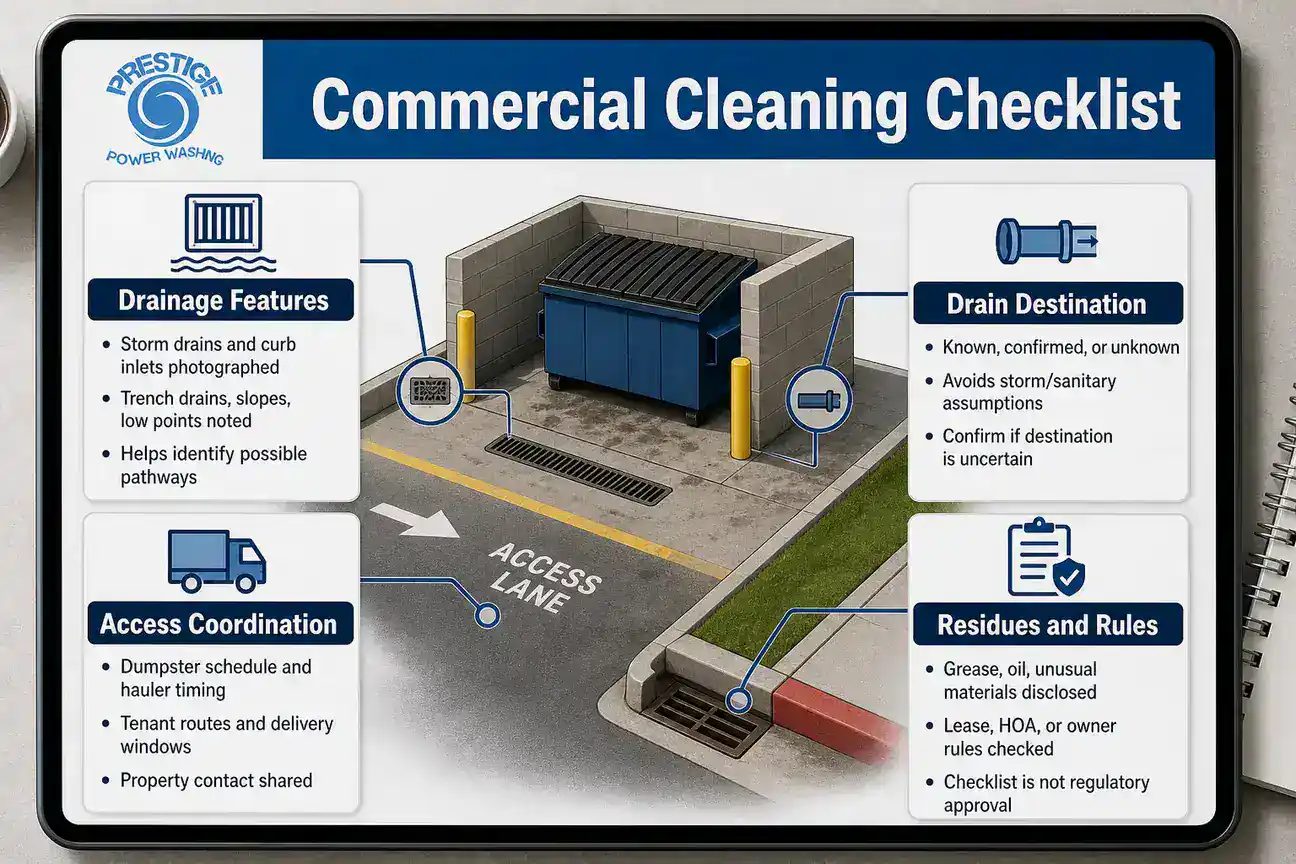
A simple commercial cleaning checklist keeps the planning conversation organized. It should include drainage, access, residue, communication, and property rules. The checklist is not a regulatory approval document, and it is not a promise of a certain outcome. It is a practical tool for property managers who want fewer surprises when discussing service.
| Planning item | What to confirm | Why it matters |
|---|---|---|
| Drainage features | Storm drains, curb inlets, trench drains, slopes, and low points photographed | Helps identify possible wash water pathways before work is evaluated |
| Drain destination | Known, confirmed, or clearly marked as unknown | Prevents assumptions about storm, sanitary, or private drainage structures |
| Access | Gate codes, locks, enclosure keys, and site contact assigned | Reduces confusion when the crew arrives for a scheduled service |
| Waste hauling | Pickup schedule, container movement responsibility, and staging area discussed | Helps avoid conflicts with haulers, tenants, and loading routes |
| Residues | Grease, oil, food waste, unknown chemicals, sharp debris, or spills disclosed | Supports realistic scope and may flag issues outside ordinary exterior cleaning |
| Property rules | Landlord, HOA, tenant, municipality, or sewer-authority questions reviewed | Helps the property manager know who may need to confirm requirements |
| Traffic and tenants | Resident, employee, customer, delivery, and emergency-access routes noted | Helps plan around active commercial-site operations |
Use the commercial cleaning checklist before requesting a quote, and update it if conditions change. For example, if a dumpster begins leaking after photos were taken, or if a storm leaves ponded water around the enclosure, tell the contractor. Good planning depends on current conditions, not just the first photo set.
This same commercial cleaning checklist can also help managers compare needs across multiple exterior areas. A dumpster enclosure, loading dock, breezeway, sidewalk, and parking area may require different scheduling and access planning. Keep each area specific so the contractor can discuss the appropriate method for the surface.
A complete checklist should connect dumpster pad preparation, storm drain cleaning observations, residue disclosure, and wash water pathways in one document. That keeps the planning focused on the actual site instead of relying on assumptions from another property.
What dumpster-pad power washing does not include
It is important to be clear about scope. Prestige Power Washing LLC provides exterior cleaning services, including confirmed dumpster-pad power washing, but that should not be presented as waste hauling, pest control, licensed plumbing, municipal drainage work, hazardous-material remediation, or regulatory permitting. It also should not be presented as a guarantee of complete stain, odor, grease, or residue removal.
Dumpster-pad cleaning is also not medical-grade disinfection or a sanitation certification. A cleaner-looking exterior surface can improve the appearance of a service area, but the work should not be described as pathogen control, disease prevention, health-inspection approval, or a certified compliance service. If the site has a health, environmental, lease, or municipal question, the property manager should confirm requirements with the appropriate authority.
Similarly, sewer work and municipal drainage work are separate from exterior surface washing. If a drain is clogged, damaged, backing up, or connected to a plumbing concern, the property manager should seek the appropriate qualified help. Do not treat a clogged or unknown drain as a normal part of a dumpster-pad washing appointment.
For Cary, Raleigh, and nearby Triangle-area commercial properties, a clear scope conversation helps keep expectations practical. If you are unsure whether the property conditions fit ordinary exterior cleaning, contact Prestige Power Washing or call 919-520-4521 to discuss the site and confirm service availability for your property.
A practical planning sequence for Cary and Raleigh property managers
For a busy commercial property, the easiest sequence is to start with site observation, then move to documentation, coordination, and confirmation. Walk the pad first. Map nearby storm drains and curbs. Photograph the enclosure. Identify unknown drains. Note tenant access, waste-hauler timing, and residue concerns. Then decide whether local confirmation is needed before the project is scheduled.
Next, organize the information into a short message. Include the property address, contact person, photo set, access notes, dumpster schedule, drainage concerns, and any unusual residues. This type of dumpster pad preparation is especially helpful for restaurants, apartment communities, shopping centers, offices, and HOAs where several people may be involved in approval or access.
Finally, avoid overpromising internally. A manager may be able to tell tenants that an exterior cleaning service is being discussed, but should avoid promising complete odor removal, perfect stain removal, regulatory approval, or uninterrupted access. Clear communication is part of a pain-free service experience, and it starts with realistic language.
Prestige Power Washing LLC is family-owned and locally operated from Cary, North Carolina, with Raleigh and other Triangle communities treated as service areas rather than branch locations. If the property has storm-drain, sewer, lease, or owner-approval questions, the manager should confirm those details with the relevant authority or property decision-maker before relying on a cleaning plan.
For recurring property-management discussions, keep a reusable commercial cleaning checklist on file. Update the wash water pathways notes when pavement, curbs, landscaping, or enclosure conditions change, and revise drainage observations if a drain is repaired, blocked, or newly identified.
Final takeaways for planning near storm drains
Successful dumpster pad cleaning planning is less about guessing the perfect method and more about sharing the right site information. The property manager should identify drainage features, document the pad, disclose residues, coordinate access, and ask specific questions about wash water pathways. When the destination of water is uncertain, or when a sewer connection, private stormwater system, or local requirement may apply, confirm before the appointment moves forward.
Use dumpster pad preparation to protect the schedule from avoidable surprises. Use a commercial cleaning checklist to keep access, haulers, tenants, residues, and drainage in one place. Use storm drain cleaning questions as a reminder to distinguish exterior surface washing from drainage maintenance, plumbing, or regulatory work.
If you manage a commercial property, HOA, restaurant, apartment community, or retail site in the Cary and Raleigh area, you can request a free estimate with photos and site details when you are ready to discuss the project. Clear information helps Prestige Power Washing LLC recommend the appropriate next conversation for the surface, setting, and access conditions.
Frequently Asked Questions
Should a property manager identify storm drains before dumpster pad cleaning?
Yes. The manager should identify nearby storm drains, curb inlets, slopes, low points, and any unknown drains before the appointment so wash-water pathways can be discussed clearly.
Can wash water from a dumpster pad enter a storm drain?
This depends on the property, pathway, and applicable requirements, so the article should not make a job-specific legal determination. NC DEQ’s vehicle pressure-washing guidance treats wash water from that activity as wastewater and says operators should check with local government when applicable. That is useful educational context for dumpster-pad planning, but it is not a dumpster-pad-specific approval for storm-drain entry.
What photos should be sent before requesting an estimate?
Send wide photos of the full enclosure, close photos of stains or residue, images of nearby drains and curbs, access points, gates, landscaping, loading areas, and the route used by waste-hauling vehicles.
What should a restaurant disclose about a dumpster pad?
Disclose grease, cooking oils, food waste, leaking containers, strong odors, unknown residues, tenant operating hours, pickup schedules, and any nearby pedestrian or delivery routes.
Who should confirm whether wash water may enter a sanitary sewer?
The property owner or manager should confirm with the sewer-system owner or other applicable authority. Do not assume that a nearby drain is connected to a sanitary sewer or that permission already exists.
What if the dumpster pad has an unknown chemical or oily residue?
Disclose it before scheduling and avoid treating it as ordinary dirt. Unknown or potentially hazardous material may require separate evaluation or handling outside ordinary exterior cleaning.
Does dumpster-pad power washing include waste removal or plumbing work?
No. Prestige Power Washing LLC’s confirmed dumpster-pad service does not include waste hauling, pest control, licensed plumbing, sewer work, or municipal drainage work.