
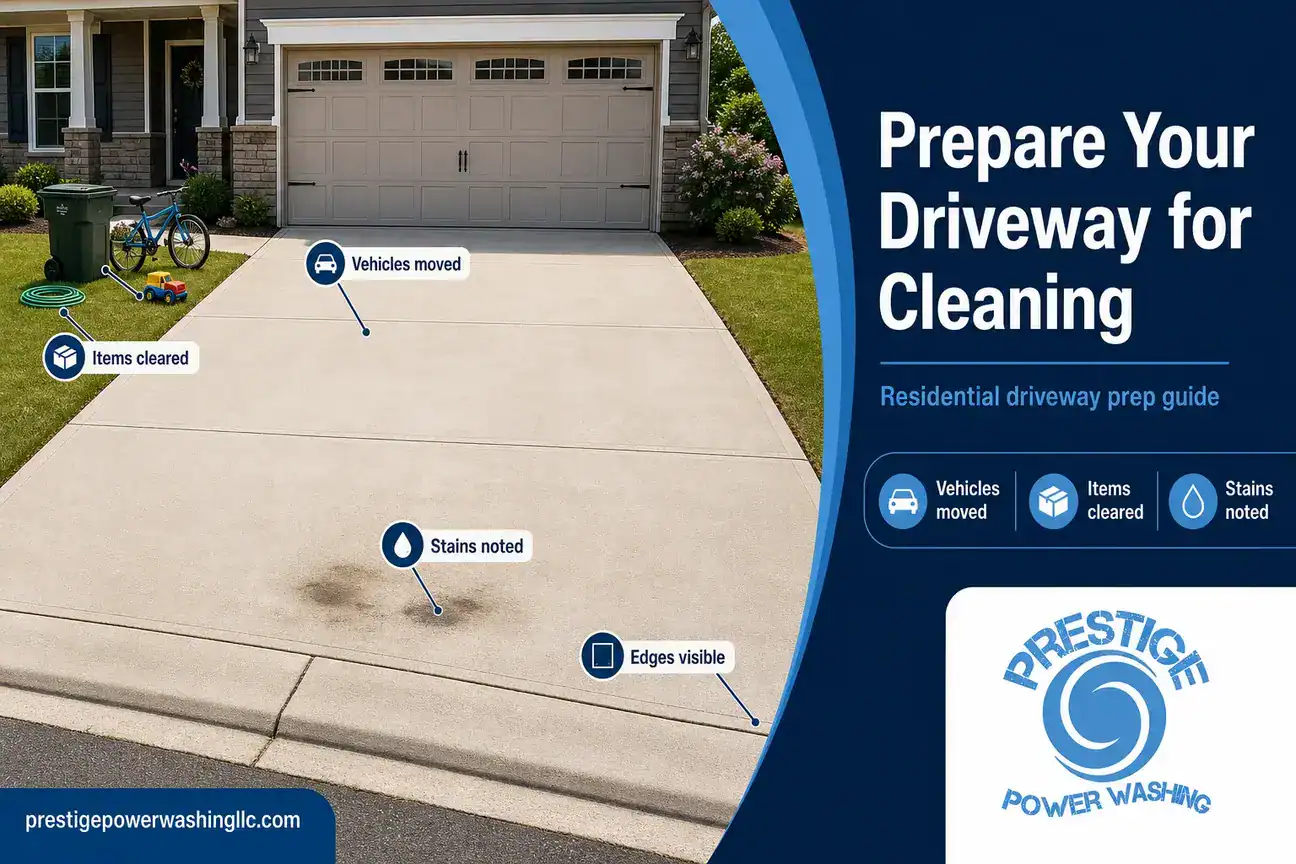
Driveway Cleaning Preparation: 11 Practical Essentials
Quick Answer: driveway cleaning preparation before the crew arrives
Move vehicles, clear the driveway and edges, identify stains, unlock needed access points, and keep children and pets away from the active work area. If the driveway is shared, part of an HOA, or connected to tenant or customer parking, coordinate parking and access ahead of time. If you are unsure whether a stain is oil, hydraulic fluid, rust, paint, or tire marking, share what you know before work begins so the scope can be discussed clearly.
If you are comparing options or planning a service visit, Prestige Power Washing LLC offers driveway pressure washing for residential driveways in Cary, Raleigh, Apex, and other verified Triangle service areas. For unusual stains, difficult access, or shared-use layouts, include those details when you request a free estimate so expectations can be discussed before the appointment is arranged.
Good driveway cleaning preparation starts with access, clear communication, and realistic expectations. Before a professional cleaning visit, move vehicles, clear loose belongings, point out oil or hydraulic-fluid stains, unlock gates, and think through where people, pets, hoses, and water may travel. For Apex homeowners, Cary and Raleigh residents, and Triangle-area property managers, a little planning helps the cleaning crew assess the driveway surface without unnecessary obstacles. It does not promise a specific result, because stain improvement depends on the substance, the age of the stain, the driveway material, weathering, and the surface’s existing condition.
Start with access: move vehicles and parked equipment
The first practical step is simple: move every vehicle off the driveway before the cleaning begins. That includes cars, trucks, motorcycles, trailers, golf carts, recreational vehicles, work vans, and any equipment parked on the surface. A clear driveway lets the cleaning professional see the full surface, including edges, drainage paths, stains, cracks, patched areas, and places where dirt or runoff may collect.
Try not to leave a vehicle partly on the driveway unless the contractor has specifically discussed that arrangement with you. Partial access can make it harder to work in a consistent pattern and may prevent the surface from being evaluated as a whole. If the driveway is long, narrow, sloped, shared with a neighbor, or attached to a rear parking pad, explain that before service so the work area can be understood in context.
Garage access matters too. Decide whether the garage door should stay closed, whether a vehicle inside the garage needs to leave before the cleaning window, and whether there are storage items close to the threshold. If you need to leave during or near the service window, park on the street or another approved location in advance rather than waiting until hoses or equipment are already set up.
Clear loose belongings, driveway edges, and nearby walkways
Loose items create obstacles and can hide problem areas. Before the visit, remove bicycles, scooters, toys, planters, trash bins, recycling carts, garden tools, hoses, sports equipment, seasonal decorations, furniture, portable basketball goals, and anything else sitting on or near the driveway. If an item is light enough to move in windy weather or could be affected by wet work, it is usually better to relocate it.
Pay special attention to the edges. Grass, mulch, pine straw, landscape borders, potted plants, and decorative stones can crowd the driveway perimeter. Clearing the edges helps reveal where the concrete or asphalt ends, where staining may have traveled, and whether there are cracks, loose aggregate, settlement, or damaged edging that should be noted before work begins.
Nearby walkways, porch steps, garage entrances, side gates, and storage areas are worth a quick look as well. A driveway cleaning visit is not a whole-home preparation project, but the surrounding access route still matters. If the crew needs to walk equipment or hoses from one area to another, blocked paths can slow setup or create avoidable complications.
How to prepare driveway washing details naturally
If you searched for how to prepare driveway washing, think beyond a basic chore list. The most useful preparation is the information you provide: what caused a stain, how long it has been there, whether the driveway was recently sealed, whether a vehicle leak is ongoing, and whether there are access concerns the crew should know about before arriving.
When you prepare driveway washing notes, include the driveway material, approximate size, visible stains, access limitations, and any shared-property considerations. For example, an Apex homeowner with a short concrete driveway may need a different access conversation than a property manager coordinating several parking spaces at a small office or apartment community. In both cases, clarity helps everyone understand what needs to be moved, protected, or discussed.
Photos can also be useful as you prepare driveway washing information. A few clear pictures can show the driveway layout, stains, slope, nearby storm drains, tight gates, retaining walls, or areas where vehicles normally park. Photos are not a substitute for an on-site assessment, but they can help communicate the condition and make the estimate conversation more practical.
For homeowners who are also planning other exterior work, it can be helpful to distinguish driveway preparation from broader exterior cleaning services. This article is focused on driveway preparation specifically: clearing the work area, identifying stains, making access practical, and coordinating people, vehicles, and shared spaces.
Driveway stain removal begins with clear stain notes
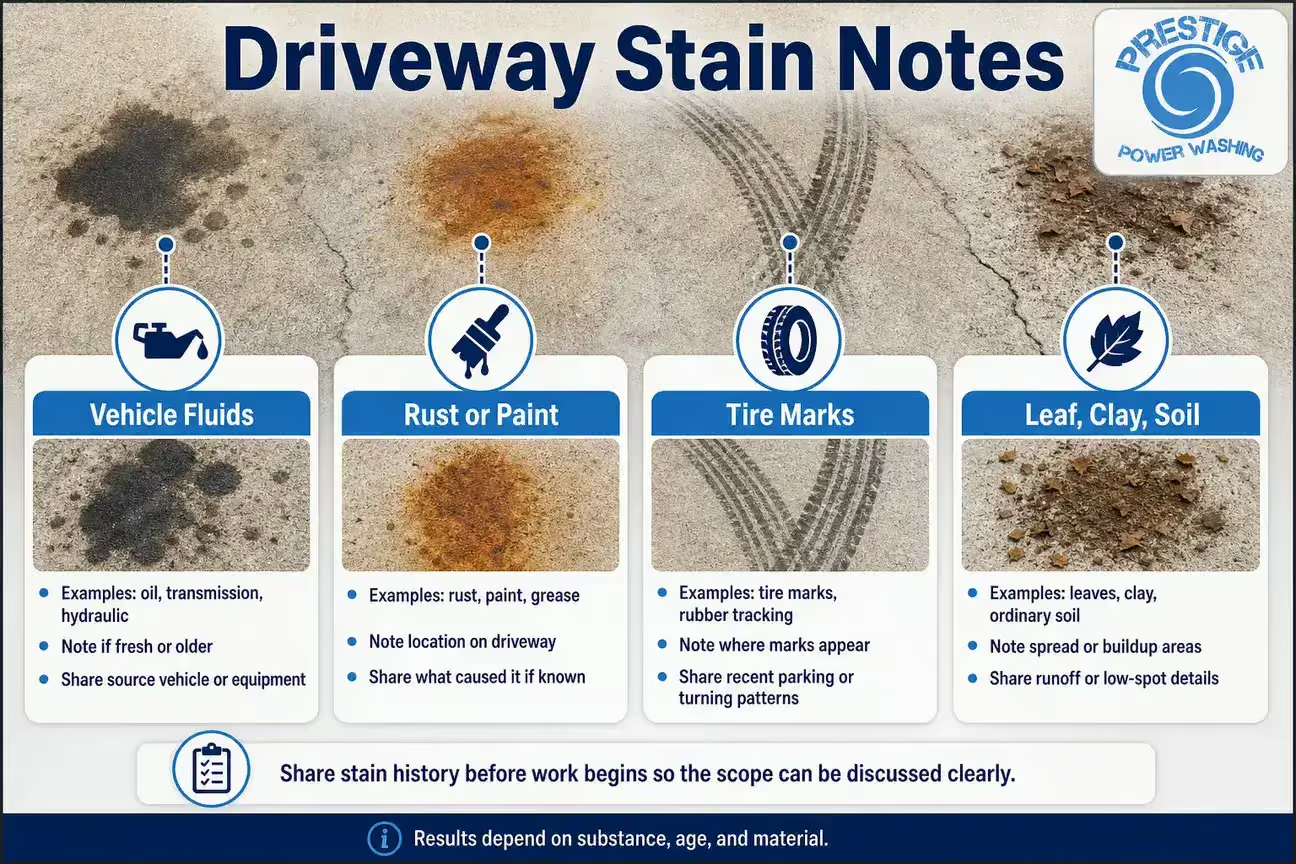
Driveway stain removal is one of the main reasons homeowners call for professional cleaning, but not all stains behave the same way. Oil, transmission fluid, power-steering fluid, hydraulic fluid, grease, rust, paint, tire marks, leaf discoloration, clay, and ordinary soil can look different, penetrate differently, and respond differently. If you know what caused a stain, tell the cleaning professional before work begins.
Fresh spills and older stains should be described differently. A recent oil drip may sit closer to the surface, while an old stain may have weathered, spread, or soaked into porous concrete or asphalt. That does not mean older staining cannot improve, but it does mean driveway stain removal should be discussed realistically. No responsible preparation checklist should promise that every stain will disappear.
If you suspect hydraulic fluid, motor oil, or another petroleum-based stain, point out the exact location and explain what you know about the source. Prestige Power Washing LLC has a confirmed service page for oil and hydraulic-fluid removal, which may be relevant when the driveway has more than ordinary dirt or surface discoloration. The appropriate discussion depends on the substance, the surface, the age of the stain, and the condition of the driveway.
Avoid applying a household degreaser, solvent, bleach, or other chemical immediately before a professional visit unless the contractor has specifically recommended it. An unfamiliar product can change how the stain looks, complicate evaluation, affect surrounding areas, or add a runoff concern. If you already applied something, be upfront about it. That information is part of practical driveway stain removal planning.
Concrete driveway cleaning expectations: what changes and what does not
Concrete driveway cleaning can improve the appearance of a dirty or stained surface, but cleaning is not the same as repair. Concrete may have cracks, spalling, pitting, exposed aggregate, patched areas, settlement, or discoloration that remains visible after surface soil is addressed. Those conditions should be noted before work begins so the discussion stays grounded in the driveway’s real condition.
Concrete and asphalt are also different materials. Concrete is often porous, and stains can settle below the visible surface. Asphalt may have soft spots, loose edges, patches, oxidation, or aging sealant. Concrete driveway cleaning expectations should account for the material, but the same preparation mindset applies: clear the surface, disclose known issues, and avoid assuming that cleaning will correct structural or material defects.
If your driveway includes both concrete and asphalt, or if you manage a property with parking pads, sidewalks, dumpster areas, or drive lanes, it may be worth discussing concrete and asphalt cleaning as part of the broader property scope. Keep the driveway conversation specific: which surfaces need attention, which stains are present, and which areas must remain accessible for residents, tenants, customers, or deliveries.
Before concrete driveway cleaning, photograph or note pre-existing damage. This is especially useful if the driveway has hairline cracks, chipped edges, uneven slabs, old patch material, or areas where water regularly collects. Documentation does not prevent conditions from existing, but it can help everyone distinguish cleaning expectations from repair concerns.
Protect access routes, people, pets, and nearby openings
A clean work area is not only about the driveway surface. Think through how the crew will reach the driveway and where hoses, equipment, and foot traffic may need to go. Unlock gates, move obstacles from narrow paths, trim or tie back low branches if they block access, and remove fragile items from nearby walls, garage entries, porch edges, and walkways.
Children and pets should stay away from the active work zone. OSHA identifies high-pressure cleaning as work that can involve hazards such as high-pressure streams and uncontrolled hoses, and its Cleaning and Cold Work Operations guidance says access to the area should be controlled. That worker-safety guidance is not a homeowner instruction to perform the work; it is a reminder that the area should not be treated like normal household space during cleaning.
Close nearby windows and doors if spray or overspray could reach them. If the driveway borders a garage, storage room, screened porch, side entrance, or basement access, check whether anything valuable, fragile, or moisture-sensitive is close to the opening. Move doormats, packages, cushions, small decor, and lightweight containers away from the driveway perimeter.
Electrical cords, outdoor outlets, low-voltage landscape lighting, irrigation controls, and other fixtures near the driveway should be identified before work starts. Do not assume every fixture is obvious from the driveway. If something is loose, recently repaired, or unusually placed, point it out. The same goes for loose stones, delicate edging, landscape borders, or areas where hoses should not be dragged.
Before driveway cleaning, think through water flow and runoff
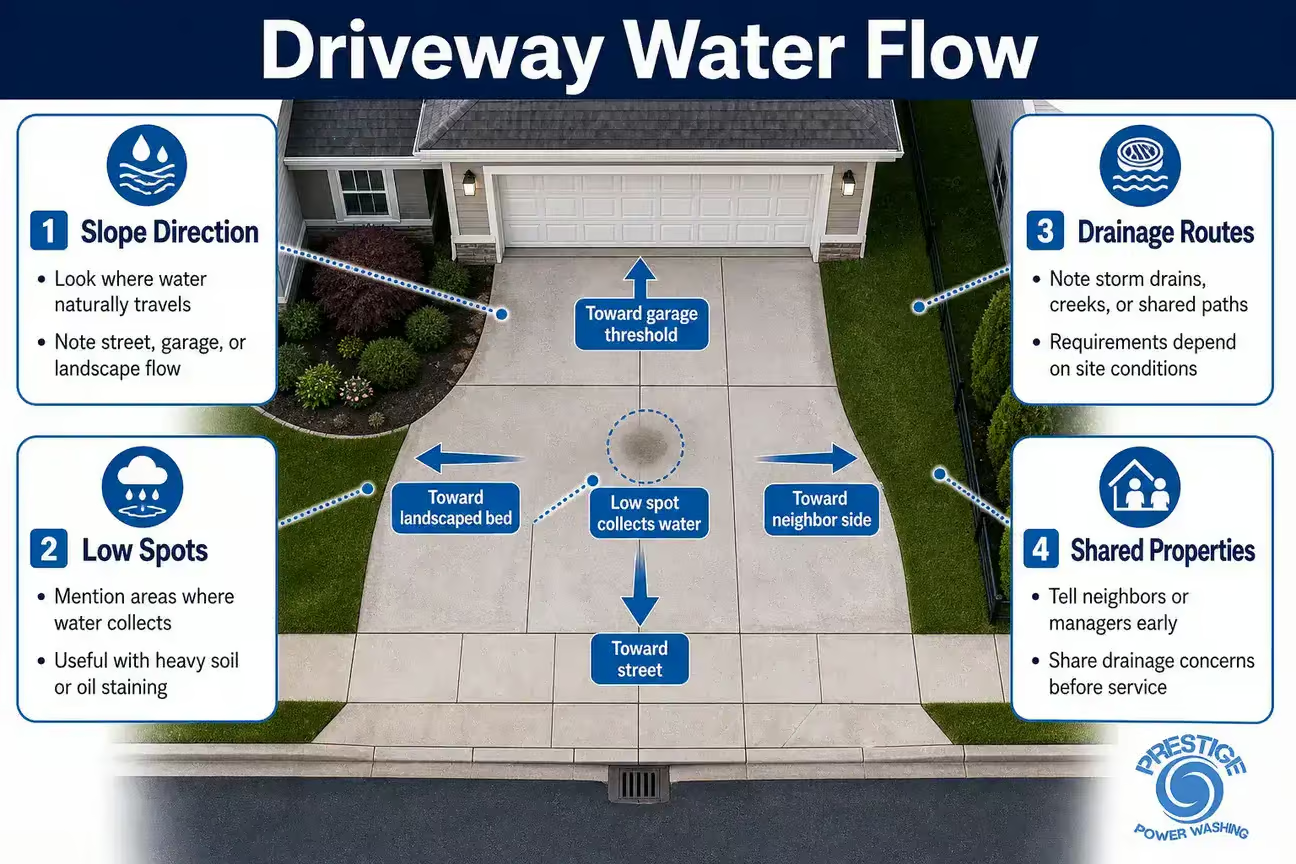
Before driveway cleaning, look at where water naturally travels. Does the driveway slope toward the street, a storm drain, a creek, a neighbor’s yard, a landscaped bed, or a garage threshold? Is there a low spot where wash water often collects? These are useful details to share, especially for driveways with oil staining, heavy sediment, or shared drainage patterns.
The EPA NPDES stormwater program explains the federal framework for stormwater discharges, and requirements can depend on the site and discharge conditions. For North Carolina properties, the North Carolina DEQ NPDES wastewater FAQs provide general permitting context for wastewater questions. North Carolina DEQ also publishes NPDES Industrial Program Technical Guidance for industrial stormwater topics. These sources should be treated as environmental education, not as a claim that any specific residential driveway appointment has the same regulatory profile.
For homeowners, the practical takeaway is to ask how wash water will be managed at the property, especially when the driveway slopes toward a storm drain, street, creek, or neighboring lot. For property managers, HOAs, apartment communities, retail centers, and office properties, unusual drainage conditions may require additional planning or confirmation with the property owner, HOA, municipality, or applicable authority.
Do not block storm drains or redirect water without understanding the site. A well-intended shortcut can create a different problem for a neighbor, landscaped area, public street, or commercial property. Before driveway cleaning, share what you know about drainage and let the service discussion account for the layout.
Coordinate shared spaces for Apex homeowners and property managers
Many Apex-area driveways are straightforward single-home layouts, but others involve shared driveways, tight cul-de-sacs, rear-load garages, alley access, townhome parking pads, or HOA-controlled streets. If any part of the driveway or parking area is shared, notify affected neighbors before the service window. Make sure vehicles are moved early enough that no one is trapped or blocked when hoses and equipment are in place.
For HOAs, apartment communities, offices, and retail properties, preparation is more about communication than the driveway itself. Decide which spaces must be cleared, how residents or tenants will be notified, where temporary parking is allowed, and whether deliveries or customer traffic need to be routed differently. Avoid scheduling assumptions that require a specific arrival or completion time unless that has been directly confirmed by the service provider.
If a gate code, parking pass, building contact, loading-zone restriction, or security instruction is needed, communicate that in advance. If a vehicle cannot be moved, do not wait until the crew arrives to mention it. The more clearly you prepare driveway washing logistics for shared spaces, the easier it is to discuss what can be accessed and what may need to be worked around.
Commercial and multi-unit properties should also consider tenant impact. Wet surfaces, hoses across access routes, and temporarily unavailable parking can affect residents, employees, customers, and vendors. Controlled access is part of practical job-site planning; OSHA’s cleaning guidance also states that hoses and connections should be inspected before use, reinforcing why active work areas should not be treated as open walkways during service.
What not to do right before professional cleaning
Some last-minute actions can make a driveway harder to evaluate. Do not apply an unapproved degreaser, solvent, bleach, or stain treatment immediately before service unless the cleaning professional has specifically advised it. Do not attempt a quick DIY pressure-washing pass over oil stains right before professional service. That can spread material, change the visible stain pattern, or make it harder to understand what was present.
Do not move cleared items back onto the driveway while waiting for the appointment. If trash pickup, lawn care, deliveries, or a family schedule conflict with the service window, plan where bins, vehicles, and equipment can go without re-blocking the surface. Before driveway cleaning, the goal is a clear, stable work area that stays clear long enough for the service discussion and cleaning process.
Do not assume that a clean-looking driveway is free of pre-existing damage. Freshly rinsed concrete can still have cracks, surface wear, or settlement. Asphalt can have soft edges, patches, or faded sealant even when dirt is not obvious. Point out conditions you already know about rather than assuming they will be visible immediately.
If oil or hydraulic fluid is involved, avoid disturbing the area more than necessary. OSHA’s Oil Spills—Response guidance notes that high-pressure washing can create exposure concerns in oil-spill response settings. That does not mean a homeowner should select protective equipment for a routine driveway appointment; it does mean oil-related conditions should be disclosed rather than treated casually.
The 11 practical essentials for driveway cleaning preparation
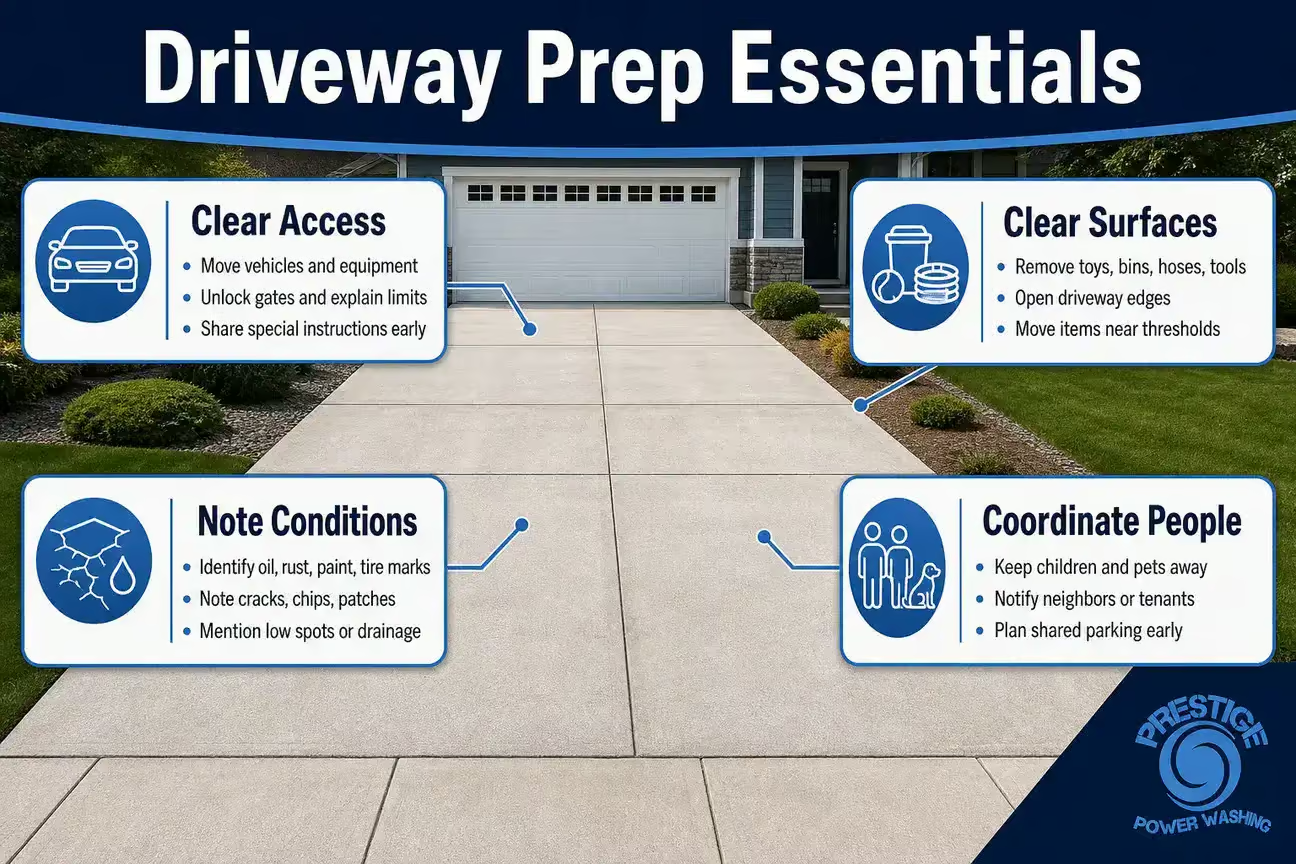
The title promises 11 practical essentials, so here they are as a structured preparation guide. Use these items the day before service and again the morning of service. They keep the focus on access, surface visibility, stain information, nearby belongings, people, pets, shared spaces, and water flow.
1. Remove vehicles from the driveway
Move cars, trucks, trailers, motorcycles, equipment, and recreational vehicles off the driveway before the cleaning window. This gives the crew a full view of the surface and helps avoid working around parked objects. If street parking, HOA rules, or shared access affects where vehicles can go, plan that in advance.
2. Clear loose items from the surface
Remove toys, planters, bins, hoses, tools, furniture, sports gear, and portable decorations. Loose items can hide staining, create obstacles, or get in the way of hoses and foot traffic. A clear surface also helps driveway stain removal discussions because the affected areas are easier to see.
3. Open up the driveway edges
Edges often show where dirt collects, water travels, and cracks or settlement begin. Clear mulch, pine straw, lightweight pots, decorative stones, and other items that crowd the perimeter. This is especially helpful for concrete driveway cleaning when stains or discoloration continue past the main parking area.
4. Unlock gates and explain access limits
If the driveway or nearby water-access route requires a gate code, key, parking pass, or special instruction, provide it before the visit. Do not assume a narrow side yard, locked gate, or rear driveway access will be obvious. Clear access notes help the service conversation stay practical.
5. Identify stains by type and location
Point out oil, hydraulic fluid, rust, paint, tire marks, leaf stains, clay, or unknown spots. If you know when a stain appeared or what vehicle or equipment caused it, say so. Driveway stain removal is easier to discuss when the stain history is not a mystery.
6. Note existing cracks, chips, patches, and settlement
Cleaning is not repair. Photograph or mention hairline cracks, spalling, loose asphalt, old patch material, exposed aggregate, chipped edges, or areas where water sits after rain. This helps separate cleaning expectations from surface conditions that already existed before the visit.
7. Close nearby windows and doors
Check garage doors, side doors, screened porch access, basement entries, and nearby windows. If spray or overspray could reach an opening, close it before work begins. Move doormats, packages, cushions, or storage items away from thresholds near the driveway.
8. Keep children and pets away from the active work area
Plan for children and pets to remain inside or in another secure area while setup and cleaning are underway. Hoses, wet surfaces, and active cleaning equipment should not be treated like normal household traffic. This is one of the simplest preparation steps to remember before driveway cleaning begins.
9. Coordinate shared access and parking
If the driveway is shared, connected to a townhome parking pad, or part of a small commercial or HOA layout, notify the affected people early. Neighbors, tenants, employees, residents, customers, and vendors may need to move vehicles or use another route during the work window.
10. Note where water naturally flows
Look for slopes toward streets, storm drains, creeks, garages, landscaped beds, or neighboring property. If there is a low spot where water collects, mention it. Water-flow details are especially important when heavy soil, oil staining, or shared drainage routes are involved.
11. Share special instructions before the visit
Do not save important instructions for the last minute. Share gate codes, HOA rules, parking restrictions, locked access points, delivery schedules, tenant notices, or surface concerns before the service conversation is complete. If you prepare driveway washing details early, the crew has a clearer picture of the property before arrival.
| Checklist item | What to do | Why it helps |
|---|---|---|
| 1. Vehicles removed | Move cars, trucks, trailers, motorcycles, and equipment off the driveway. | The full surface can be viewed and accessed. |
| 2. Loose items cleared | Remove toys, planters, bins, tools, hoses, furniture, and sports equipment. | Obstacles and hidden stains are reduced. |
| 3. Edges accessible | Clear the driveway perimeter and nearby walkways. | Edges, cracks, and drainage paths are easier to see. |
| 4. Gates unlocked | Provide access codes, keys, or instructions if needed. | The crew can reach the work area without delay. |
| 5. Stains identified | Point out oil, hydraulic fluid, rust, paint, tire marks, or unknown stains. | Driveway stain removal expectations can be discussed more clearly. |
| 6. Existing damage noted | Photograph or mention cracks, spalling, patches, loose asphalt, or settlement. | Cleaning expectations stay separate from repair needs. |
| 7. Nearby openings checked | Close windows and doors near the driveway when overspray could be a concern. | Adjacent interior and storage areas are considered. |
| 8. Children and pets kept away | Keep the active work area clear during setup and cleaning. | Access can be controlled while wet work is underway. |
| 9. Shared access coordinated | Notify neighbors, tenants, residents, or employees as needed. | Parking and access conflicts are less likely. |
| 10. Runoff direction considered | Note slopes toward streets, drains, creeks, garages, or neighboring lots. | Water-flow questions can be discussed before work begins. |
| 11. Special instructions shared | Provide gate codes, parking rules, HOA instructions, or access limitations. | The service conversation is clearer and more practical. |
When to discuss the driveway before scheduling
Some driveways deserve a more detailed conversation before a service visit is arranged. Reach out early if the surface has heavy oil staining, hydraulic-fluid marks, paint, rust, significant cracking, soft asphalt, large patched areas, steep slopes, drainage concerns, locked gates, shared parking, or limited hose access. These details can affect what needs to be moved, what should be discussed, and what expectations are reasonable.
If you are not sure whether you need standard driveway pressure washing, driveway stain removal discussion, or broader concrete and asphalt cleaning, send clear photos and explain what you are trying to address. A driveway that looks dirty from pollen and soil is different from one with old fluid stains or surface deterioration. Concrete driveway cleaning can improve appearance, but it does not replace repairs, resurfacing, or sealant decisions.
Prestige Power Washing LLC is family-owned and locally operated, with a published business address of record in Cary and service areas that include Apex, Raleigh, and other verified Triangle communities. The business was founded in February 2017. Cary is the address of record; Apex, Raleigh, and other Triangle communities should be understood as service areas, not branch locations or walk-in offices.
If your driveway has heavy staining, difficult access, or a shared-use layout, include those details when you request a free estimate or contact Prestige Power Washing. You can also call 919-520-4521. This is a low-pressure way to discuss the surface, access, and scope without assuming a specific appointment time or a promised result.
Final thoughts on preparation and realistic results
Driveway cleaning preparation is not complicated, but it is important. A ready driveway is free of vehicles and loose belongings, accessible around the edges, accompanied by clear stain notes, and coordinated with neighbors or tenants when shared spaces are involved. The more clearly you communicate unusual stains, drainage concerns, access limits, and existing surface conditions, the better the service conversation can be.
Remember that cleaning can improve the appearance of many driveways, but it does not repair cracks, reverse material aging, or ensure complete driveway stain removal. Stain improvement depends on the substance, the age of the stain, the driveway material, weathering, and the existing condition. Before driveway cleaning, focus on what you can control: clear the area, share what you know, keep people and pets away from the active work zone, and ask practical questions about access and runoff.
Frequently Asked Questions
Do I need to move my car before driveway pressure washing?
Yes. Vehicles should generally be moved so the full driveway can be accessed and inspected. If a vehicle must remain nearby because of a shared parking arrangement or another limitation, disclose that before the appointment rather than assuming partial access will be acceptable.
Should I remove planters, trash cans, and outdoor furniture?
Yes. Remove loose or movable items from the driveway and its edges, including planters, trash cans, toys, bicycles, furniture, hoses, and tools. Clearing the perimeter gives the crew a better view of the surface and reduces obstacles.
What should I tell the cleaner about oil or hydraulic-fluid stains?
Identify the stain’s location, likely substance, and approximate age. Mention whether it may be motor oil, transmission fluid, power-steering fluid, hydraulic fluid, grease, rust, paint, or tire marking. Oil and hydraulic-fluid removal can be discussed as a separate service, but no particular level of removal should be promised.
Can driveway cleaning remove every stain?
No. Stain improvement depends on the substance, how long it has been present, the porosity and material of the driveway, weathering, and the driveway’s overall condition. Some stains may lighten, while others may remain visible.
Should I apply a degreaser before the appointment?
Not unless the cleaning professional specifically recommends it. An unfamiliar product may affect the surface, create additional runoff, or complicate evaluation of the stain. If you already applied a product, tell the contractor before work begins.
What if my driveway is shared with a neighbor?
Discuss the cleaning plans with the neighbor in advance, coordinate vehicle removal, and identify any shared gates or access routes. For an HOA, apartment community, or commercial property, property managers should communicate the work area and parking expectations to affected residents, tenants, employees, or customers.
What should I do if the driveway slopes toward a storm drain?
Tell the contractor before work begins and ask how wash water will be managed at the site. Site-specific requirements can vary, so unusual commercial or drainage situations may require confirmation with the property owner, HOA, municipality, or applicable authority.
Does cleaning repair driveway cracks or damaged asphalt?
No. Cleaning addresses surface dirt and staining; it does not replace repairs for cracking, settlement, spalling, loose aggregate, or other material defects. Point out existing damage before work begins so the condition can be considered when discussing the service.