
Commercial Vendor Checklist for Pressure Washing in Cary
A commercial vendor checklist helps Cary-area property managers, HOAs, apartment communities, retail centers, and office decision-makers request exterior-cleaning proposals that can be compared fairly. Instead of asking for a broad quote, gather property details, identify surfaces, define access, plan occupant communication, ask drainage questions, and require written exclusions. The result is a clearer proposal conversation and fewer hidden assumptions before work is approved.
This guide is written for commercial exterior cleaning in Cary, Raleigh, and nearby Triangle service areas, with Cary as Prestige Power Washing LLC’s published business-address location and other communities treated as service areas only. If you are preparing to request pricing, review Prestige’s commercial pressure washing service and assemble the site details below before you request a free estimate. This article does not assume unverified insurance, bonding, certifications, equipment, pricing, or regulatory documentation for any vendor.
Commercial vendor checklist: 9 items to compare before proposals
Use this commercial vendor checklist as a practical comparison tool before inviting vendors to walk the property or submit a written estimate. The point is not to tell a contractor exactly how to work. The point is to make your property conditions visible so each vendor is pricing the same scope, exclusions, access limits, and follow-up expectations.
| Checklist item | What to collect or ask | Why it matters |
|---|---|---|
| 1. Property inventory | Buildings, entrances, breezeways, sidewalks, parking, roofs, patios, dumpster pads, and restricted areas | Helps vendors price the same property footprint |
| 2. Surface list | Concrete, asphalt, brick, pavers, siding, stucco, metal, wood, roof coverings, and painted areas | Different materials may need different cleaning approaches |
| 3. Staining and soil conditions | Organic growth, grease, oil, hydraulic fluid, graffiti, tire marks, food-service residue, or accumulated debris | Sets realistic expectations and flags areas needing separate attention |
| 4. Access limits | Gates, keys, roof hatches, loading docks, parking rules, hose routes, and exterior water access | Prevents assumptions that can change the scope later |
| 5. Occupant coordination | Resident, tenant, customer, employee, and HOA communication requirements | Reduces disruption and identifies who approves field changes |
| 6. Drainage and wash water | Storm drains, sanitary-sewer connections, landscaped drainage, ponds, streams, or unknown inlets | Raises site-specific questions before work begins |
| 7. Written exclusions | Interior cleaning, repairs, waste hauling, pest control, plumbing, roof repair, or code sign-off | Prevents a proposal from appearing broader than it is |
| 8. Documentation | Written scope, marked-up map, condition notes, photos, sequencing, change-order process, and required vendor documents | Creates a record for internal approval and proposal comparison |
| 9. Estimate follow-up | Questions asked, missing information, site visit status, revisions, and remaining unconfirmed items | Keeps the procurement process organized |
A complete property manager checklist should also separate one-time cleaning needs from recurring maintenance discussions. For example, an apartment community may ask about building and breezeway areas, sidewalks, dumpster pads, and leasing-office entrances, while a retail center may focus on storefront walks, curbs, loading zones, restaurant-adjacent areas, and customer paths.
Build the property manager checklist before requesting estimates
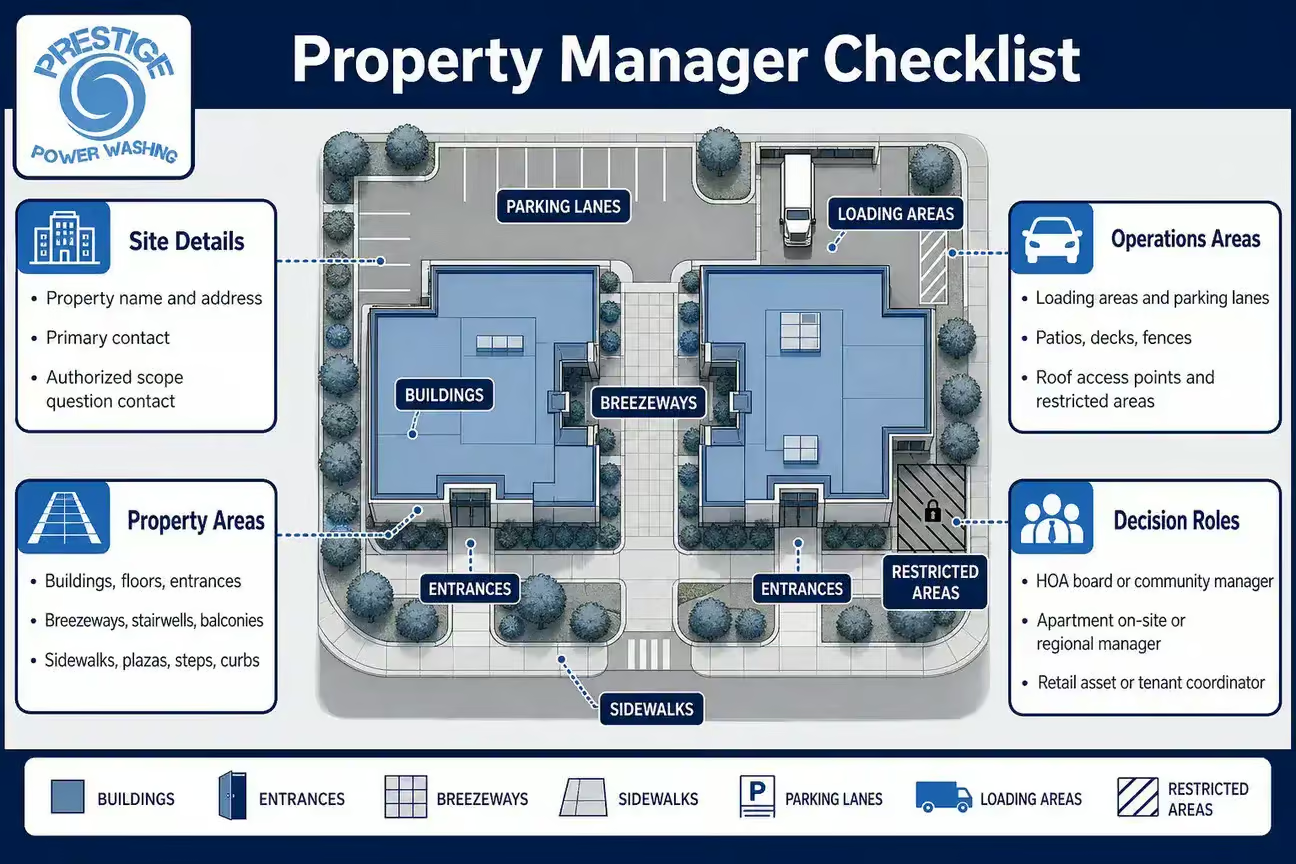
The most useful property manager checklist begins with a site-information packet. Include the property name, address, primary contact, property type, and the person authorized to answer scope questions. For an HOA, that might be a board representative or community manager. For an apartment community, it may be a regional manager, maintenance supervisor, or on-site manager. For a retail center or office property, it may be an asset manager, facilities contact, or tenant coordinator.
Next, list the property areas that may be included. Count buildings, floors, entrances, breezeways, stairwells, balconies, sidewalks, plazas, steps, curbs, loading areas, parking lanes, patios, decks, fences, roof sections, and dumpster pads. A commercial cleaning proposal is easier to compare when each vendor sees the same site boundaries.
If you have site plans, property maps, photos, maintenance notes, or prior cleaning records, collect them before outreach. These materials do not need to be perfect. Even a marked-up aerial image can help a vendor understand where work may start, where equipment could be staged, and which areas must remain open during business hours.
Include preferred work windows, blackout dates, tenant-notice requirements, school traffic patterns, customer peak periods, special events, and leasing-office hours when relevant. Cary and Raleigh commercial properties often have different daily rhythms depending on whether they serve residents, shoppers, office employees, restaurant customers, or mixed-use visitors.
The property manager checklist should also identify which areas are likely recurring maintenance concerns and which are one-time concerns. Routine sidewalk buildup, breezeway cleaning, and entrance maintenance may be discussed differently from graffiti, oil staining, roof staining, or a single post-construction cleanup request. Avoid asking vendors to price “the whole property” without defining what that phrase means.
Put each surface into the vendor scope of work
A strong vendor scope of work identifies surfaces and areas rather than treating the property as one uniform job. Pressure washing, power washing, and soft washing are not interchangeable labels for every material. The appropriate method depends on the surface, condition, staining, access, and cleaning objective.
Ask each vendor to distinguish concrete sidewalks, plazas, steps, curbs, and parking areas from asphalt pavement, brick, pavers, stone, stucco, siding, painted surfaces, metal, wood, roof coverings, and drainage components. Dumpster pads and areas affected by food-service residue should be identified separately, especially for restaurant-adjacent or mixed-use properties.
For multi-unit properties, consider whether building and breezeway cleaning is part of the request or a separate line item. Breezeways, stairs, railings, doors, ceilings, walls, and adjacent walks may not all be included unless the proposal says so. The vendor scope of work should state the included surfaces clearly enough that another manager can review it later.
For parking lots, curbs, sidewalks, and loading zones, link the request to surface type and stain type. Concrete and asphalt cleaning may involve different expectations depending on age, porosity, prior coatings, oil saturation, tire marks, deterioration, and access. A proposal should avoid absolute promises about complete stain removal because results can depend on material condition and the history of the stain.
Roof areas also need separate handling. If commercial roof staining or rooftop buildup is part of the request, ask whether commercial roof cleaning is being considered as a separate scope. Exterior roof cleaning is not roofing repair, roof replacement, manufacturer warranty service, or a substitute for a roofing contractor’s assessment.
A practical vendor scope of work can include a surface-by-surface list, a marked-up map, and notes about what is excluded. If the vendor uses terms such as pressure washing, power washing, soft washing, hand detailing, spot treatment, or rinse-down, ask what areas those terms apply to. The goal is not to force a technical method. It is to make sure the commercial cleaning proposal explains what the vendor intends to clean.
Write pressure washing questions that reveal access and operations
Good pressure washing questions turn access limits into written assumptions. Ask where vehicles, hoses, tanks, and other equipment may be staged. Ask whether exterior water sources are available, who authorizes their use, and whether there are locked gates, key boxes, access cards, elevators, roof hatches, utility rooms, or loading-dock rules.
Access questions matter because they can affect time, sequencing, and which areas are practical to include. A narrow drive, underground garage, height restriction, busy storefront path, or limited loading area may change how the work is planned. The commercial cleaning proposal should not assume unrestricted access unless that is actually true for the property.
Ask whether hoses may cross pedestrian paths or vehicle lanes. If they can, ask how walkways, doors, ramps, and traffic areas will be coordinated. Some properties may require cones, barricades, signage, spotters, or temporary restricted zones under the property’s own operating procedures. The vendor can respond to the site conditions, but the property manager should identify the restrictions early.
Your pressure washing questions should also cover fragile or movable items. Note outdoor furniture, planters, umbrellas, signs, lighting, cameras, security devices, menu boards, mail kiosks, gates, loose trim, aging paint, deteriorated surfaces, and electrical equipment. These details help the vendor identify items that may need to be moved, protected, avoided, or excluded.
For roof access, do not assume that a roof is available for exterior cleaning just because it is visible. Ask about roof hatches, ladders, locked access, tenant-controlled areas, pitch, surface condition, nearby electrical equipment, and any property-specific access policy. If additional access equipment or specialty contractors are needed, the proposal should say so instead of quietly folding that uncertainty into a general estimate.
Coordinate tenants, residents, and business operations
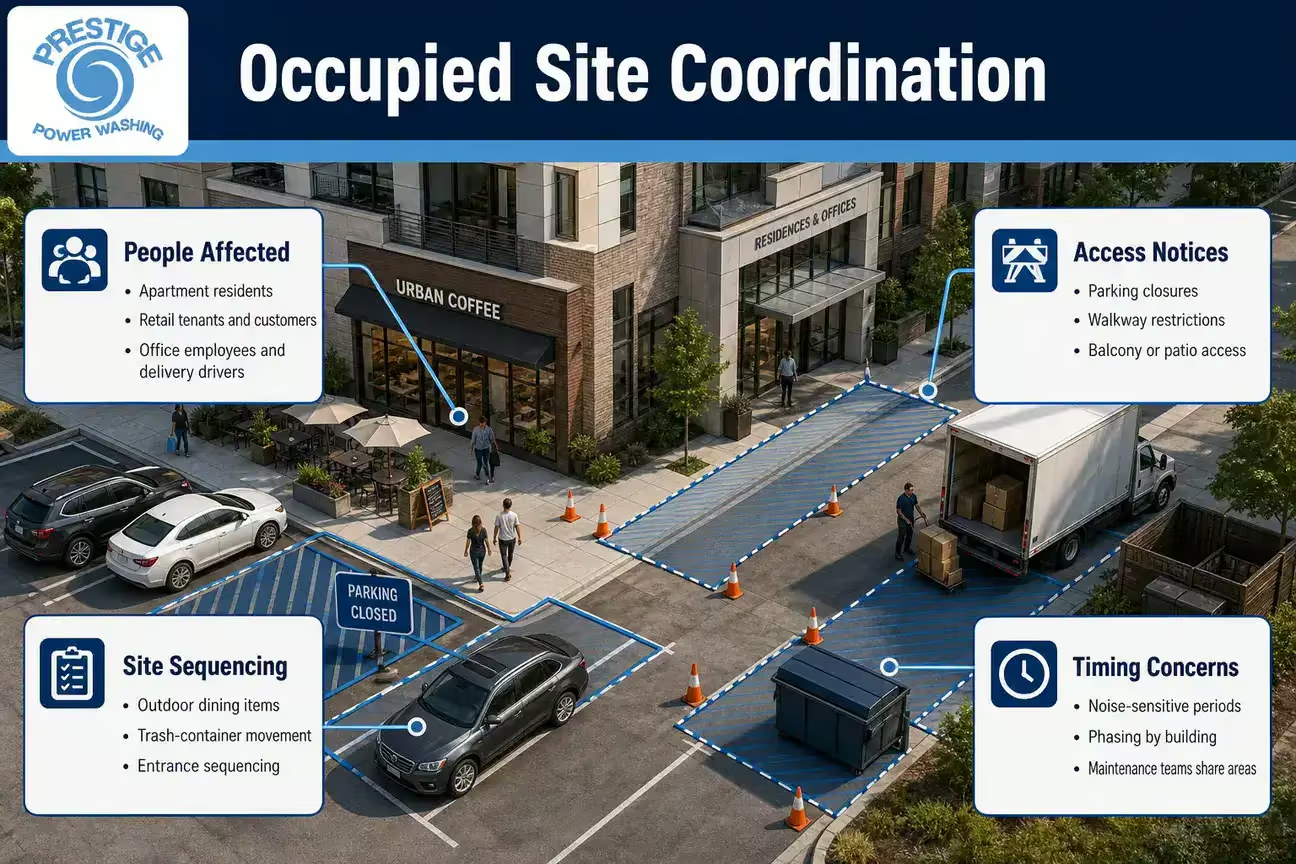
A commercial cleaning project affects people, not just surfaces. Apartment residents, HOA members, retail tenants, restaurant customers, office employees, delivery drivers, and maintenance teams may all use the same exterior areas. The property manager checklist should include a communication plan before the first proposal is approved.
Ask who sends notices, how much lead time is expected, and what the notice should include. Parking closures, walkway restrictions, balcony or patio access, outdoor dining items, trash-container movement, entrance sequencing, and noise-sensitive periods may all need coordination. The commercial cleaning proposal should identify whether work is phased by building, elevation, parking area, breezeway, storefront row, or common area.
For apartment communities and HOAs, resident-use areas need practical sequencing. Mail areas, leasing offices, pool entrances, gyms, sidewalks, pet areas, and trash enclosures may require different timing. For retail and office properties, entrances and customer routes may need to remain usable or be temporarily redirected. A plan that works for a closed loading area may not work near a lunch-hour restaurant entrance.
Clarify who can approve field changes. If a vehicle blocks access, a gate code does not work, a tenant refuses temporary access, or an unexpected drain is discovered, the vendor should know whom to call. The vendor scope of work should identify the property contact and the process for revising the plan when conditions change.
Ask wash-water and storm-drain questions early
Drainage deserves its own section because wash water is not the same thing as ordinary rainwater. North Carolina property managers should ask where water will go, whether nearby inlets connect to storm drains or sanitary sewers, and who is responsible for confirming local requirements before work begins.
The NC DEQ Technical Guidance states: “Vehicle pressure washing wash water is a wastewater, and discharge to surface waters through storm drains is not authorized by any NPDES stormwater permit.” The same NC DEQ Technical Guidance says property owners should check with their local government because some local governments may require a permit.
The NC DEQ NPDES Program FAQs state that a facility discharging wastewater to a municipal sanitary sewer generally does not need an NPDES permit, but should ask the municipality about applicable requirements. The same NC DEQ NPDES Program FAQs explain that wastewater discharged to a municipal storm sewer may require a permit depending on the type of wastewater, and that a point-source discharge into waters of the United States requires an NPDES permit unless it is deemed permitted.
At the federal level, the EPA NPDES Stormwater Program describes stormwater permitting as a program for addressing discharges from certain municipal, industrial, and construction activities. For property managers, this is a reminder to treat storm drains as a planning issue, not as an afterthought, while still confirming site-specific requirements with the appropriate local authority.
Those source statements are regulatory education, not a claim that any specific vendor has a documented recovery system, permit, or compliance program. They do show why a commercial cleaning proposal should discuss drainage assumptions in writing. Ask where wash water is expected to flow, whether storm-drain inlets are nearby, whether connections are known or unknown, and what happens if a drain is discovered after mobilization.
Approved guidance commonly points property owners toward planning concepts such as preventing wash water from entering storm drains when applicable, confirming whether sanitary-sewer discharge is allowed by the local municipality, collecting or redirecting water where appropriate, or using other site-specific controls required by the property or local authority. These are general source-described options, not proof of Prestige Power Washing LLC’s specific equipment, water-recovery setup, permit status, or compliance program.
Ask whether the property has sensitive receiving areas, streams, ponds, landscaped drainage channels, low points, or known drainage restrictions. If a property owner, municipality, or management company has site-specific requirements, include them in the vendor scope of work. A vendor cannot price or plan for restrictions the property does not share.
Practical pressure washing questions include: How will wash water be kept from entering storm drains when that is a concern? If water needs to be collected or redirected, where will it go? Who confirms whether a sanitary-sewer connection may be used? Who contacts the municipality if clarification is needed? What written assumptions will appear in the estimate?
What a commercial cleaning proposal should include and exclude
A useful commercial cleaning proposal should include the property areas being cleaned, the surfaces identified, known conditions, exclusions, access assumptions, occupant coordination, drainage assumptions, and the process for handling changes. If a proposal only says “clean exterior” or “pressure wash property,” it may be difficult to compare against a more detailed estimate.
Ask for a line-by-line or area-by-area structure when the site is complex. A retail center may need storefront walks, curbs, dumpster pads, loading areas, and restaurant-adjacent zones separated. An apartment community may need breezeways, stairs, building entrances, sidewalks, mail areas, clubhouse walks, and trash enclosures separated. A property manager checklist should make each of these potential areas visible before pricing.
The commercial cleaning proposal should also state what is excluded or subject to separate approval. Common exclusions can include interior janitorial cleaning, waste hauling, dumpster servicing, pest control, plumbing, sewer-line repair, municipal drainage work, roofing repair, painting, exterior repairs, hazardous-material remediation, and work on inaccessible or unstable surfaces.
For dumpster areas, ask whether dumpster pad power washing is included and whether the proposal excludes waste hauling, pest control, plumbing, and indoor janitorial work. For restaurant or food-service tenants, the area around the dumpster pad may have different soils and access needs than a typical sidewalk.
For commercial kitchens, hood-vent work should be treated as a separate scope that requires current verification. Prestige Power Washing LLC has a hood vent cleaning service page, but decision-makers should not assume NFPA 96 compliance, local-code sign-off, insurer approval, inspection certification, or a compliance sticker unless current documentation is separately provided and verified for that job.
If a vendor says a stain will be removed, ask for more precise language. Some stains, organic growth, oil, grease, rust-like discoloration, tire marks, graffiti shadows, etched marks, or deeply saturated areas may improve without disappearing fully. The vendor scope of work should avoid absolute result promises and should note where results depend on material, age, depth, prior coatings, deterioration, or access.
Compare proposals on scope before comparing price
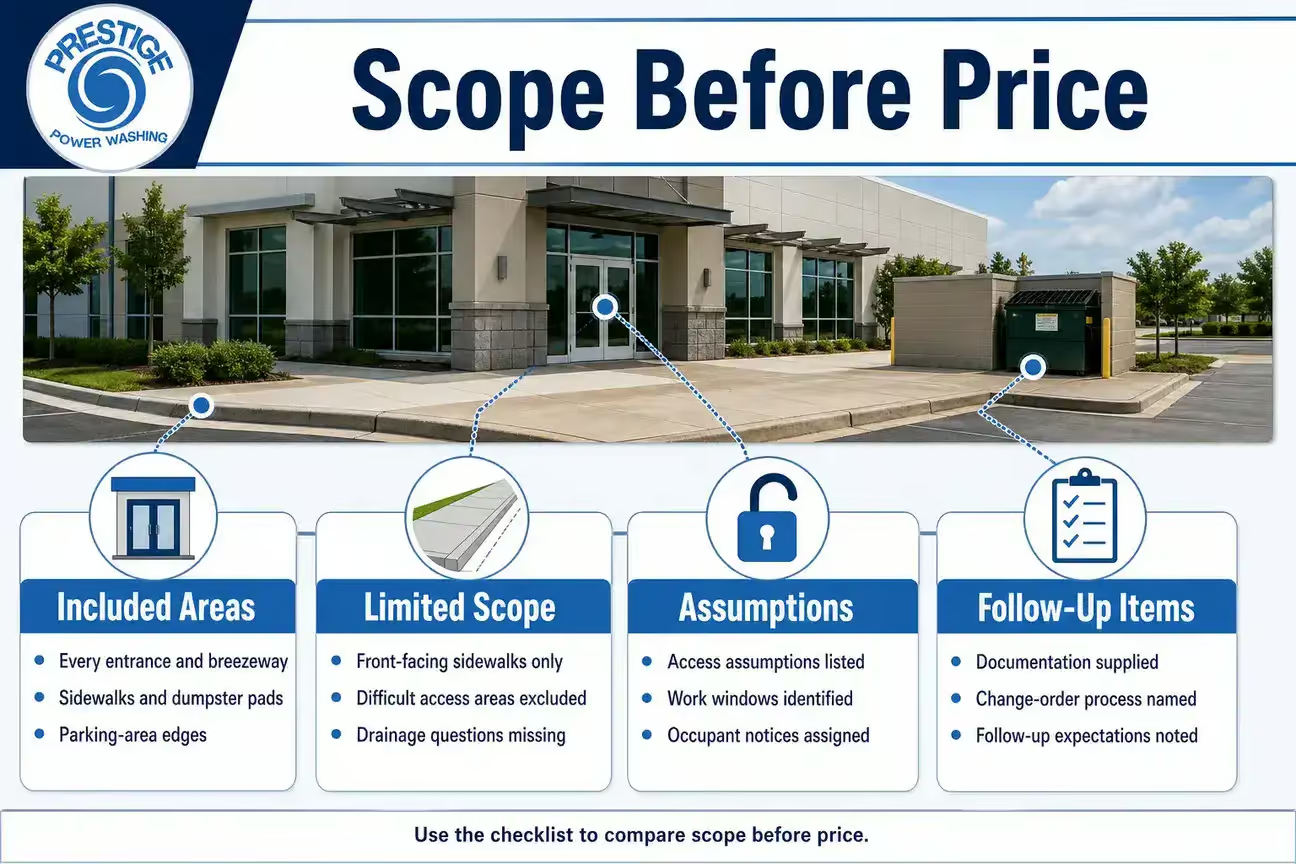
Price matters, but a headline number is only meaningful when the scope is comparable. One estimate may include every entrance, breezeway, sidewalk, dumpster pad, and parking-area edge. Another may include only front-facing sidewalks. A third may exclude drainage questions, tenant coordination, and difficult access areas. Those differences can make a lower number less informative.
Use the property manager checklist as a side-by-side comparison worksheet. Create columns for each vendor and rows for included areas, excluded areas, surfaces identified, known staining, access assumptions, work windows, occupant notices, drainage assumptions, documentation supplied, change-order process, and follow-up contact.
Ask whether recurring service is being proposed and, if so, what each visit includes. A recurring proposal should not be compared to a one-time proposal unless the service frequency, included areas, and limitations are clear. Do not assume that every visit includes roof areas, dumpster pads, breezeways, or all parking surfaces unless the commercial cleaning proposal says so.
A vendor scope of work can also reveal what remains unresolved. If one vendor asks detailed drainage and access questions while another does not, that does not automatically make one proposal better or worse. It does give the property manager a clearer list of issues to resolve before approval.
If your team is ready to discuss a Cary-area commercial exterior cleaning project, you can contact Prestige Power Washing with the property details you have gathered. Service availability should be confirmed for the specific property, surface, location, and requested scope.
Documentation that supports a clear vendor scope of work
Documentation does not need to be complicated. It needs to make the vendor scope of work reviewable. Ask for a written scope, a property map or marked-up site plan when useful, a surface-by-surface work list, areas excluded from the proposal, access assumptions, scheduling assumptions, occupant-notification responsibilities, drainage assumptions, and service-specific limitations.
Photos can be helpful when they show existing conditions, staining, damaged surfaces, restricted areas, drainage features, or tenant-sensitive zones. They should not be used to promise a particular before-and-after outcome. Instead, they help everyone understand what was visible before the proposal was prepared.
Your commercial cleaning proposal file can also include internal procurement requirements. Some properties may require documents from vendors before work begins, based on their own management policies, owner requirements, or tenant rules. This guide does not assume that any specific document is universally required or that Prestige Power Washing LLC holds any unverified credential. Ask for whatever your property policy requires and confirm directly before approval.
Include a change-order procedure. Commercial sites often change between estimate and service: a gate fails, a tenant adds a restriction, an outdoor dining area expands, a new drain is discovered, or a previously hidden stain appears after movable items are relocated. The proposal should say how revisions are handled and who approves them.
Track follow-up after the estimate request
The estimate process is part of the comparison. Record the date the request was submitted, who acknowledged it, whether a site visit was proposed or completed, what questions the vendor asked, what information was missing, and whether the proposal identifies surfaces and exclusions. This is where a property manager checklist becomes a working procurement record instead of a one-time note.
After receiving a proposal, send clarifying questions in writing. Ask what remains outside scope, how drainage assumptions were made, whether tenant notices are the property’s responsibility, and how revisions will be handled. Good pressure washing questions are specific: “Does this include the rear dumpster pad?” is better than “Is everything included?”
If you request a proposal from Prestige Power Washing LLC, use the approved request a free estimate page or the contact us page. Do not assume instant scheduling or a particular booking flow; provide as much property information as you can so the team can respond to the scope you are actually considering.
What commercial exterior cleaning does not include
This section is intentionally direct because exclusions protect both the property manager and the vendor. Commercial exterior cleaning is not a blanket substitute for every maintenance trade, inspection, repair, or compliance task. A commercial cleaning proposal should say what is not included before work begins.
- Roof cleaning is not roof repair, roof replacement, leak diagnosis, or manufacturer warranty service.
- Concrete and asphalt cleaning may help remove visible buildup and improve appearance, but stain outcomes depend on surface condition, stain age, depth, prior coatings, and access.
- Building and breezeway cleaning does not automatically include every adjacent surface, balcony, window, ceiling, fixture, or interior area unless the proposal says so.
- Dumpster-pad cleaning does not include waste hauling, pest control, plumbing, or indoor janitorial work.
- Hood-vent cleaning should not be treated as NFPA 96-compliant, code-certified, inspection-ready, or insurer-approved without current, job-specific verification.
- Hydro-jetting drainage cleaning, when separately discussed, should not be treated as licensed plumbing, sewer-line repair, camera inspection, municipal drainage work, or emergency service without current verification.
- Exterior cleaning does not include painting, structural repair, hazardous-material remediation, or repair of damaged, loose, deteriorated, or unstable materials.
These limits do not make a proposal weaker. They make it clearer. A careful vendor scope of work helps owners, boards, tenants, and managers understand what will be cleaned, what will not be cleaned, and what must be handled by another qualified party.
Closing checklist for Cary-area decision-makers
Before requesting or approving exterior-cleaning proposals, confirm that your commercial vendor checklist includes property inventory, surface identification, access details, occupant coordination, drainage and wash-water questions, written exclusions, supporting documentation, and follow-up notes. If you manage a property in Cary, Raleigh, or another verified Triangle service area, keep the focus on the specific site rather than assumptions based on property type alone.
Prestige Power Washing LLC is a family-owned and locally operated exterior-cleaning business based in Cary, North Carolina, founded in February 2017. The company provides residential and commercial pressure washing, power washing, and soft washing for Cary, Raleigh, and other verified Triangle-area service areas, with the cleaning method matched to the surface. For a pain-free service conversation, gather the details above, confirm service availability for your property and requested scope, and request a written proposal that can be compared fairly.
Frequently Asked Questions
What should a commercial pressure-washing proposal include?
It should identify the property areas and surfaces included, proposed work scope, exclusions, access assumptions, scheduling considerations, occupant coordination, drainage assumptions, and the process for handling changes. A written proposal is easier to compare when it separates buildings, sidewalks, parking areas, breezeways, roofs, and dumpster pads instead of grouping everything into one vague line.
Should a property manager provide a site plan before requesting an estimate?
A site plan can help vendors identify buildings, walkways, parking areas, drainage features, entrances, and restricted areas. It is useful, but it should not be treated as universally required. A marked-up aerial image, photos, or a simple property map may also help explain the requested scope.
What questions should be asked about storm drains?
Ask whether nearby inlets connect to a stormwater system, where wash water will go, how entry into storm drains will be addressed, whether collection or other controls are anticipated, and whether local requirements need to be confirmed. The property manager should document any site-specific drainage restrictions before approving work.
Is commercial pressure washing the same for concrete, asphalt, roofs, and siding?
No. A proposal should identify the material and condition of each surface because different surfaces may require different cleaning approaches and limitations. Concrete, asphalt, roof coverings, siding, painted surfaces, wood, brick, and metal should not all be treated as one uniform surface.
Should tenants and residents be notified before exterior cleaning?
Often, notification is operationally useful when work affects parking, entrances, walkways, patios, balconies, mail areas, storefronts, or business access. The property manager and vendor should decide who sends notices, how much lead time is appropriate, and who approves field changes.
Does dumpster-pad cleaning include waste removal?
Not automatically. For Prestige Power Washing LLC, dumpster-pad power washing is an exterior-cleaning service and does not include waste hauling, pest control, plumbing, or indoor janitorial work. Those tasks should be handled separately if the property needs them.
Does hood-vent cleaning automatically include NFPA 96 compliance or inspection certification?
No such claim should be assumed. A property or restaurant operator should separately verify the vendor’s current scope, documentation, credentials, and any requirements imposed by the authority having jurisdiction, insurer, or property policy before approving commercial kitchen exhaust-related work.
Can a vendor guarantee complete stain or organic-growth removal?
A proposal should avoid absolute promises. Results can depend on the material, age and depth of staining, prior coatings, deterioration, drainage, access, and other site conditions. Ask the vendor to describe limitations in writing before work begins.