
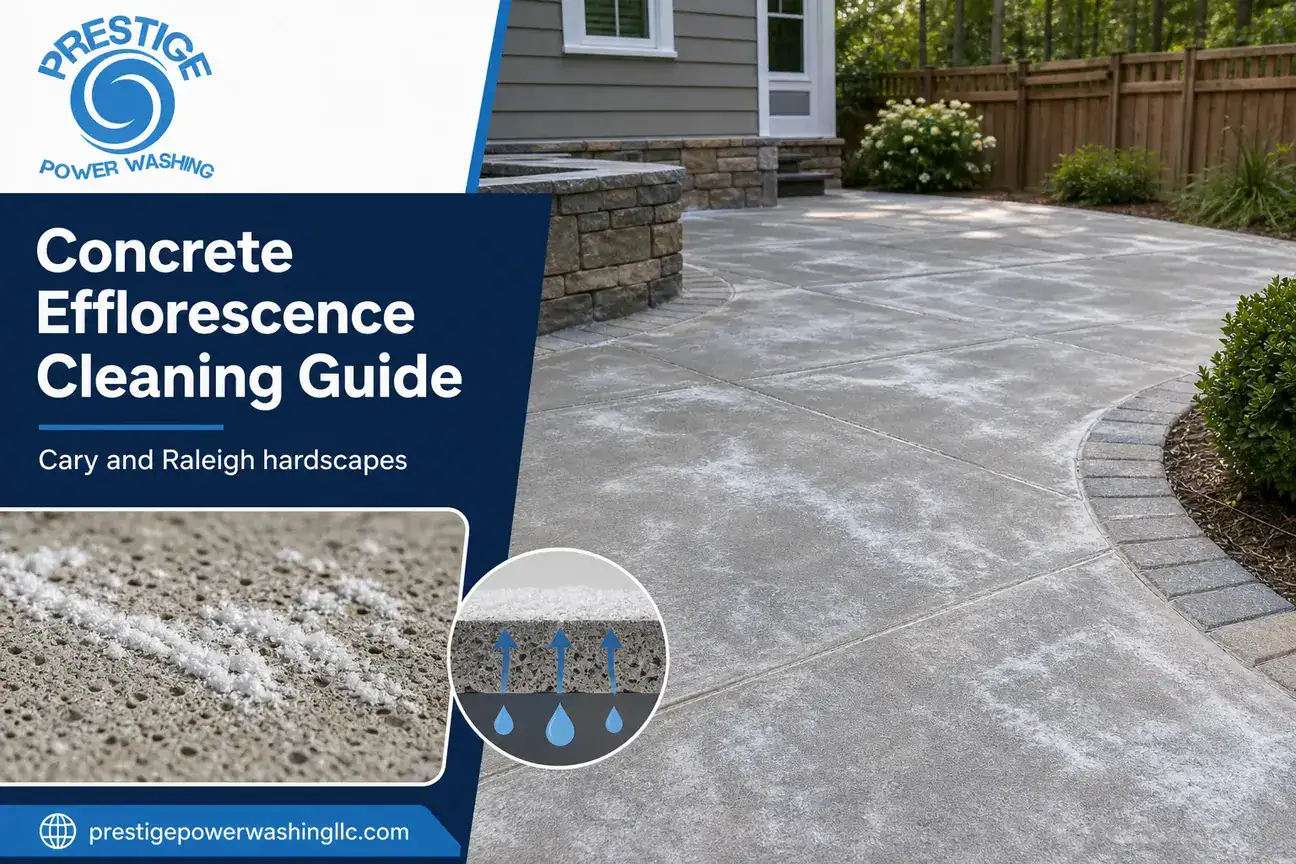
Efflorescence Cleaning Cary and Raleigh: 7 Essential Clues to Avoid Risk
If you are researching efflorescence cleaning Cary options because a driveway, patio, brick wall, or paver area has developed a white powdery film, start with a careful surface assessment. Efflorescence is one possible explanation, but not every pale deposit is the same.
Quick answer: white powder on concrete, brick, or pavers is often a salt-like deposit left after moisture moves through or across a porous surface and evaporates. Before choosing a cleaning method, look at the material, moisture pattern, recent construction history, drainage, irrigation, surface condition, and whether the deposit keeps returning.
For homeowners, HOAs, and property managers in Cary, Raleigh, and nearby Triangle communities, the practical question is not just “Can this be cleaned?” It is “What is causing the deposit, and is cleaning the right next step?” Prestige Power Washing LLC provides surface-specific exterior cleaning for residential and commercial properties, including driveway, patio, and hardscape cleaning conversations. If you are unsure what you are seeing, you can request a free estimate for a project-specific conversation without assuming the issue is simple surface dirt.
The seven clues below are material type, deposit texture, moisture pattern, recent construction, drainage and irrigation, surface condition, and recurrence after cleaning. Together, those clues help separate routine exterior cleaning questions from issues that may need a mason, installer, drainage professional, or other qualified specialist.
Efflorescence cleaning Cary: start with the source-backed basics
The National Park Service defines efflorescence in masonry as a crystalline deposit of soluble salts that can appear when water moves through masonry and evaporates at the surface. That source-backed definition matters because it explains why a white film is not always just “dirt” and why the same mark may return if moisture movement continues. See the NPS Masonry Deterioration: A Glossary for the technical foundation behind this article’s efflorescence discussion.
That definition also sets an important boundary. Exterior cleaning may help remove or reduce visible deposits when the surface is sound and the residue is compatible with the cleaning method. Cleaning does not, by itself, correct drainage, repair masonry, replace mortar, redesign paver installation, or stop moisture moving through the material.
This is why a practical assessment should come before any aggressive cleaning plan. A pale film on a driveway could be loose salt residue, hard-water spotting, construction residue, previous cleaner residue, ordinary dust, or a mixture of conditions. A white haze on pavers may involve joint materials, moisture movement, irrigation, or installation details. A light-colored stain below a wall may suggest water is traveling through or behind masonry.
Prestige Power Washing LLC is based in Cary and serves Cary, Raleigh, and verified Triangle-area communities as an on-site exterior cleaning business. Cary is the company’s published address of record; Raleigh and other Triangle communities are service areas, not branch locations. For a specific property, service availability and the appropriate cleaning approach should be confirmed before work is scheduled.
White powder concrete: Clue 1 is the material type
The phrase white powder concrete usually describes a pale film, haze, dust, crust, or chalky-looking residue on a porous hard surface. Concrete, brick, block, stone, manufactured pavers, and mortar joints can each react differently to moisture, pressure, brushing, and cleaning products. The first clue is therefore simple: identify the affected material before choosing a method.
On concrete, a powdery deposit may sit on the surface, collect near cracks, appear along edges, or show up where water evaporates. On pavers, residue may follow joints or collect around low spots. On brick or stone, deposits may appear near mortar joints, wall bases, caps, steps, or sheltered areas. The same white appearance does not prove the same cause across all materials.
For a homeowner, white powder concrete may be a driveway, front walkway, patio edge, or pool-deck approach. For a commercial property manager, it may be a sidewalk, breezeway, storefront pad, or dumpster-pad approach. For an HOA, it may be a shared paver area, mail-kiosk pad, entry feature, or retaining wall. The setting changes the questions that should be asked.
A sound broom-finished driveway may allow a different cleaning conversation than a deteriorated brick wall, a newly installed paver patio, or a stone surface with unknown previous treatments. Historic masonry and deteriorated materials call for extra caution. Even on modern properties, material condition matters more than a one-size-fits-all cleaning label.
When someone describes white powder concrete, the words usually describe appearance, not a confirmed cause. A surface can look powdery because residue is sitting on top, because moisture carried minerals outward, or because a previous product left a film. Material identification is the first step toward deciding whether exterior cleaning is reasonable or whether another professional should evaluate the condition first.
White stains pavers: Clue 2 is deposit texture and pattern
White stains pavers are especially frustrating because paver installations include individual units, joints, bedding material, edges, and drainage details. A paver surface may show a scattered haze, pale joint lines, crusty borders, or cloudy patches where water repeatedly evaporates.
Texture gives useful clues. Loose powder that brushes away easily suggests a different condition than a bonded crust, etched surface, sticky film, or stain that appears embedded. A powdery haze may be a surface deposit. A hard crust may require more caution. A film that appeared after a sealer or previous cleaning product may not be ordinary efflorescence.
Pattern is just as important. White stains pavers near joints may suggest moisture movement through joint sand or bedding materials. Deposits near sprinklers may point to irrigation minerals. A pale edge near a low spot may relate to water collecting and evaporating. A cloudy surface after recent installation may need input from the installer before cleaning is attempted.
Concrete and brick can show similar pattern clues. A white tide line near the bottom of a wall may suggest moisture traveling upward or outward. A powdery area near a control joint, crack, or edge may suggest a moisture pathway. A broad haze on a patio may be more consistent with surface residue, irrigation spotting, or previous product use.
When a property owner says white stains pavers, the key question is not only “What cleaner removes this?” It is “Where is the deposit strongest, and what does that pattern say about water movement, recent work, or product history?” That question helps keep the cleaning plan realistic.
Mineral deposits concrete: Clue 3 is the moisture path
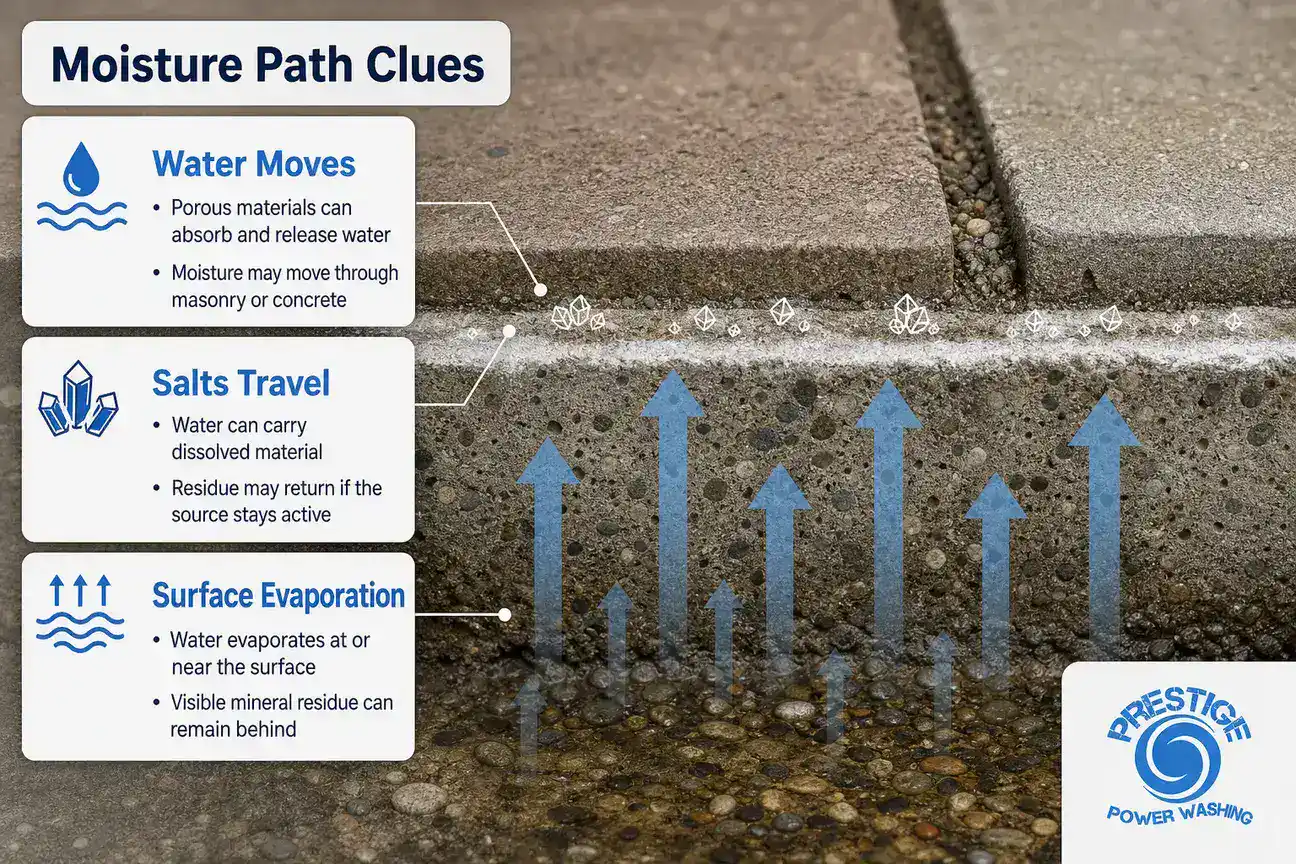
Mineral deposits concrete often point back to one key idea: moisture moves. Porous materials can absorb water, release water, and carry dissolved material with that movement. When water evaporates at or near the surface, visible residue may remain.
The National Park Service’s moisture-management guidance explains that unwanted moisture in buildings and masonry can move in multiple ways and that controlling moisture sources is central to preservation. For exterior hardscapes and masonry, that same broad principle helps explain why visible deposits may return when the moisture source remains active. The NPS Preservation Brief 39: Holding the Line is a useful technical source for understanding moisture-management concerns.
Possible contributors include ground moisture, irrigation overspray, sprinkler patterns, downspout discharge, grading that sends water toward a slab or wall, open joints, cracks, retained moisture behind masonry, or moisture introduced during recent work. These are assessment possibilities, not automatic conclusions from a photo.
For homeowners, mineral deposits concrete may show up after wet weather, seasonal humidity, or a change in irrigation patterns. In HOAs and commercial properties, similar residue may appear along shaded walkways, low-lying breezeways, curb lines, or hardscapes near planting beds. A pattern that follows water movement is often more informative than the color alone.
Moisture also affects expectations. Exterior cleaning may help remove or reduce visible deposits on a suitable surface, but it does not redesign drainage, repair masonry, replace joints, correct installation details, or stop groundwater movement. If the source is below, behind, or inside the material, cleaning addresses what can be seen at the surface.
For a mineral deposits concrete concern, look for downspouts, irrigation heads, low spots, damp soil, wall bases, cracks, and joints before assuming the visible surface is the only issue. If the same area repeatedly turns pale after rain or watering, cleaning may improve what can be seen while the source remains active.
Efflorescence removal: Clue 4 is recent construction or repair
Efflorescence removal should be understood as visible deposit reduction, not a promise that the underlying cause is gone. Recent construction, paver installation, repointing, patching, mortar work, or concrete placement can all change how a surface behaves.
The National Park Service’s Preservation Brief 2 on repointing mortar joints emphasizes the importance of appropriate mortar work and careful treatment of masonry joints. For this article, the practical takeaway is simple: if white deposits appear after repointing, masonry repair, new pavers, or other recent work, the installer or mason may need to advise before cleaning proceeds.
A newly installed paver area with white haze may involve the pavers, joint material, bedding conditions, drainage, or installation process. A brick wall with deposits after repointing may need a masonry-focused evaluation. A driveway or patio that was recently poured, patched, coated, or cleaned may also require caution before another cleaning method is used.
For a residential driveway, driveway pressure washing may be appropriate when the surface condition supports it and the deposit is not tied to a repair issue. For patios, paver areas, and outdoor living spaces, patio pressure washing may be considered after looking at surface type, joint condition, and drainage. The decision should follow the assessment, not replace it.
In commercial and HOA settings, efflorescence removal should also be discussed alongside operations. A property manager may need to coordinate resident notices, tenant access, pedestrian routing, and vendor timing. Apartment communities may need to consider breezeways, stair landings, mail areas, pool-deck approaches, and common-area walkways.
The fourth clue is therefore timing. A white deposit that appeared after new work should not be treated the same way as an older recurring moisture pattern. If warranties, installer instructions, or material guidance may apply, pause before cleaning and confirm the right next step.
White powder concrete and cleaning limits: Clue 5 is drainage and irrigation
Drainage and irrigation often explain why a white deposit appears in one place but not another. Sprinklers, downspouts, low spots, planter beds, retaining-wall backs, and shaded corners can all influence where water sits, evaporates, or moves through a surface.
Water-based cleaning deserves care because adding water to a moisture-related condition may not solve the underlying issue. NPS Preservation Brief 1 on cleaning and water-repellent treatments cautions that cleaning methods should be selected carefully for the masonry material and condition. That guidance supports a measured approach instead of assuming more water, more pressure, or a stronger chemical is always better.
For white powder concrete near irrigation overspray, the issue may be water repeatedly carrying or leaving minerals on the surface. For white stains pavers near a low edge, the issue may be water collecting below or between units. For mineral deposits concrete near a downspout or wall base, the visible residue may be the final sign of a moisture path that starts elsewhere.
Runoff planning also matters. Exterior cleaning can involve water, loosened soil, residue, and cleaning products. Property owners, HOAs, and commercial managers should ask how runoff will be handled for the specific site, especially near storm drains, curb inlets, ponds, landscaped areas, parking lots, and common walkways.
The North Carolina DEQ stormwater technical guidance page, listed in the Sources section, is useful background for understanding that stormwater concerns can be site-specific. This article does not claim that any contractor has a documented compliance program for a given property. It simply encourages property owners to ask practical site questions before work begins.
Useful runoff and moisture questions include:
- Where will wash water naturally flow from this surface?
- Are storm drains, curb inlets, ponds, or landscaped areas nearby?
- Are residues, previous chemicals, oils, or construction materials present?
- Is irrigation overspray hitting the same area repeatedly?
- Do downspouts or grading send water toward the slab, wall, or pavers?
- Does the property have site rules, tenant requirements, or HOA expectations?
Drainage and irrigation are the fifth clue because they affect both cleaning decisions and recurrence. If water continues to feed the same area, the deposit may return after cleaning.
Mineral deposits concrete and surface condition: Clue 6 is material distress
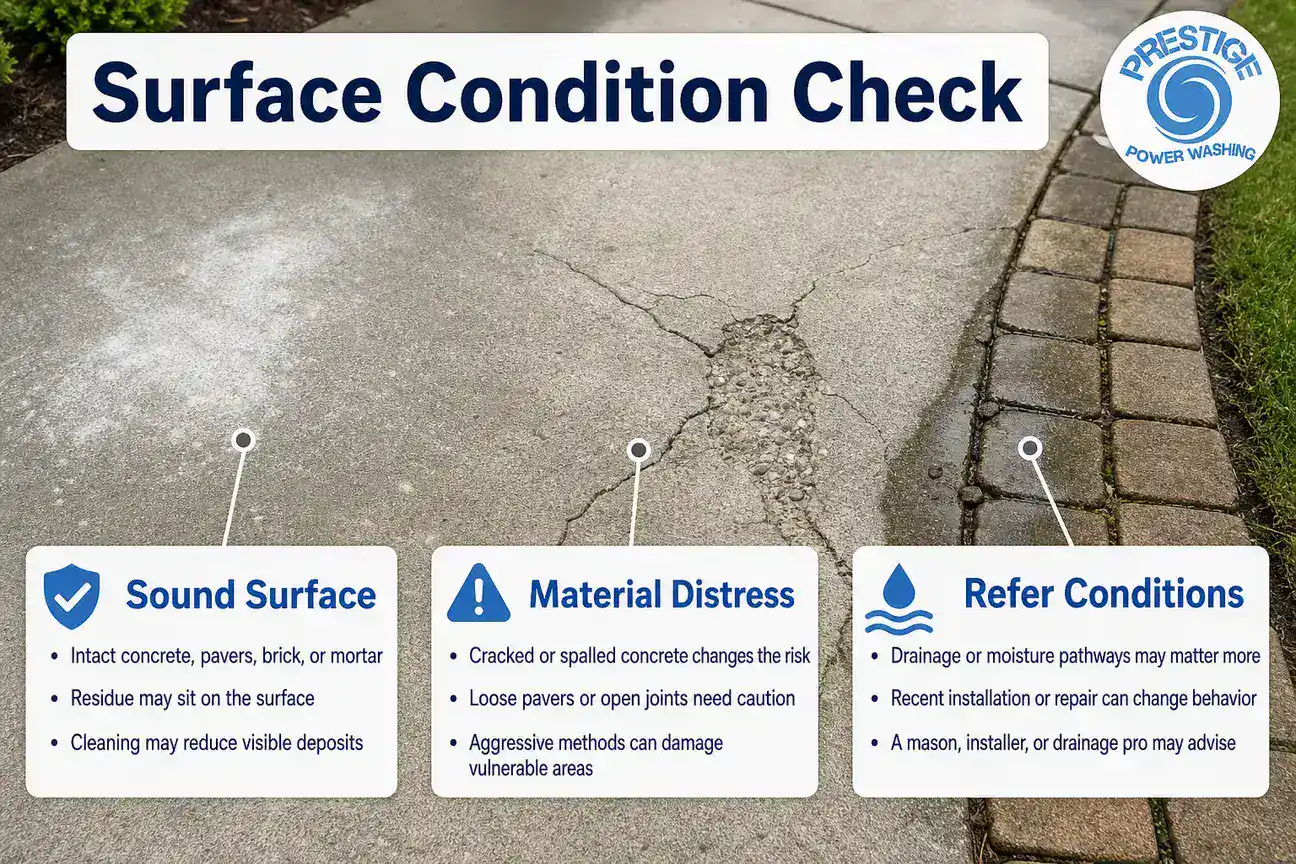
Surface condition changes the cleaning conversation. Sound concrete, intact pavers, stable brick, and healthy mortar joints are different from cracked concrete, spalled surfaces, loose pavers, open joints, deteriorated brick, or failing mortar.
The NPS Preservation Brief 6 on abrasive cleaning dangers cautions that aggressive cleaning can damage historic building materials. While many Cary and Raleigh-area driveways and patios are not historic buildings, the source-backed principle still applies: aggressive methods can create avoidable risk when the material is vulnerable.
For mineral deposits concrete, the underlying moisture pathway may matter more than the immediate cleaning product. More pressure, stronger chemicals, or repeated wet cleaning is not automatically more professional. Some surfaces tolerate cleaning well; others need a cautious approach or a referral before cleaning begins.
Chemical history is part of surface condition. If a white film appeared after a previous cleaner, sealer, coating, or maintenance product, the issue may not be ordinary efflorescence. If white stains pavers appeared after product use, surface compatibility and manufacturer guidance become especially important.
This is also where muriatic acid deserves clear language. The NPS masonry deterioration glossary states that hydrochloric or muriatic acid is “generally ineffective” for efflorescence, “should not be used,” and “may liberate additional salts.” That is stronger than a casual “use caution” warning. Property owners should not improvise with muriatic acid for efflorescence; product labels, manufacturer guidance, and qualified trade advice matter.
Prestige Power Washing LLC’s surface-specific approach is built around matching the method to the material and visible condition. For larger properties, relevant exterior cleaning conversations may include commercial pressure washing or building and breezeway cleaning, but the surface condition should still guide what is appropriate.
The sixth clue is material distress. Efflorescence removal planning should change when concrete is spalled, pavers are loose, brick is deteriorated, or mortar joints are failing. Cleaning a sound surface is different from cleaning a surface already showing visible damage.
Concrete cleaning Cary: Clue 7 is recurrence after cleaning
Concrete cleaning Cary searches often start with a simple photo: a white patch on a driveway, a cloudy patio, or a chalky paver border. A surface assessment adds context that a photo may miss. It can identify the affected material, observe whether the deposit appears loose or bonded, check nearby water sources, and flag conditions that may need another professional.
Recurrence is one of the strongest clues. A one-time haze after construction is different from a deposit that comes back in the same place after rain, irrigation, or each cleaning. Recurring mineral deposits concrete should prompt questions about moisture movement instead of repeated cleaning alone.
For homeowners, concrete cleaning Cary conversations may focus on driveways, front walks, patios, pool-deck approaches, and retaining-wall areas. For commercial decision-makers, the discussion may include storefront sidewalks, breezeways, building approaches, dumpster-pad access routes, and parking-lot edges. For HOAs, it may include shared walkways, paver common areas, amenity spaces, and entry features.
A useful assessment does not promise a perfect outcome. Instead, it helps answer practical questions:
- Does the deposit appear to be superficial, recurring, or connected to moisture movement?
- Is the surface sound enough for the proposed cleaning method?
- Are there signs that a mason, installer, or drainage professional should evaluate first?
- What nearby surfaces, plants, drains, doors, or tenant areas require planning?
- What visible improvement is realistic without calling the work repair or permanent prevention?
For a concrete cleaning Cary request, helpful photos can show the whole area, the closest water source, the edge or joint pattern, and a close view of the residue. Photos do not replace an assessment, but they can make the first conversation more productive and can help identify when cleaning may be only part of the next step.
Prestige Power Washing LLC is family-owned and locally operated, with a published Cary address of record and service across Cary, Raleigh, and verified Triangle-area communities. The company was founded in 2017 and provides on-site exterior cleaning; other communities are service areas, not branch offices. If you are considering exterior cleaning for a home, HOA, or commercial property, confirm the property details and service fit before assuming a method.
Efflorescence versus other white deposits
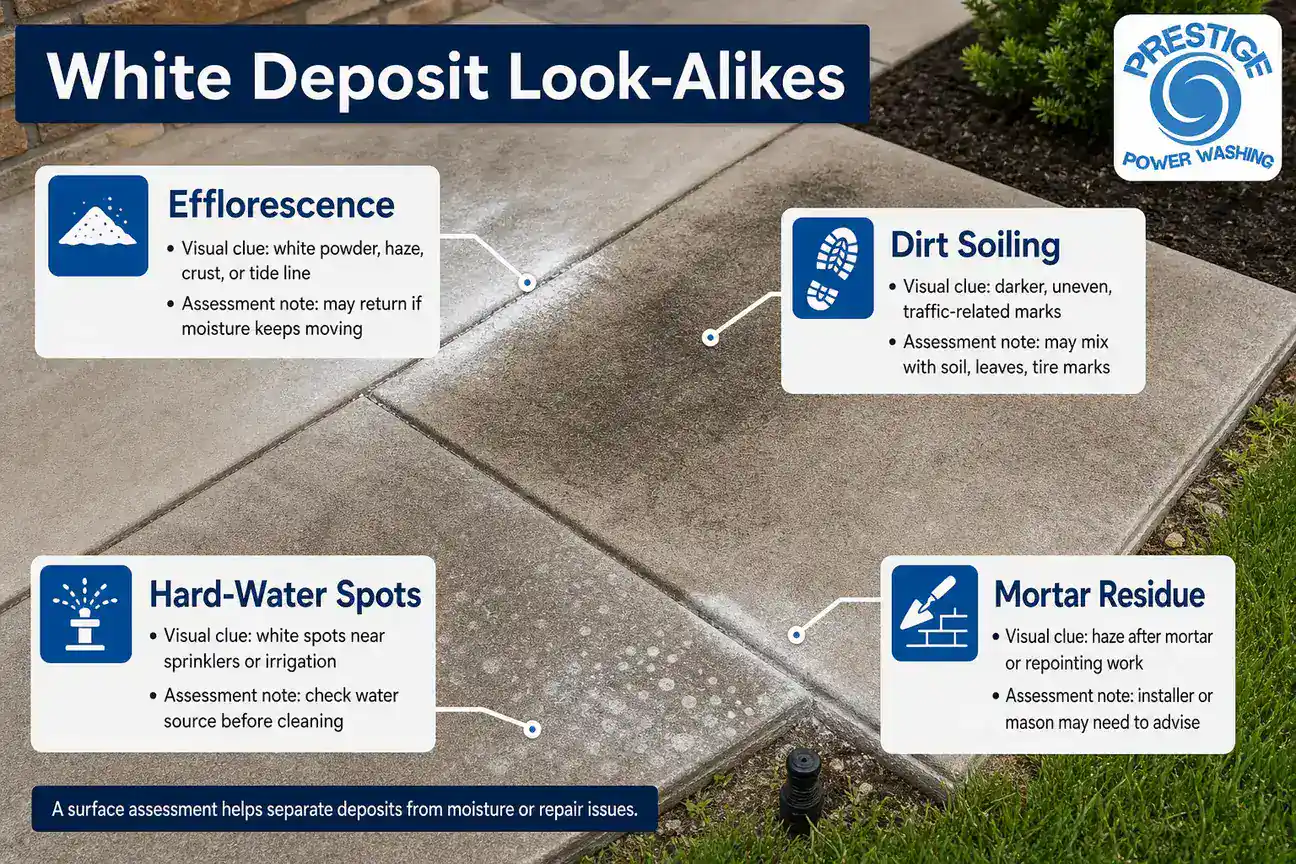
A useful assessment compares the deposit against several look-alike conditions. This table is not a substitute for a qualified inspection, but it can help homeowners and property managers ask better questions before authorizing work.
| Possible condition | Clues that may support it | Why assessment still matters |
|---|---|---|
| Efflorescence | White or pale powder, haze, crust, or tide-line appearance; often near moisture pathways; may brush away when loose | The visible deposit may return if moisture and soluble material keep moving through the surface |
| Dirt or general soiling | Darker, uneven, traffic-related, or mixed with soil, leaves, tire marks, pollen, or organic debris | Cleaning may improve appearance, but it should still be matched to the surface and condition |
| Biological growth | May appear green, gray, black, fuzzy, blotchy, or associated with damp shade | Color and texture are not definitive, and exterior cleaning should not be described as a health or disinfection service |
| Hard-water spotting | Mineral rings, drip marks, or spotting near sprinklers, hose bibs, irrigation overspray, fountains, or runoff paths | The deposit may be surface-applied rather than coming from within the concrete, brick, or pavers |
| Mortar residue or construction bloom | Appears after installation, repointing, repair work, or new masonry construction | The mason or installer may need to advise before cleaning, especially if warranties or fresh materials are involved |
| Chemical residue | Film, streaks, discoloration, or deposits after previous cleaning, treatment, or product use | Improvised follow-up cleaning can worsen appearance if the residue and material are not understood |
For white stains pavers, the table is especially helpful because pavers may have multiple contributors at once. A shaded paver walkway could have organic growth, irrigation minerals, and moisture-related white residue in the same area. A commercial sidewalk could show general soil, gum shadows, hard-water spotting, and pale residue around joints.
A good surface assessment looks at where the residue appears, whether it is loose or bonded, what material is affected, what has changed recently, and whether water is present. It also considers whether the property has drainage concerns, recent construction, or recurring dampness.
What exterior cleaning does not include
For this topic, scope limits matter. Exterior cleaning is not masonry repair, paver installation correction, waterproofing, drainage design, engineering, or structural diagnosis. It does not establish code compliance, inspection passage, warranty approval, or permanent prevention. It also should not be presented as complete removal of every white deposit on every surface.
Exterior cleaning may improve the look of suitable concrete, pavers, brick, or commercial hardscapes when the deposit and surface condition support cleaning. It may also reveal that more evaluation is needed. For example, if a cleaned area quickly develops the same deposit again, the recurrence may point to moisture movement, drainage, irrigation, construction details, or material conditions that cleaning alone cannot resolve.
The same caution applies to environmental language. A contractor should be able to discuss runoff awareness and site planning, but property owners should avoid assuming that any cleaning method is automatically appropriate for every site, every drain, or every discharge path. Ask questions that are specific to your property and the proposed work.
If your property in Cary, Raleigh, or a nearby Triangle service area has recurring white deposits, the next step is a practical conversation about the surface, the pattern, and the scope. You can contact Prestige Power Washing or call 919-520-4521 to discuss the project. No cleaning contractor should need to promise permanent results to help you make a better maintenance decision.
Planning a realistic next step
White deposits on concrete, brick, and pavers can be simple, stubborn, or connected to a larger moisture issue. The most useful approach is to identify the surface, compare likely causes, evaluate water movement, and decide whether cleaning is appropriate before work begins.
For some properties, a careful cleaning plan can improve visible appearance and help remove loose residue. For others, the better first call may be a mason, installer, drainage professional, or maintenance specialist. In many cases, the right plan involves clear expectations: what can be cleaned, what should be monitored, and what falls outside exterior cleaning.
When you are comparing options for efflorescence cleaning Cary properties, look for plainspoken answers rather than one-size-fits-all promises. Ask about the surface, the suspected deposit, runoff considerations, and the signs that would call for referral. That approach gives homeowners, HOAs, and commercial decision-makers a more grounded path than chasing the strongest cleaner or assuming every white mark has the same cause.
Frequently Asked Questions
Is white powder on concrete always efflorescence?
No. Efflorescence is one possible cause, but dirt, hard-water deposits, mortar residue, biological growth, and chemical residue can appear similar. The material, location, timing, moisture pattern, and recent work should be considered together before choosing a cleaning approach.
Can pressure washing remove efflorescence?
Exterior cleaning may improve visible deposits when they are superficial and compatible with the surface, but complete or permanent removal should not be promised. If moisture continues moving through the concrete, brick, or pavers, the deposit may recur.
Does efflorescence mean the concrete or brick is damaged?
Not necessarily. A visible deposit does not by itself establish structural or material damage. Cracking, spalling, loose mortar, displaced pavers, persistent dampness, or recurring deposits warrant evaluation by a qualified mason, installer, or other appropriate specialist.
Should muriatic acid be used on efflorescence?
No. National Park Service guidance says hydrochloric or muriatic acid is “generally ineffective,” “should not be used,” and “may liberate additional salts.” Property owners should avoid improvised chemical treatments and follow product labels, manufacturer guidance, or qualified trade advice.
Why does efflorescence return after cleaning?
Recurring white deposits often point to ongoing moisture movement. Cleaning may remove or reduce what is visible at the surface, but it may not correct drainage, irrigation overspray, ground moisture, cracks, joints, or water trapped behind or beneath the material.
Should a mason inspect recurring white deposits?
A mason or installer is appropriate when deposits follow recent construction or repointing, or when the surface has deteriorating joints, cracks, spalling, or displaced units. A drainage professional may be more appropriate when grading, downspouts, irrigation, or standing water appears involved.
Is efflorescence cleaning appropriate for an HOA or commercial property?
It may be appropriate after the surface and deposit are assessed. Property managers should also consider resident or tenant access, pedestrian routing, runoff handling, recent construction warranties, and whether the issue requires repair or drainage work rather than cleaning alone.
Sources
- National Park Service — Masonry Deterioration: A Glossary
- National Park Service — Preservation Brief 1: Assessing Cleaning and Water-Repellent Treatments for Historic Masonry Buildings
- National Park Service — Preservation Brief 2: Repointing Mortar Joints in Historic Masonry Buildings
- National Park Service — Preservation Brief 6: Dangers of Abrasive Cleaning to Historic Buildings
- National Park Service — Preservation Brief 39: Holding the Line: Controlling Unwanted Moisture in Historic Buildings
- North Carolina DEQ — NPDES Industrial Stormwater Technical Guidance