
Roof Moss Removal: 7 Risks to Avoid on Asphalt Shingles
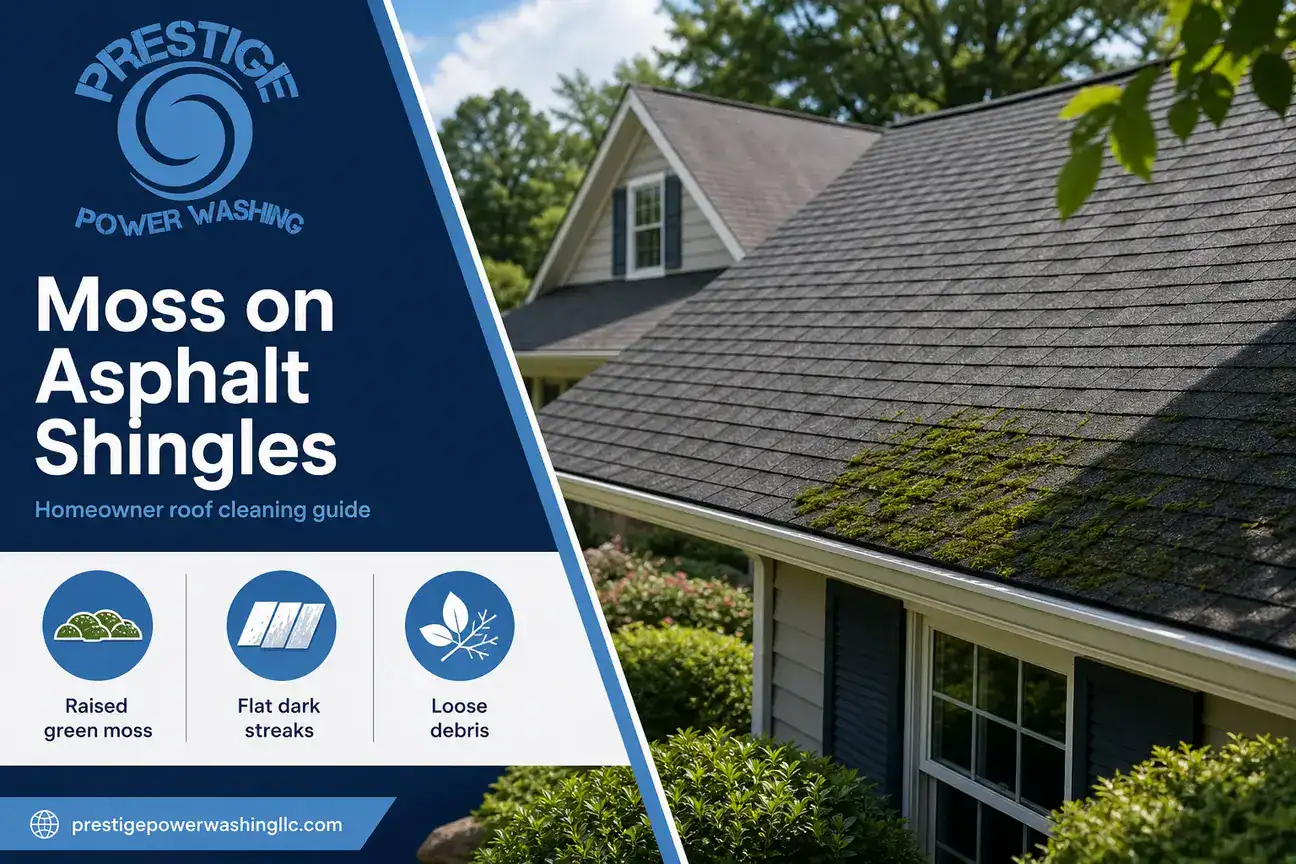
Roof moss removal starts with one important question: are you looking at raised moss, flat algae streaking, loose dirt and debris, or a roof condition that needs a roofer? Moss on asphalt shingles usually looks textured and three-dimensional, while algae often appears as dark streaks or discoloration. Homeowners in Cary, Raleigh, and nearby Triangle communities should avoid pressure washing, scraping, or aggressive brushing because those actions can harm shingles. The right next step is a surface-specific assessment that respects the shingle manufacturer’s guidance and separates cleaning from repair.
Quick Answer
Moss is typically raised, green, and plant-like. Algae is usually flatter and darker, while dirt, leaves, and pine needles sit on the surface without forming a living mat. If shingles are missing, cracked, curled, lifted, or leaking, call a roofer before scheduling cleaning. If the shingles appear intact and the concern is surface growth, Prestige Power Washing LLC can discuss roof cleaning and roof soft washing options for the property without treating cleaning as roof repair.
Roof moss removal starts with correct identification
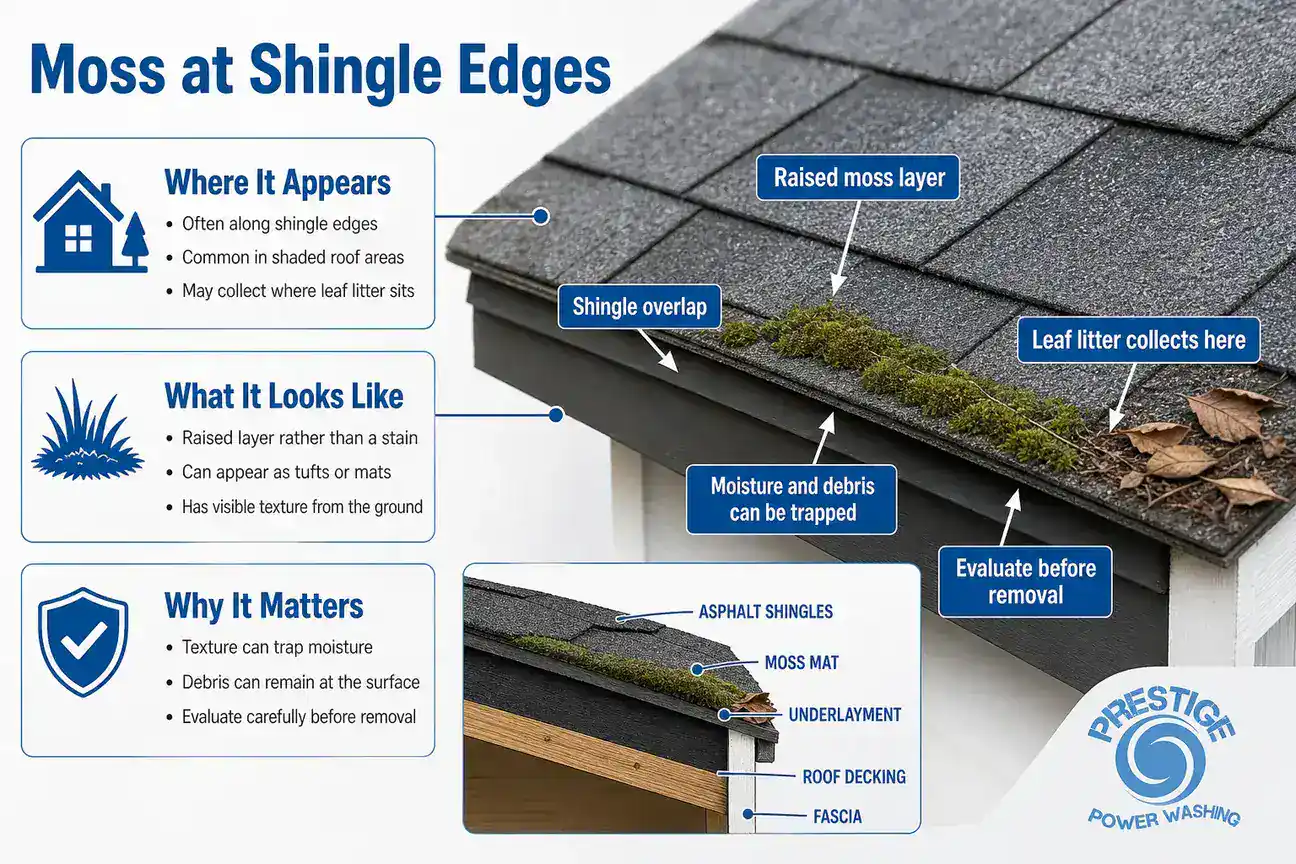
From the ground, several roof conditions can look similar. A shaded roof plane may show dark streaks, green patches, brown organic deposits, or uneven shingle color. The difference matters because roof moss cleaning, algae cleaning, debris removal, and roofing repair are not the same decision.
Moss on shingles usually looks like a raised layer rather than a stain. It may appear in tufts, clumps, or mats, especially along shingle edges, in shaded areas, or where leaf litter collects. Because moss has texture, it can trap moisture and debris at the surface. That does not automatically mean the roof is failing, but it does mean the roof should be evaluated carefully before anyone tries to remove it.
Algae is different. It often appears as dark, diffuse staining or vertical streaking. The Asphalt Roofing Manufacturers Association explains that algae discoloration can be difficult to remove and that cleaning may only lighten the discoloration rather than erase every visual trace; ARMA also states that high-pressure washing systems are likely to damage asphalt roofing and should not be used. That guidance is especially important when a homeowner is unsure whether the visible issue is algae, dirt, or asphalt roof moss.
Dirt and organic debris are usually loose surface materials. Leaves, pine needles, small branches, pollen, and dust may sit on the roof without attaching as a living mat. Debris can still hold moisture against the shingles, so it should be handled with care, but it should not be confused with moss roof damage or structural deterioration.
Possible roof damage is another category altogether. Missing shingles, cracked shingles, curled or lifted edges, exposed underlayment, damaged flashing, sagging roof planes, blocked or overflowing gutters, or water stains inside the home are not cleaning issues first. Those signs call for roofing evaluation before roof moss cleaning is considered.
How moss on shingles differs from algae, dirt, and possible damage
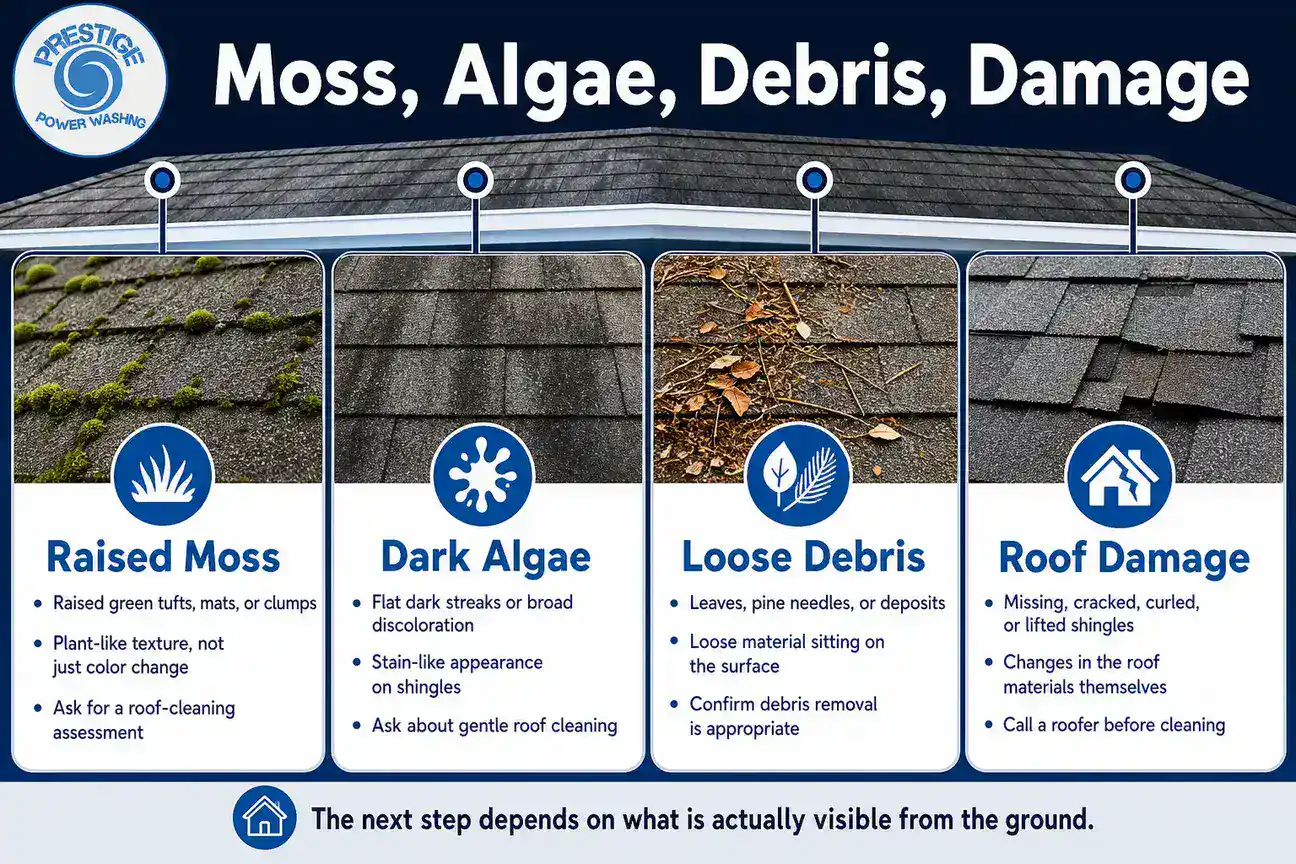
The simplest way to think about moss on shingles is to look for height, texture, and attachment. Moss is not just a color change. It has a raised, plant-like appearance. Algae is usually a stain-like discoloration. Dirt and debris can often be recognized as loose material. Damage shows up as changes in the roof materials themselves.
| What you see | What it may indicate | What to do next |
|---|---|---|
| Raised green tufts, mats, or clumps | Possible moss on shingles | Ask for a roof-cleaning assessment and manufacturer-aware method discussion |
| Flat dark streaks or broad discoloration | Possible algae staining | Ask about gentle roof cleaning and realistic lightening expectations |
| Leaves, pine needles, or loose deposits | Organic debris or dirt | Remove using non-abrasive, down-slope methods when appropriate |
| Missing, cracked, curled, lifted, or displaced shingles | Possible roofing condition | Consult a roofer before cleaning |
| Interior water stains, sagging, or exposed roof materials | Possible leak or structural concern | Prioritize roofing evaluation |
Photos can help start a conversation, but they cannot prove the roof’s age, remaining serviceability, leak status, or warranty position. A cleaning provider can point out visible concerns, but a cleaning visit should not be presented as a substitute for roofing repair, roof replacement, or manufacturer warranty service.
For Cary homeowners, this distinction is practical. A roof surrounded by mature trees may show a mix of algae, debris, and moss in the same area. A shaded roof slope in Raleigh or Apex may dry more slowly than a sunnier slope. Those observations can guide the conversation, but they should not become a diagnosis without an appropriate inspection.
Why asphalt roof moss often shows up in shaded roof areas
Asphalt roof moss is often associated with conditions that allow organic material and moisture to remain on the roof surface. Shade, nearby trees, leaf accumulation, limited airflow, and clogged or slow-draining gutters can all contribute to a roof staying damp longer after rain or heavy dew. These are common property conditions, not proof by themselves that a roof is defective.
The Asphalt Roofing Manufacturers Association’s guidance on algae, moss, and debris points homeowners toward prevention basics such as reducing debris, improving roof drying conditions where possible, and keeping gutters clear. ARMA advises homeowners and contractors to consult the shingle manufacturer for moss effects and removal recommendations, rather than assuming one product or method is appropriate for every asphalt shingle roof.
That last point is important. Asphalt roof moss may be visible, but the correct response depends on the roof material, roof condition, shingle manufacturer, access, surrounding landscaping, drainage, and whether any shingles appear fragile or displaced. A thick moss mat near shingle edges is a different situation from light surface discoloration on an otherwise intact slope.
Overhanging branches can also change the roof environment. Trimming branches may improve sunlight and airflow in some settings, but tree work should be handled safely and separately from roof cleaning. Cleaning may help remove visible growth, but it does not change every surrounding condition that allowed growth to develop.
When roof growth is a cleaning question and when it is a roofing question
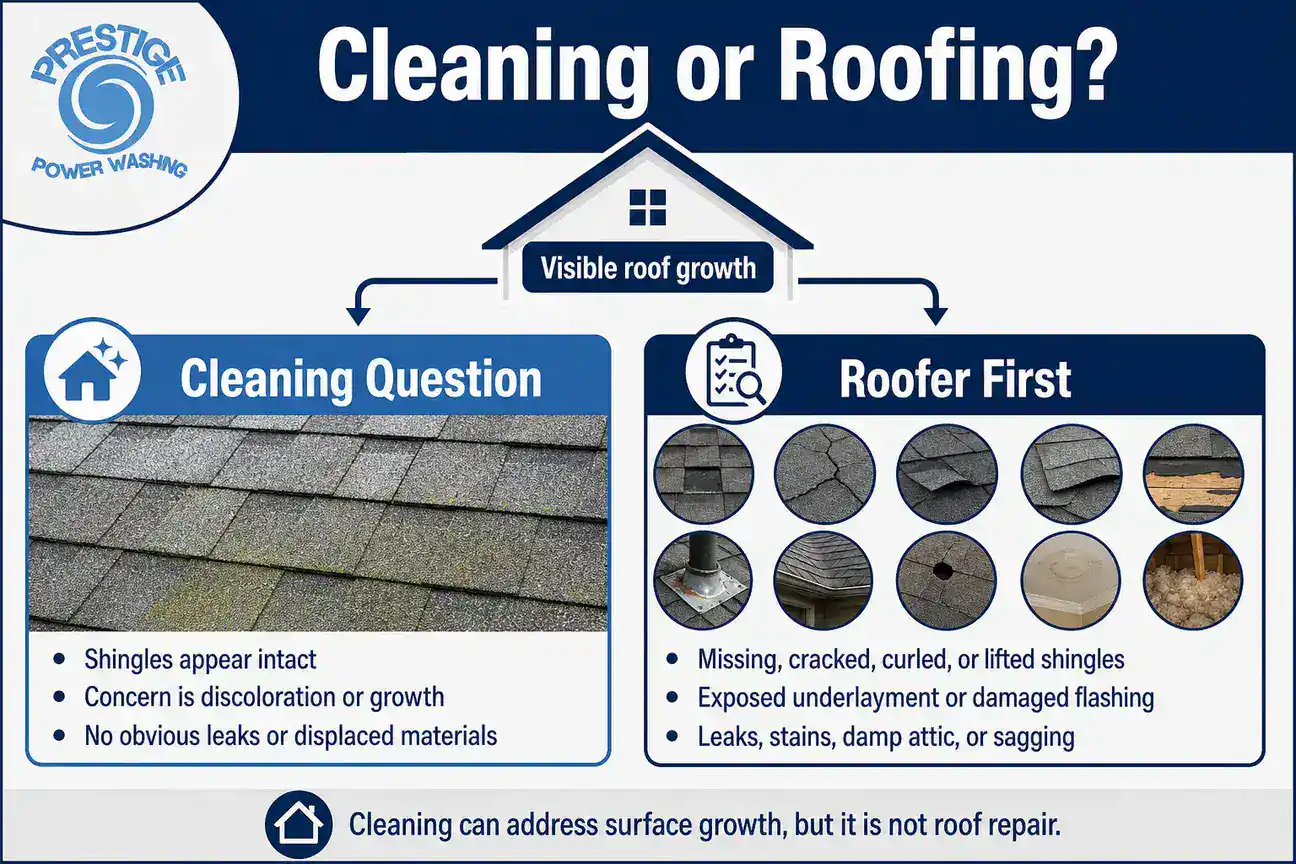
A surface-growth issue is more likely to be a cleaning question when the shingles appear intact, the concern is limited to visible discoloration or growth, and there are no obvious signs of leaks or displaced materials. In those cases, a homeowner may reasonably ask about a surface-specific cleaning method and what results are realistic.
Roofing evaluation should come first when there are missing shingles, cracked shingles, curled edges, lifted tabs, exposed underlayment, damaged flashing, sagging roof planes, visible holes, recurring ceiling stains, damp attic materials, or active leaks. Moss roof damage can also be a concern when growth appears to have lifted shingle edges or when the roof surface looks brittle or fragile.
Cleaning does not repair shingles, flashing, underlayment, decking, or roof structure. It also does not establish that a roof is leak-free or that a manufacturer warranty remains available. If a homeowner is already worried about replacement, warranty coverage, or active water entry, a roofer should be part of the conversation before any roof moss cleaning is scheduled.
Prestige Power Washing LLC provides exterior cleaning services, including roof cleaning and roof soft washing, in its Cary and Raleigh service area. The company is based in Cary, and other Triangle communities are service areas rather than branch offices. If you are outside Cary or Raleigh, confirm availability for your specific property and service before making plans.
Why pressure washing, scraping, and aggressive brushing can harm shingles
Asphalt shingles are not a hard, pressure-washable surface like some concrete areas. Their outer surface includes protective granules. Aggressive water pressure, scrubbing, scraping, or brushing can loosen granules, disturb shingle edges, or worsen an already fragile roof surface. That is why a homeowner should be cautious about any quote that treats asphalt shingles like a driveway or patio.
ARMA’s current algae guidance says high-pressure washing systems are likely to damage asphalt roofing and should not be used. Its revised guidance also states: “DO NOT use a power washer or any type of brush or broom to clean algae from the roof surface.” While that quoted instruction addresses algae cleaning, the same practical concern applies when someone proposes forceful removal for moss on shingles.
Scraping deserves special caution. Scraping is tempting because asphalt roof moss can look like something that should be peeled away. But scraping can remove granules, tear or lift shingles, disturb seal strips, and expose weak spots that were already developing. The more aged, steep, brittle, or moss-covered the roof is, the more important it becomes to avoid forcing material off the shingles.
Walking on a roof can also create risk. Foot traffic may disturb shingles, especially on steep, wet, brittle, or already damaged surfaces. A professional assessment should consider access and roof pitch instead of assuming the technician can simply walk across the shingles and scrub the surface.
Soft washing is different from pressure washing because it generally uses lower pressure and a solution-based approach. However, the word “soft” is not enough by itself. The method still needs to match the roof material, manufacturer guidance, roof condition, surrounding surfaces, runoff plan, and realistic expectations.
What manufacturer-directed roof moss cleaning guidance means
Manufacturer-directed roof moss cleaning means the roof-cleaning method should be checked against the shingle manufacturer’s current instructions, not copied from a generic internet recipe. Different shingle products, warranty terms, and manufacturer bulletins may contain different requirements. A homeowner does not need to become a roofing technical expert, but it helps to ask the right questions.
Start by identifying the roof material and, if possible, the shingle manufacturer. If you have closing documents, installation records, warranty paperwork, or an invoice from a prior roof replacement, those documents may help. If you do not have them, a roofer may be better positioned to identify product details than a cleaning provider working only from ground-level photos.
Next, ask whether the proposed products and application method are consistent with manufacturer guidance. Avoid universal mixing recipes, fixed dwell-time instructions, or “works on every roof” claims. The responsible question is not whether a solution sounds strong; it is whether the method is appropriate for the specific asphalt shingle system and the roof’s current condition.
For algae discoloration, ARMA notes that cleaning effectiveness is temporary and discoloration may recur. In its wording, “The effectiveness of such cleaning is only temporary, and the discoloration may recur.” Homeowners should apply that same realistic mindset to moss: cleaning can improve appearance and reduce visible growth, but it should not be sold as permanent prevention or as a way to reverse underlying roof aging.
It is also reasonable to ask about ordinary handling precautions for cleaning products and surrounding surfaces. That does not mean a provider should promise universal plant safety, pet safety, surface safety, or environmental compliance. It means the provider should be able to discuss planning, protection, rinsing, and runoff in a practical, property-specific way.
What a professional assessment should consider before roof moss cleaning
A useful roof moss cleaning assessment looks at more than the green growth. It considers what the roof is made of, how the growth is attached, whether the shingles are intact, how water will move off the roof, and what areas around the home could be affected during the work.
Before recommending a method, a provider should consider:
- The apparent shingle type and any available manufacturer information.
- Visible roof condition, including missing, cracked, curled, lifted, or fragile shingles.
- The thickness and location of moss on shingles.
- Whether the issue appears to be moss, algae, dirt, debris, or a mix.
- Roof pitch, access, and whether direct roof contact is appropriate.
- Gutters, downspouts, splash areas, and where rinse water may travel.
- Nearby plants, siding, windows, patios, decks, and neighboring property.
- Whether a roofer should inspect before cleaning.
This is where surface-specific cleaning matters. Prestige Power Washing LLC describes its work in terms of matching the method to the surface, whether that is roof soft washing, a full detail house wash, or other exterior cleaning services. Roof work should be treated with the same kind of surface-specific thinking.
A homeowner should also be wary of any provider who diagnoses roof replacement from a quick photo or promises that cleaning will solve a leak. A cleaning assessment can identify visible concerns and recommend pausing for roofing evaluation, but it is not roofing repair.
Runoff planning for homes, HOAs, and commercial roofs
Runoff planning is part of responsible exterior cleaning. Roof work can involve water moving through gutters, downspouts, landscaping, mulch beds, siding, windows, walkways, driveways, neighboring surfaces, and storm-drain areas. The plan should be specific to the property, not a generic promise that runoff is harmless.
North Carolina DEQ’s pressure-washing technical guidance states that vehicle pressure-washing wash water is wastewater and that discharge through storm drains is not authorized by an NPDES stormwater permit. While that page is not a roof-cleaning procedure, the wastewater principle is relevant enough that homeowners should ask practical questions about where wash water will go; NC DEQ’s technical guidance on pressure-washing wash water is a useful starting point for understanding why storm drains matter.
The EPA’s NPDES stormwater program also explains the broader federal framework for stormwater permitting and water-quality protection. Homeowners do not need to interpret permits themselves for a roof-cleaning estimate, but they should expect a provider to discuss gutters, downspouts, landscaped areas, and storm-drain paths in plain language.
For HOAs, apartment communities, retail centers, offices, and other managed properties, runoff planning also intersects with scheduling and communication. Property managers may need to think about resident notices, parking areas, entry points, sidewalks, tenant expectations, and how visible work areas will be managed. Prestige Power Washing LLC offers commercial roof cleaning, but commercial cleaning should not be described as code compliance, inspection certification, or a substitute for roofing evaluation.
Results, recurrence, and moss roof damage expectations
Homeowners often ask whether moss roof damage has already occurred or whether cleaning will stop future growth. The honest answer is condition-dependent. Moss alone does not prove that the roof needs replacement. At the same time, moss that appears to lift or displace shingle edges deserves careful evaluation before cleaning.
Roof cleaning may improve appearance and help remove visible growth. It may also reveal shingle conditions that were hidden by moss or debris. That does not mean every stain, shadow, or discoloration will disappear, and it does not mean the roof has been restored to a newer condition.
Recurrence is also realistic. Shade, moisture, leaf litter, nearby trees, limited airflow, and gutter issues can continue to support organic growth. If those conditions remain, moss or algae can return. ARMA’s algae guidance is clear that cleaning effectiveness is temporary and discoloration may recur, so homeowners should be cautious about any promise of permanent prevention.
Maintenance can help manage conditions, but it should be non-abrasive and practical. Keeping gutters clear, addressing overhanging branches where appropriate, and removing debris in a way that does not scrape or brush shingles can all be part of a maintenance conversation. For gutter-related roof-edge concerns, homeowners can also review Prestige Power Washing LLC’s exterior gutter cleaning service.
It is equally important to remember what cleaning does not do. It does not repair curled shingles, reseal lifted tabs, replace missing materials, fix flashing, stop an active leak, or verify that decking and underlayment are sound. If you are trying to determine whether moss roof damage requires repair, a roofer should evaluate the roof.
7 essential risks to avoid before hiring a provider
Before hiring anyone for roof moss removal, use the conversation to identify risk. A good provider should welcome clear questions because they help define whether the project is a cleaning job, a roofing issue, or a situation where both professionals may be needed.
1. Avoid treating every dark roof mark as moss
Dark streaks may be algae, not moss. Loose deposits may be debris. Raised growth may be moss on shingles. The proposed method should match what is actually present, and the provider should be comfortable explaining the difference in plain language.
2. Avoid pressure-washing proposals for asphalt shingles
Pressure washing may be appropriate for some exterior surfaces, but asphalt shingles are not a driveway. Ask directly whether the provider avoids power washing, aggressive brushing, and scraping on shingles. If the answer is vague, slow the conversation down.
3. Avoid ignoring the shingle manufacturer
Roof moss cleaning should be discussed in relation to the shingle manufacturer’s current guidance. Ask whether the provider can explain how the proposed method fits the roof material. If nobody knows the manufacturer, ask how that uncertainty will be handled.
4. Avoid assuming cleaning is repair
Cleaning can address surface growth; it does not repair roof materials. If the roof is leaking, sagging, missing shingles, or showing exposed underlayment, the next call should be to a roofer. Cleaning should not be used to delay necessary repair evaluation.
5. Avoid promises of complete removal or permanent prevention
Visible improvement is a reasonable goal, but complete removal and permanent prevention should not be promised. Asphalt roof moss and algae can recur when shade, moisture, debris, and airflow conditions remain. Ask what results are realistic for your roof condition.
6. Avoid vague runoff answers
Ask where water will go, what areas will be rinsed or protected, and how gutters, downspouts, plants, siding, windows, and nearby surfaces will be considered. A practical plan is better than a blanket claim that runoff cannot affect any surface or surrounding area.
7. Avoid skipping service-area confirmation
Prestige Power Washing LLC is based in Cary and serves Cary, Raleigh, and verified Triangle-area communities as service areas, not branch locations. If your property is outside the core Cary/Raleigh area or involves a larger commercial roof, confirm availability and service scope for that specific address.
When to call a roofer before scheduling cleaning
A roofer should be involved first when you see active leaks, recurring interior water stains, damp insulation, sagging roof planes, missing shingles, displaced shingles, exposed underlayment, visible holes, damaged flashing, or substantial granule loss. A roofer should also be consulted when the roof is old, brittle, steep, difficult to access, or under warranty questions.
Call a roofer first if moss appears to have lifted shingle edges or if you can see shingles curling around a moss mat. In that situation, cleaning may still be discussed later, but repair evaluation comes first. Removing growth from an already compromised area may reveal more damage, and a cleaning company should not represent that as repair.
For homeowners preparing for a sale, insurance conversation, or roof replacement decision, keep documentation separate. A roof-cleaning estimate is not the same as a roofing inspection report. If the decision depends on roof condition, remaining serviceability, or warranty position, use the appropriate roofing professional.
How Prestige Power Washing LLC can help with a surface-specific conversation
Prestige Power Washing LLC is a family-owned and locally operated exterior-cleaning business based in Cary, North Carolina. The company was founded in February 2017 and provides pressure washing, power washing, and soft washing services for residential and commercial properties in Cary, Raleigh, and other verified Triangle-area service communities.
For asphalt shingle roofs, the conversation should focus on the appropriate method for the surface, visible roof condition, manufacturer guidance, realistic outcomes, and whether roofing evaluation is needed first. Prestige Power Washing LLC offers roof cleaning and roof soft washing, but roof cleaning is not roofing repair, replacement, warranty service, or structural evaluation.
If you are unsure whether you are seeing algae, dirt, or moss on shingles, you can request a free estimate to start a property-specific discussion. The estimate request should not be treated as instant scheduling or a confirmed appointment time. It is simply a practical next step for reviewing the visible condition and discussing a surface-specific approach.
Homeowners comparing roof cleaning with other exterior maintenance can also review exterior cleaning services to understand how different surfaces call for different cleaning methods. A concrete driveway, vinyl siding, wood fence, gutter exterior, and asphalt shingle roof should not all be approached the same way.
Final thoughts for Cary homeowners
Roof moss removal is not about forcing growth off shingles as quickly as possible. It is about identifying what is on the roof, understanding whether the shingles appear intact, following manufacturer-aware guidance, planning runoff, and knowing when a roofer should evaluate the roof before cleaning.
If the issue is surface growth on an otherwise intact roof, roof moss cleaning may be part of a sensible maintenance conversation. If the issue includes leaks, missing materials, lifted shingles, exposed underlayment, sagging, or warranty concerns, roofing evaluation should come first. Clear communication at the beginning helps protect expectations and keeps cleaning, repair, and long-term maintenance in their proper lanes.
Frequently Asked Questions
How can I tell whether the growth is moss or algae?
Moss is usually raised, textured, and plant-like. Algae often appears as flat dark streaking or broad discoloration. Dirt and leaves usually sit on the surface without forming a living mat. If shingles look damaged, lifted, cracked, or displaced, a roofing inspection may be needed before cleaning.
Can I pressure-wash moss off asphalt shingles?
No. Asphalt shingles should not be treated like concrete or other hard surfaces. High water pressure can loosen granules, disturb shingle edges, and worsen fragile roof areas. A lower-pressure, manufacturer-aware cleaning discussion is more appropriate for asphalt shingles.
Is scraping moss from shingles safe?
Scraping can remove protective granules, lift shingle edges, or tear materials, especially on aged or brittle roofs. The better question is which method fits the roof material, visible condition, and shingle manufacturer’s current guidance.
Does moss automatically mean I need a new roof?
No. Moss alone does not prove that a roof needs replacement. However, missing shingles, curled edges, lifted tabs, exposed underlayment, sagging, leaks, or damaged flashing should be evaluated by a roofer before roof cleaning is considered.
Will roof cleaning permanently stop moss or algae?
No. Roof cleaning may improve appearance and reduce visible growth, but it should not be presented as permanent prevention. Shade, moisture, debris, nearby trees, limited airflow, and gutter conditions can contribute to recurrence.
Is soft washing the same as pressure washing?
No. Soft washing generally refers to a lower-pressure, solution-based method, while pressure washing relies more heavily on water pressure. The label alone is not enough; the roof material, roof condition, manufacturer guidance, application method, and runoff planning all matter.
What should happen to roof-cleaning runoff?
The provider should discuss where rinse water will travel, including gutters, downspouts, landscaping, siding, windows, storm-drain areas, and neighboring surfaces. Homeowners should ask practical questions about surrounding-area protection and project-specific runoff planning.
Should I hire a roofer or a roof-cleaning provider?
Call a roofer first if there are leaks, missing or displaced shingles, sagging, exposed materials, damaged flashing, substantial granule loss, or warranty concerns. A roof-cleaning provider may be appropriate when the concern is surface growth on shingles that otherwise appear intact.
Sources
- Asphalt Roofing Manufacturers Association, “Algae Discoloration of Roofs”
- Asphalt Roofing Manufacturers Association, “Algae & Moss Prevention and Cleaning for Asphalt Roofing Systems”
- North Carolina Department of Environmental Quality, “Technical Guidance”
- U.S. Environmental Protection Agency, “NPDES Stormwater Program”