
Can You Pressure Wash Asphalt Roof Shingles?
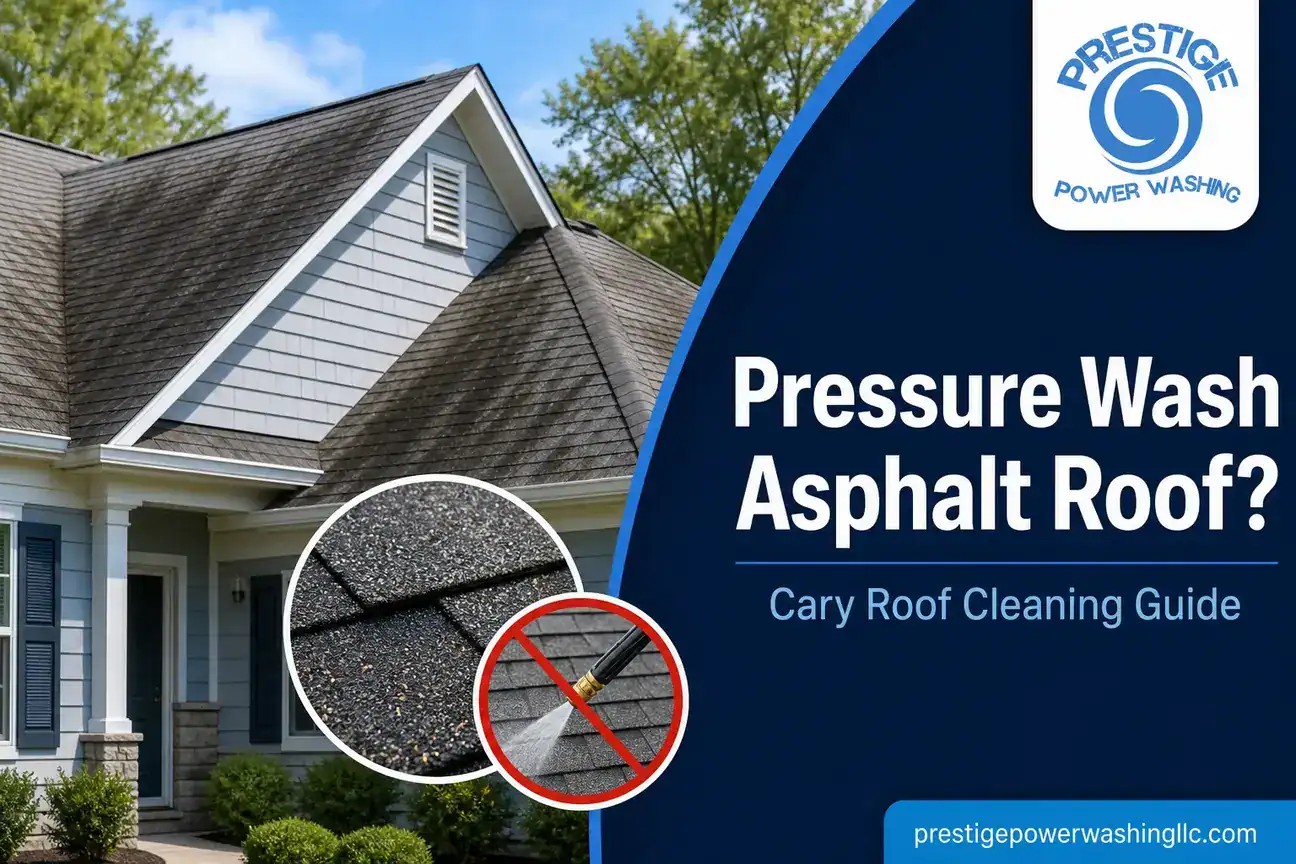
If you are wondering whether to pressure wash asphalt roof stains, the practical answer is no: conventional pressure washing is not recommended for asphalt shingles. Asphalt-shingle roof cleaning is different from washing a driveway, patio, or concrete pad because shingles have layered materials and embedded granules that can be disturbed by force or abrasion. A roof with algae streaks, moss, loose shingles, or visible wear should be evaluated by condition, manufacturer guidance, runoff considerations, and safe access before any cleaning method is selected.
Quick Answer: No—conventional pressure washing is not the right approach for asphalt-shingle roofs. The Asphalt Roofing Manufacturers Association says, “DO NOT use a power washer or any type of brush or broom to clean algae from the roof surface,” in its Algae Discoloration of Roofs guidance. Roof cleaning should be evaluated according to the roof’s condition and the shingle manufacturer’s instructions.
For homeowners in Cary, Raleigh, and nearby Triangle communities, this is a common point of confusion. Prestige Power Washing LLC provides roof cleaning and roof soft washing, but that does not mean a roof should be treated like concrete. If you see dark streaks, moss, or roof discoloration and want a property-specific discussion, you can request a free estimate without choosing a pressure setting or treatment method yourself.
Asphalt shingle cleaning is different from driveway washing
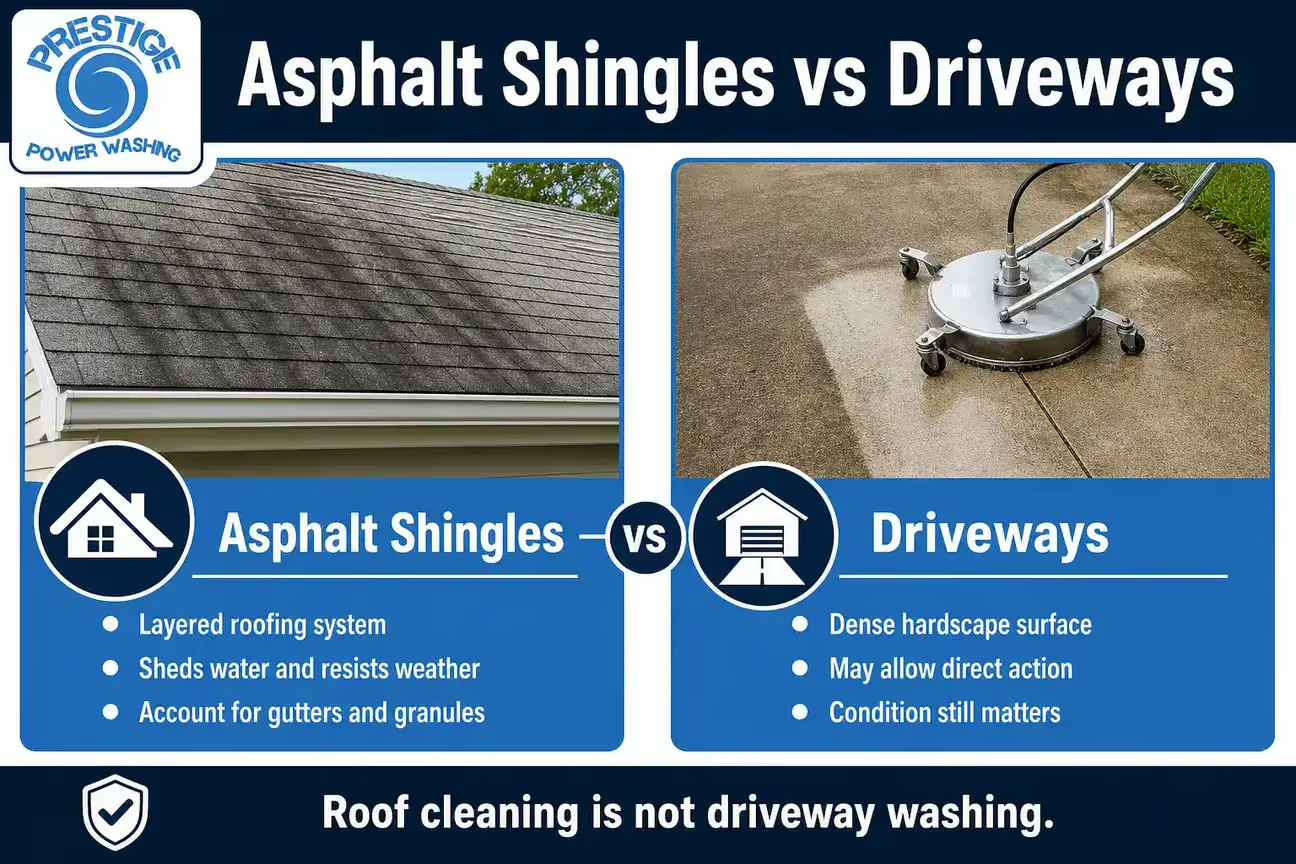
Asphalt shingle cleaning should start with one simple idea: a roof is not a hardscape. Driveways, concrete walkways, some patios, and many commercial pads are dense surfaces that may be cleaned with more direct mechanical action when the surface condition supports it. Asphalt shingles are part of a layered roofing system. Their job is to shed water, resist weather, and remain in place as an overlapping roof covering.
That difference matters because the cleaning objective is not to blast away every visible mark. A roof-cleaning process needs to account for the shingles, granules, surrounding gutters, siding, landscaping, roof pitch, access, and existing wear. Asphalt shingle cleaning is a surface-specific decision, not a stronger version of driveway washing.
When Prestige Power Washing LLC talks about surface-specific cleaning, this is the type of decision that matters. A driveway may be a fit for concrete and asphalt cleaning, while an asphalt-shingle roof calls for a much more careful approach. A stained roof may look dirty from the ground, but the answer is not to treat it like pavement.
| Surface or situation | Cleaning concern | More appropriate direction |
|---|---|---|
| Asphalt-shingle roof with dark streaks | Granules, roof condition, manufacturer instructions, runoff, and roof algae removal expectations | Asphalt shingle cleaning evaluation using a low-impact, manufacturer-compatible approach where suitable |
| Concrete driveway or sidewalk | Surface wear, stains, runoff, nearby landscaping | Surface-specific pressure or power washing when condition supports it |
| Roof with moss, lifted shingles, or visible deterioration | Possible shingle damage, roof defects, or shingle granule loss | Roofing-professional evaluation before cleaning is considered |
| Commercial or multi-unit roof surface | Tenant impact, scheduling, access, roof condition, drainage | Commercial roof-cleaning discussion with clear scope and realistic expectations |
What ARMA says about pressure wash asphalt roof decisions
The strongest technical guidance for this question comes from the Asphalt Roofing Manufacturers Association, often shortened to ARMA. ARMA says not to use a power washer, brush, or broom to clean algae from the roof surface. The same guidance says high-pressure washing systems are likely to damage asphalt roofing and should not be used for algae or other foreign stains.
That wording is important. ARMA does not describe roof pressure washing as a preferred way to make shingles look new. It warns against high pressure and abrasive tools because they can damage asphalt roofing and loosen granules. This is why a homeowner should be cautious when a roof-cleaning conversation sounds like driveway washing moved up onto the roof.
ARMA’s guidance also points homeowners and contractors back to the shingle manufacturer. The manufacturer’s cleaning instructions and warranty-related requirements can vary by product. A roof-cleaning company should not ask you to ignore those instructions, and a homeowner should not rely on a generic online recipe for an unknown roof system.
This does not mean every stained roof needs the same response. It means the decision starts with the roof’s material, condition, and manufacturer guidance—not with a pressure washer. In Cary and Raleigh, where shaded roofs, trees, humidity, and seasonal debris can contribute to roof discoloration, that distinction helps homeowners ask better questions before booking service.
Why roof pressure washing raises shingle granule loss concerns
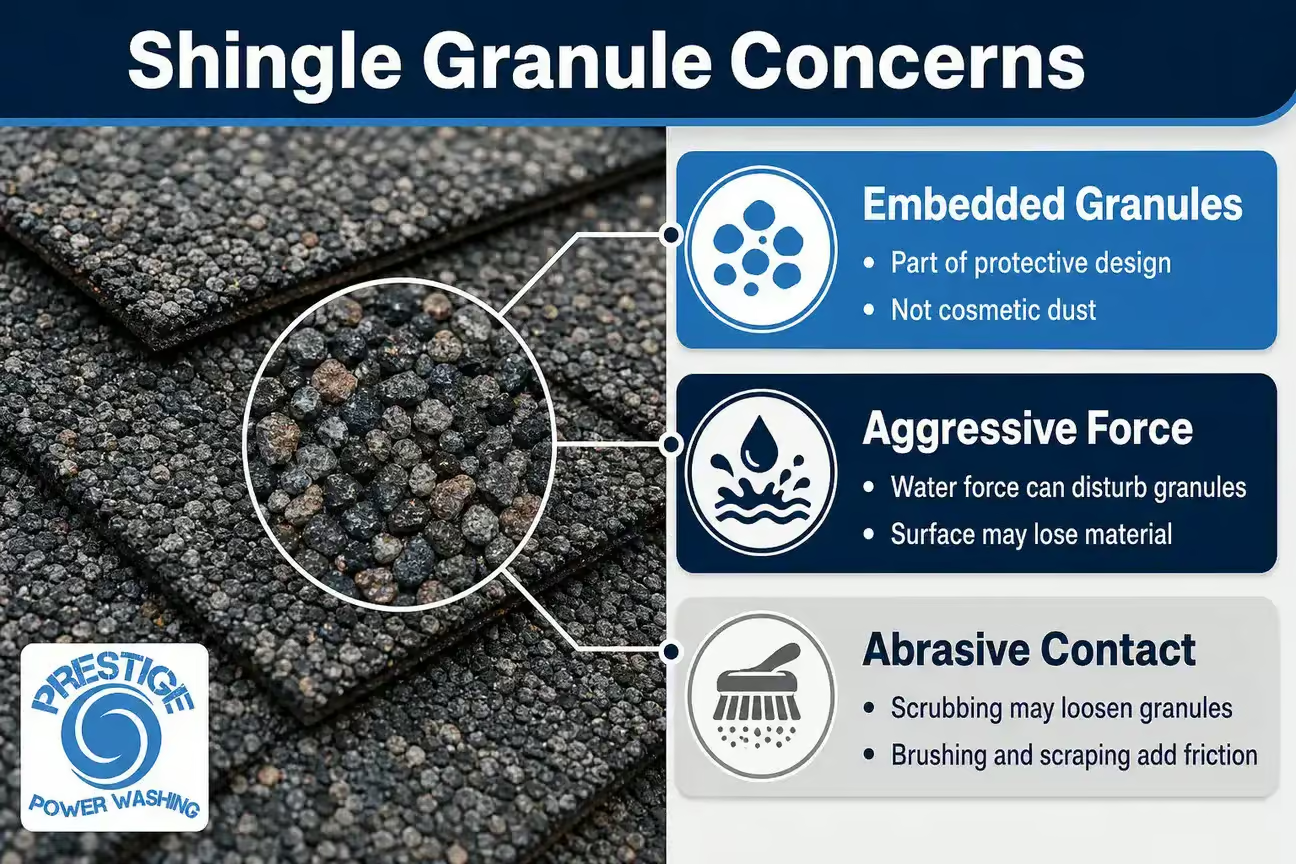
Roof pressure washing is risky for asphalt shingles because shingles rely on their surface granules as part of the roofing material’s protective design. Granules are not cosmetic dust sprinkled on top after installation; they are embedded into the shingle surface. When aggressive water force, scrubbing, brushing, or scraping disturbs those granules, the roof surface can lose material it was intended to keep.
ARMA specifically cautions against scrubbing because friction may loosen and remove granules. That is the heart of the shingle granule loss concern. The issue is not just whether the roof looks cleaner immediately afterward. The concern is what the cleaning action may have removed or disturbed along the way.
At the same time, shingle granule loss can have more than one cause. Granules in gutters or at the ends of downspouts may indicate age, weathering, storm wear, installation factors, or other roof conditions. A homeowner should not automatically blame one cause without a closer look.
If you see a noticeable amount of granules collecting in gutters, or if shingles look bare, brittle, curled, cracked, or loose, a roofing professional may be the right next call before cleaning is considered. Asphalt shingle cleaning should not make existing roof wear harder to evaluate.
Shingle granule loss also helps explain why “just use less pressure” is not a complete answer. The cleaning method still has to account for the roof’s condition, the shingle manufacturer’s instructions, and whether the surface is already fragile. A roof near the end of its expected service life or one with obvious damage may not be a good cleaning candidate at all.
Homeowners can document visible concerns before discussing cleaning. Photos taken safely from the ground can help show whether moss buildup, bare-looking shingles, missing shingles, or visible granules near downspouts are part of the conversation.
Roof algae removal, moss, and discoloration need different expectations
Roof algae removal is one reason homeowners start researching roof cleaning. Dark streaks on asphalt shingles are often associated with algae discoloration, especially on shaded roof sections or areas that stay damp longer. ARMA states that discoloration may be lightened, but homeowners should not expect a promise that every streak will disappear completely or permanently.
That expectation matters. Roof algae removal is not the same thing as replacing old shingles, correcting ventilation issues, fixing flashing, or restoring a roof to a new condition. Cleaning may improve the appearance of stained areas, but algae discoloration can return over time. ARMA has noted that the effectiveness of a cleaning technique may be temporary and discoloration can recur.
Algae discoloration on asphalt shingles
Algae often appears as dark streaking or staining. From the ground, it may look like dirt, soot, or general grime. A homeowner may assume that a more forceful wash will remove it faster. On asphalt roofing, that assumption is the problem.
Roof algae removal should be discussed in terms of realistic appearance improvement. Some discoloration may lighten. Some staining may be persistent. Some roofs may have a mix of algae, weathering, and shingle wear. A responsible conversation should leave room for those condition-dependent outcomes.
Moss growth is a different problem
Moss is not simply a dark stain. It is a physical growth that may hold moisture and sometimes grows along shingle edges, in shaded valleys, or below overhanging trees. The temptation is to scrape or brush it off, but abrasive contact can disturb shingles and granules.
If moss appears to lift shingles, collect in thick mats, or accompany cracked, curled, or missing shingles, cleaning may not be the first step. A roofing professional can evaluate whether the roof has repair concerns before an exterior-cleaning company discusses roof soft washing or other roof-cleaning options.
Lichen and persistent growth should not invite stronger pressure
Some roof growth clings more tightly than algae streaking. That does not make high pressure a better idea. More stubborn growth may call for patience, product-label guidance, manufacturer instructions, or a roofing evaluation—not a more aggressive blast. Complete removal should not be promised because the result depends on the roof condition, the type of growth, and the approved cleaning approach.
When homeowners compare asphalt shingle cleaning options, it helps to separate the stain type from the cleaning method. Roof algae removal, moss concerns, and lichen-like growth may require different expectations even when the same roof surface is involved.
What roof cleaning may involve instead of high pressure
Asphalt shingle cleaning may involve a lower-impact process when the roof condition and manufacturer guidance support cleaning. That process should begin with a look at the roof’s visible condition and nearby surfaces. A contractor should be thinking about shingles, gutters, landscaping, siding, windows, painted surfaces, access, and where rinse water may travel.
ARMA describes gentle application of an appropriate cleaning solution and gentle rinsing with water. Its algae and moss prevention guidance also emphasizes non-abrasive roof care, including attention to debris, gutters, and drainage. The important point for homeowners is not to copy treatment details from an article. The important point is to ask whether the method follows current manufacturer instructions and avoids high-pressure washing, brushing, and scrubbing.
Prestige Power Washing LLC’s roof soft washing service is a roof-cleaning option, not roofing repair, roof replacement, or manufacturer warranty service. The appropriate method for the surface depends on the roof itself. No roof-cleaning process should be described as universally appropriate for every asphalt-shingle roof.
- Condition review: Look for visible issues such as missing shingles, curling, cracking, loose edges, heavy moss, or suspicious staining near roof penetrations.
- Manufacturer guidance: Consider the shingle manufacturer’s cleaning instructions and any warranty-related requirements that may apply to the specific roof.
- Non-abrasive approach: Avoid power washing, brushing, brooming, and scraping that can disturb granules or shingles.
- Gentle rinsing: Rinsing should not be treated as a chance to blast away roof growth with force.
- Surrounding surfaces: Plan for gutters, siding, windows, landscaping, soil, and hardscape near the work area.
If you are comparing service options, ask how the company decides whether a roof is a cleaning candidate. A clear answer is more useful than a promise of a perfect-looking roof. Prestige Power Washing LLC can discuss roof soft washing for homes in Cary, Raleigh, and verified Triangle-area service communities, with the understanding that the roof’s condition guides the conversation.
A careful asphalt shingle cleaning conversation should also explain what will not happen. Roof pressure washing, scraping, and abrasive brushing should not be presented as shortcuts for dark streaks or moss. That distinction helps keep roof algae removal expectations realistic before anyone starts work.
Runoff and surrounding property considerations are part of the scope
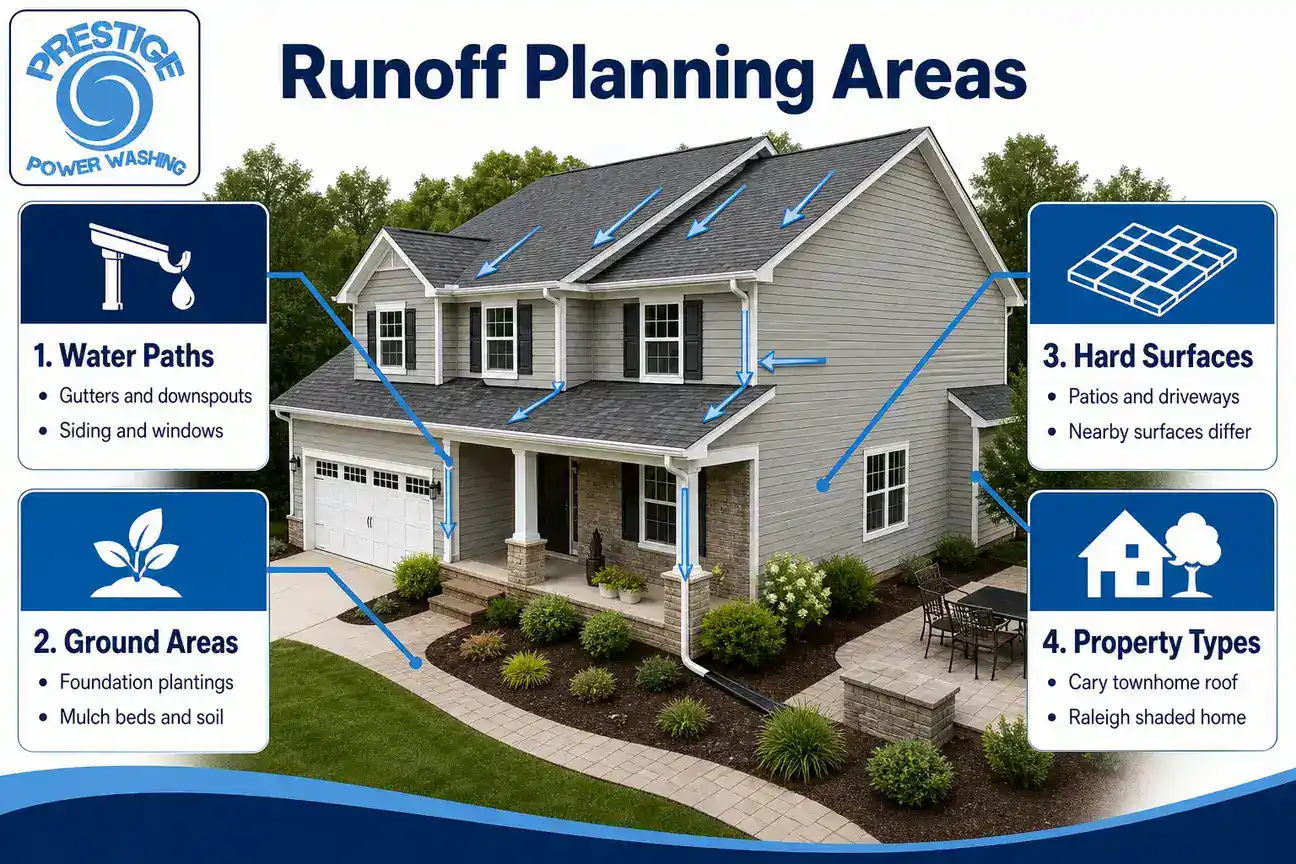
Roof cleaning does not happen in isolation. Cleaning solution and rinse water can move toward gutters, downspouts, siding, windows, foundation plantings, mulch beds, patios, driveways, and soil. A responsible service discussion should identify where water may go, what surfaces are nearby, and what the product label and manufacturer instructions require.
That does not mean a homeowner should expect a one-size-fits-all runoff promise. Properties differ. A townhome roof in Cary, a shaded single-family home in Raleigh, and a commercial building with internal roof drainage may each have different practical concerns.
Runoff planning also matters because stormwater is regulated and managed differently from ordinary indoor wastewater. The EPA’s NPDES stormwater program overview explains the broader stormwater permitting framework, and North Carolina DEQ provides stormwater technical guidance for regulated settings. Those sources do not prove anything about a specific roof-cleaning job, but they show why runoff questions should be taken seriously.
Gutters are part of that conversation because they help move water from the roofline. Clogged or poorly draining gutters can complicate roof-adjacent maintenance and may send water where it is not intended to go. Prestige Power Washing LLC provides gutter cleaning, which can be discussed separately when roofline debris or drainage is part of the homeowner’s concern.
Runoff planning should avoid exaggerated claims. It is reasonable to ask a contractor how surrounding surfaces will be considered. It is not reasonable to assume that any service automatically proves regulatory compliance, protects every plant, or eliminates every runoff concern without property-specific details and product-level documentation.
When a roofing professional should inspect first
Roof cleaning is not a substitute for roof inspection, leak diagnosis, repair, or replacement. If the roof has signs of damage, the next step may be a roofing professional rather than an exterior-cleaning appointment. That is especially true when the concern involves leaks, missing materials, structural questions, or manufacturer warranty issues.
Consider a roofing professional before cleaning if you see water stains inside the home, suspected leaks, missing shingles, loose shingles, cracked shingles, curled edges, brittle-looking material, exposed underlayment, damaged flashing, or heavy moss that appears to lift shingle edges. Significant shingle granule loss in gutters or downspouts is another reason to pause and ask whether the roof needs evaluation.
Warranty questions are also a reason to slow down. If you know the shingle manufacturer, check its current instructions. If you do not know the manufacturer or the roof has a complicated history, a roofing professional may be better suited to evaluate warranty-related concerns. A cleaning company should not promise to preserve, restore, or certify a roof warranty.
Safe access matters, too. Steep roofs, fragile roof sections, multi-story properties, and roofs with uncertain structural conditions should not be treated as simple cleaning jobs. The more uncertain the condition, the more important it is to separate roofing evaluation from exterior cleaning.
If a contractor recommends roof pressure washing before addressing visible damage, that is a reason to ask more questions. Asphalt shingle cleaning should not be used to cover up symptoms that need roofing expertise.
Commercial roofs and multi-unit properties need the same caution
Although this topic often starts with homeowners, HOAs, apartment communities, retail centers, and office properties may ask similar questions. A property manager may see dark roof streaks from a parking lot or resident walkway and wonder whether roof pressure washing is a fast fix. The answer remains cautious: asphalt roofing should not be treated like concrete or asphalt paving.
Commercial and multi-unit properties also bring scheduling, tenant communication, access, and runoff considerations. The service conversation should identify the roof type, visible condition, surrounding surfaces, and realistic appearance goals. It should not promise code compliance, inspection passage, or roof repair as part of cleaning.
Prestige Power Washing LLC offers commercial roof cleaning, but the scope is exterior cleaning—not roofing repair, replacement, or certification. Property managers should clarify whether the roof surface is asphalt shingles or another material, whether there are active leaks or known defects, and whether a roofing professional has already evaluated any structural or warranty issues.
For HOAs and apartment communities in the Triangle, consistency matters. One roof may be a suitable cleaning discussion while another roof in the same community may have age or damage concerns. A property-specific review helps avoid assuming that every building should receive the same treatment.
On multi-building properties, shingle granule loss may vary from one roof section to another. A single roof algae removal plan should not be assumed for every building until roof type, condition, access, and surrounding surfaces are reviewed.
Questions Cary and Raleigh homeowners should ask before booking
Before booking asphalt shingle cleaning, ask direct questions. You do not need to know technical treatment details, chemical ratios, dwell times, or pressure settings. In fact, choosing those details yourself can create more confusion. The better goal is to understand whether the company’s approach respects the roof material and manufacturer guidance.
- Will you use a power washer on the shingles?
- Will any brush, broom, scraping, or abrasive tool be used on the roof surface?
- How do you account for the shingle manufacturer’s cleaning instructions?
- What visible roof conditions would cause you to recommend a roofing professional first?
- How will gutters, siding, windows, landscaping, and hardscape be considered?
- How will roof algae removal expectations be explained if discoloration may only lighten?
- What is included in the roof-cleaning scope, and what is not included?
The answer to the last question is especially important. Prestige Power Washing LLC provides roof cleaning and roof soft washing as exterior-cleaning services. Roof cleaning does not include shingle replacement, leak repair, flashing repair, warranty service, or a roofing inspection certification. If those issues are present, a roofing professional is the right resource.
For a low-pressure next step, homeowners can call 919-520-4521 or get a free estimate. That request should be used to start a property-specific conversation, not to assume that any roof is automatically a cleaning candidate.
Maintenance habits that may reduce future roof staining conditions
Roof maintenance is not just about cleaning after discoloration appears. ARMA’s algae and moss guidance discusses non-abrasive care, debris removal, and keeping gutters clear so water can drain as intended. Those recommendations align with a simple homeowner takeaway: avoid abrasive contact and help water move where it should.
Tree cover is another practical factor in Cary and Raleigh neighborhoods. Shade and overhanging branches can keep parts of a roof damp longer and contribute to debris accumulation. Trimming branches may improve sunlight and airflow, but any tree work should be handled by an appropriate professional when the work is beyond routine homeowner maintenance.
Downspouts should also be considered. Upper-level downspouts that discharge onto lower roof sections may keep shingles wet or move debris onto roofing surfaces. Directing water into lower gutters, where appropriate for the home’s design, may help roof drainage. Homeowners should avoid modifying drainage in a way that creates new water problems.
These habits do not guarantee that algae or discoloration will never return. They simply address conditions that can contribute to roof staining and debris. Asphalt shingle cleaning may improve appearance, but recurring exposure to shade, moisture, debris, and roof age can affect future results.
Routine roof observation can also help homeowners notice shingle granule loss before cleaning becomes part of the conversation. If you see changing roof texture, granules collecting near downspouts, or bare-looking shingle areas, pause before scheduling roof pressure washing or any other roof-cleaning service.
Roof cleaning is not roof repair
One of the most important distinctions is the difference between cleaning and repair. Roof cleaning addresses surface discoloration and organic growth when the roof is a suitable candidate. It does not repair leaks, replace missing shingles, correct flashing problems, reinforce decking, or diagnose attic moisture issues.
If you see interior stains, active dripping, soft roof decking, loose flashing, missing shingles, or storm-related damage, cleaning should not be used as a workaround. A roofing professional can evaluate those issues. Once repair concerns are addressed, a homeowner can revisit whether a roof-cleaning service is appropriate.
This distinction protects the homeowner’s expectations. A cleaner-looking roof is not the same as a repaired roof. A roof soft washing conversation should stay in its lane: visible exterior cleaning, condition-dependent recommendations, and clear communication about what the service does and does not include.
The same distinction applies to roof algae removal. Cleaning may address appearance when the roof is suitable, but it should not be described as correcting roof age, stopping leaks, replacing missing shingles, or reversing shingle granule loss.
How to make a practical decision for your roof
If your asphalt-shingle roof has dark streaks, algae discoloration, moss, or general staining, start with the roof’s condition. Look from the ground if possible. Avoid climbing onto the roof if access is questionable. Note whether the roof has missing or curled shingles, heavy moss, visible granule loss, or signs of leaks. Those conditions may point toward a roofing professional first.
Next, think about the goal. If the goal is roof algae removal for appearance, the right conversation is about a low-impact cleaning approach and realistic expectations. If the goal is to fix leaks, stop shingle deterioration, or resolve warranty questions, cleaning is not the right service category.
Finally, ask whether the cleaning method follows manufacturer guidance and avoids high-pressure washing, brushing, brooming, and scraping. The right question is not “How much pressure will you use?” The better question is “How will you decide whether this asphalt-shingle roof should be cleaned at all?”
For many homeowners, the practical answer to “Can I pressure wash my roof?” is to avoid the pressure washer and request a condition-aware roof-cleaning discussion. That keeps the focus where it belongs: on the appropriate method for the surface, the visible condition of the roof, and clear expectations before service.
A practical decision may also mean waiting. If asphalt shingle cleaning would interfere with warranty questions, active repair concerns, or visible shingle granule loss, a roofing professional may need to evaluate the roof before any exterior-cleaning scope is discussed.
Final answer for Cary-area homeowners
The short answer is no: do not pressure wash asphalt roof shingles with conventional high-pressure cleaning. ARMA’s guidance warns against power washers and abrasive tools, and shingle granule loss is a central concern. Roof cleaning is a separate service category that should be evaluated by roof condition, shingle manufacturer instructions, surrounding surfaces, runoff, and access.
Prestige Power Washing LLC is a family-owned, locally operated exterior-cleaning business based in Cary, North Carolina, and founded in February 2017. The company serves Cary, Raleigh, and other verified Triangle-area communities as an on-site exterior-cleaning business, not as a branch-office network. If you are unsure whether your roof is a cleaning candidate, request a free estimate or call 919-520-4521 for a property-specific conversation that keeps expectations realistic.
Frequently Asked Questions
Can you pressure wash an asphalt shingle roof?
Conventional pressure washing is not recommended for asphalt shingles. Industry guidance from ARMA warns against power washers on asphalt roofing and notes that high-pressure systems are likely to damage the roof surface.
Why is pressure washing okay for some driveways but not asphalt shingles?
Driveways and concrete are hard surfaces that may tolerate more direct mechanical cleaning when their condition supports it. Asphalt shingles are layered roofing materials with embedded granules, so high pressure or abrasion can disturb the roof surface.
Will roof cleaning remove black algae streaks completely?
Not necessarily. Algae discoloration may lighten after an appropriate roof-cleaning process, but complete removal should not be promised. Discoloration can also return over time depending on shade, moisture, roof age, and other conditions.
Can a brush or broom be used to remove moss from shingles?
Abrasive brushing, brooming, scraping, or scrubbing can disturb shingles and granules. Substantial moss, especially moss that appears to lift shingle edges, should be evaluated carefully before any cleaning method is chosen.
Should a roof be inspected before cleaning?
A condition review is appropriate when a roof has leaks, missing shingles, curled edges, cracks, heavy moss, visible deterioration, or possible warranty concerns. In those situations, a roofing professional may be the better first step.
Does roof cleaning repair leaks or damaged shingles?
No. Roof cleaning addresses surface discoloration and organic growth when the roof is a suitable candidate. It does not replace roofing repair, leak investigation, flashing work, shingle replacement, or roof replacement.
What should homeowners ask a roof-cleaning company?
Ask whether the company avoids power washing and abrasive tools, how it accounts for the shingle manufacturer’s guidance, how it considers surrounding surfaces and runoff, and what happens if the roof appears too deteriorated to clean.