
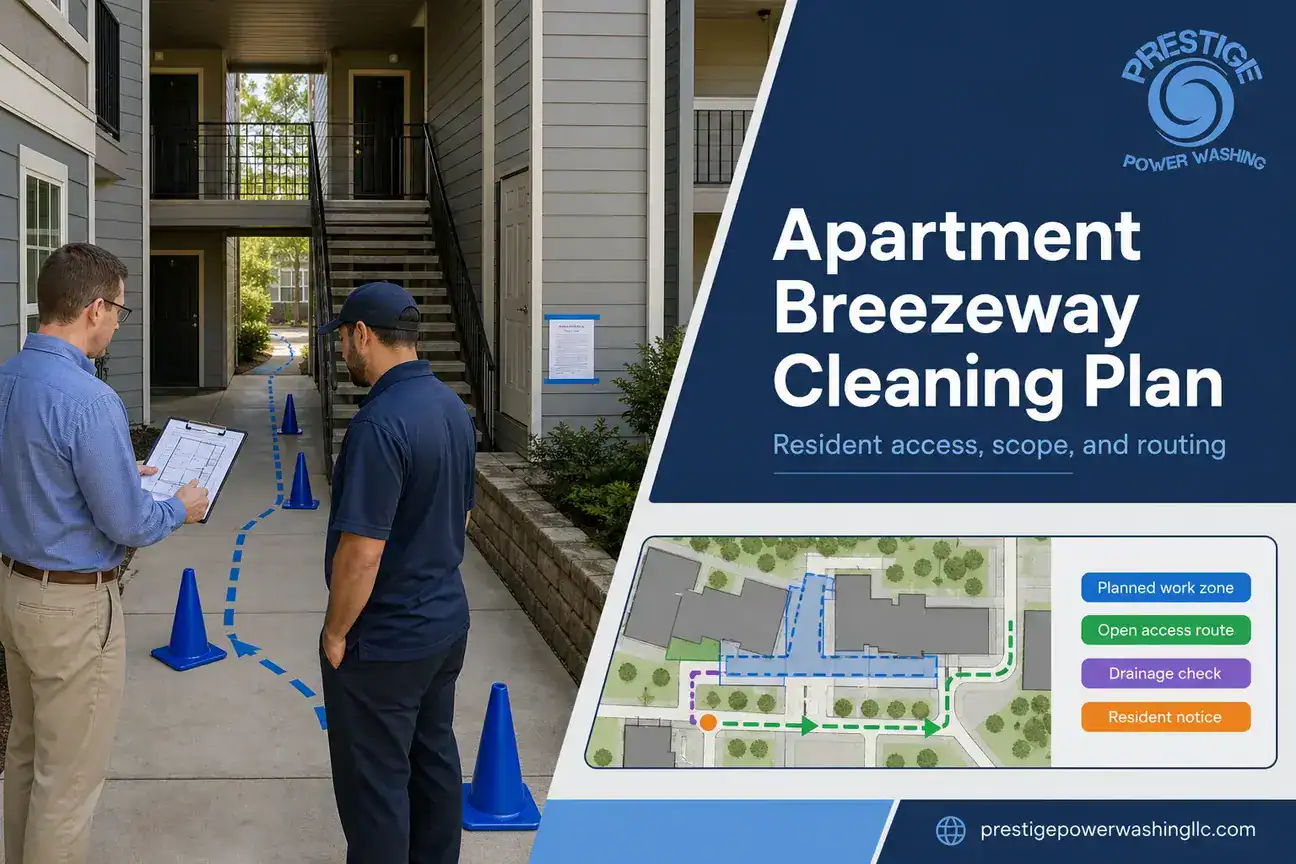
How to Plan Apartment Breezeway Cleaning Without Disrupting Residents
Apartment breezeway cleaning works well when the property manager plans the scope, resident routes, drainage, signage, and work sequence before requesting an estimate. The goal is not to promise a disruption-free project; it is to reduce avoidable confusion by identifying which breezeways, sidewalks, entrances, railings, building exteriors, and access routes may be affected. For apartment communities and HOAs in Raleigh and the Triangle, a clear plan helps the cleaning provider understand the property layout, surface conditions, and resident access needs before confirming availability and scope.
Quick Answer: Start with a property map, a surface-by-surface scope, a resident-access plan, drainage notes, and temporary work-zone questions. Then share those details when you request a free estimate so the provider can evaluate the specific property rather than guessing from a general request.
Quick Answer: apartment breezeway cleaning plan basics
A practical apartment breezeway cleaning plan answers four questions before scheduling is discussed: what areas are included, how residents will move around the work, where wash water may travel, and who will communicate temporary route changes. Those questions matter because breezeways are not isolated surfaces. They connect homes, stairs, parking, package areas, leasing offices, trash routes, courtyards, and maintenance access.
For Prestige Power Washing LLC, the relevant service to review first is building and breezeway cleaning. That service is different from a one-line request to “pressure wash the property” because the planning emphasis is on multi-unit common areas where residents regularly pass through. Final methods, timing, work areas, and availability should still be confirmed for the specific apartment community, HOA, or commercial property.
Why breezeways need more planning than a sidewalk-only job
Breezeways are everyday resident routes. A sidewalk in front of a retail building may have busy periods, but apartment corridors and stair landings are part of daily home access. Residents may be leaving for work, carrying groceries, walking dogs, receiving packages, helping children, or using mobility aids. Cleaning one corridor can affect the stairs, ramps, building entrances, and connecting walks around it.
That is why apartment exterior cleaning should be scoped as a property-management project, not only as a surface-cleaning task. The property may need to coordinate with leasing staff, maintenance teams, package carriers, trash vendors, school-bus routes, and HOA representatives. In Raleigh apartment communities, parking and building layout can also affect where equipment, signs, and temporary route markers can be placed.
Building and breezeway work is narrower and more resident-focused than general commercial pressure washing. Commercial pressure washing may include façades, sidewalks, service zones, parking-related surfaces, or other exterior areas depending on the confirmed scope. On an apartment property, those services can overlap, but the estimate should identify each surface and route rather than relying on one broad phrase.
Service scope: building and breezeway cleaning versus hardscape work
Property managers often group breezeways, sidewalks, entry pads, exterior walls, and parking-lot edges into one project. That can make sense operationally, but each area may require different planning. A breezeway floor involves resident access. Railings involve hand-contact areas and coating conditions. Siding, brick, and soffits involve vertical exterior surfaces. Concrete and asphalt may involve different staining, slopes, drains, and vehicle movement.
If the request includes sidewalks, entrance pads, drive lanes, or parking-related surfaces, review whether the project also needs concrete and asphalt cleaning. That does not mean every stain will respond the same way or that a uniform result can be promised. It simply helps the estimate separate hardscape surfaces from breezeway corridors and building exteriors.
A well-organized request may include building and breezeway cleaning for common corridors, apartment exterior cleaning for selected building surfaces, breezeway pressure washing for appropriate hard surfaces, and separate hardscape cleaning for sidewalks or asphalt areas. This gives the contractor a better starting point for evaluating methods and exclusions.
9 essential planning moves for Raleigh apartment communities
The following planning moves help property managers, HOA boards, and regional managers prepare for an estimate conversation. They are not a fixed operating procedure, completion schedule, or compliance plan. They are practical questions to help the property and contractor discuss resident access, work sequencing, drainage, and scope before work begins.
1. Create a map for apartment exterior cleaning
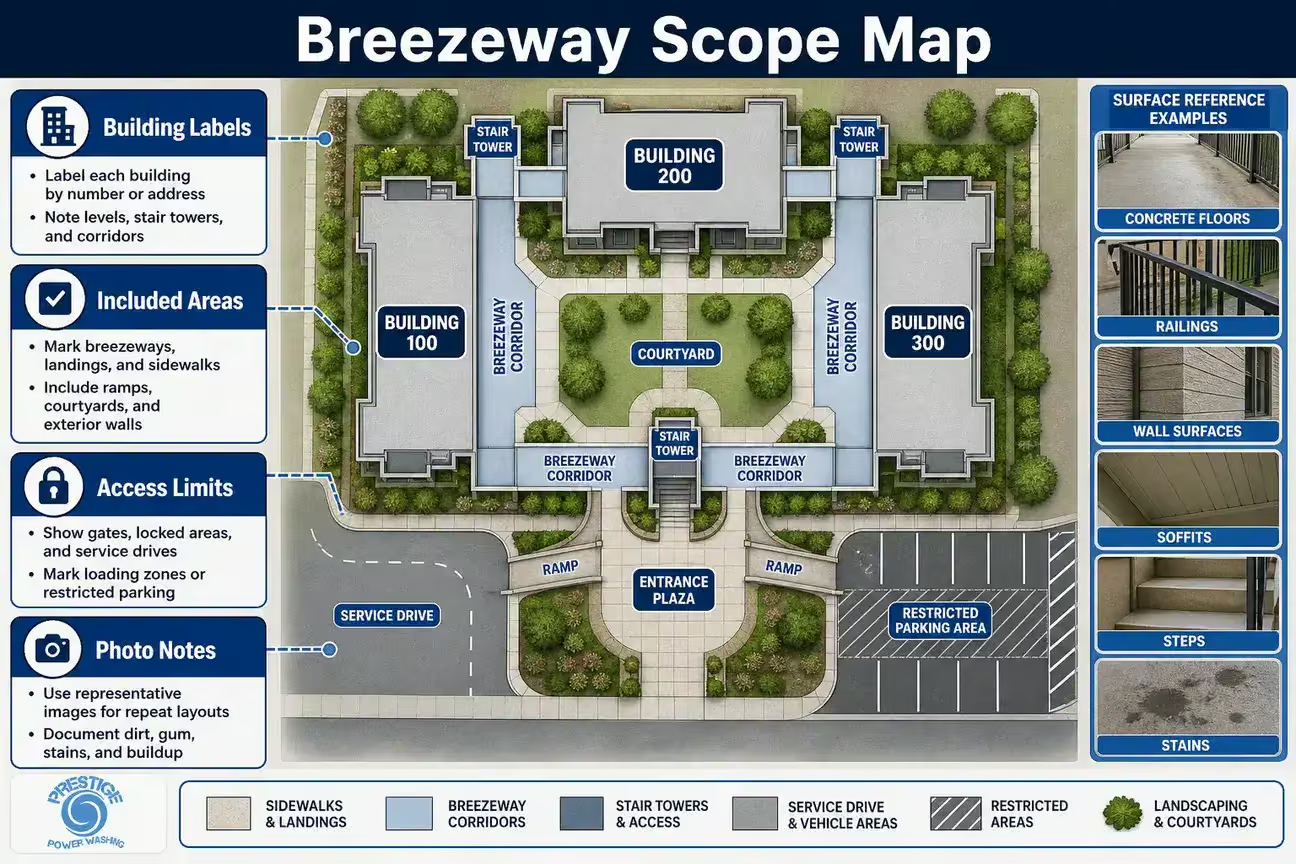
Start with a property map, building list, or simple marked-up site plan. Label each building by number, name, or address. Note the number of levels, stair towers, breezeway corridors, landings, sidewalks, ramps, entrance plazas, courtyards, and exterior walls that may be included. If the property has gates, locked areas, service drives, loading zones, or restricted parking, mark those as well.
For apartment exterior cleaning, photos can help explain the request, especially when buildings repeat the same layout. A few representative images may show concrete floors, railings, wall surfaces, columns, soffits, steps, stains, gum, dirt, algae-like growth, irrigation marks, or grease-like spots near trash paths. Avoid assuming that a photo alone determines the final method or outcome; it is a planning tool for the estimate conversation.
Include everyday site details, too. Leasing-office entrances, pool access, package lockers, mail areas, school-bus paths, trash collection points, and maintenance routes may all affect how a zone is cleaned. The more clearly these areas are mapped, the easier it is to discuss resident access planning before the project is approved.
2. Define surfaces before breezeway pressure washing
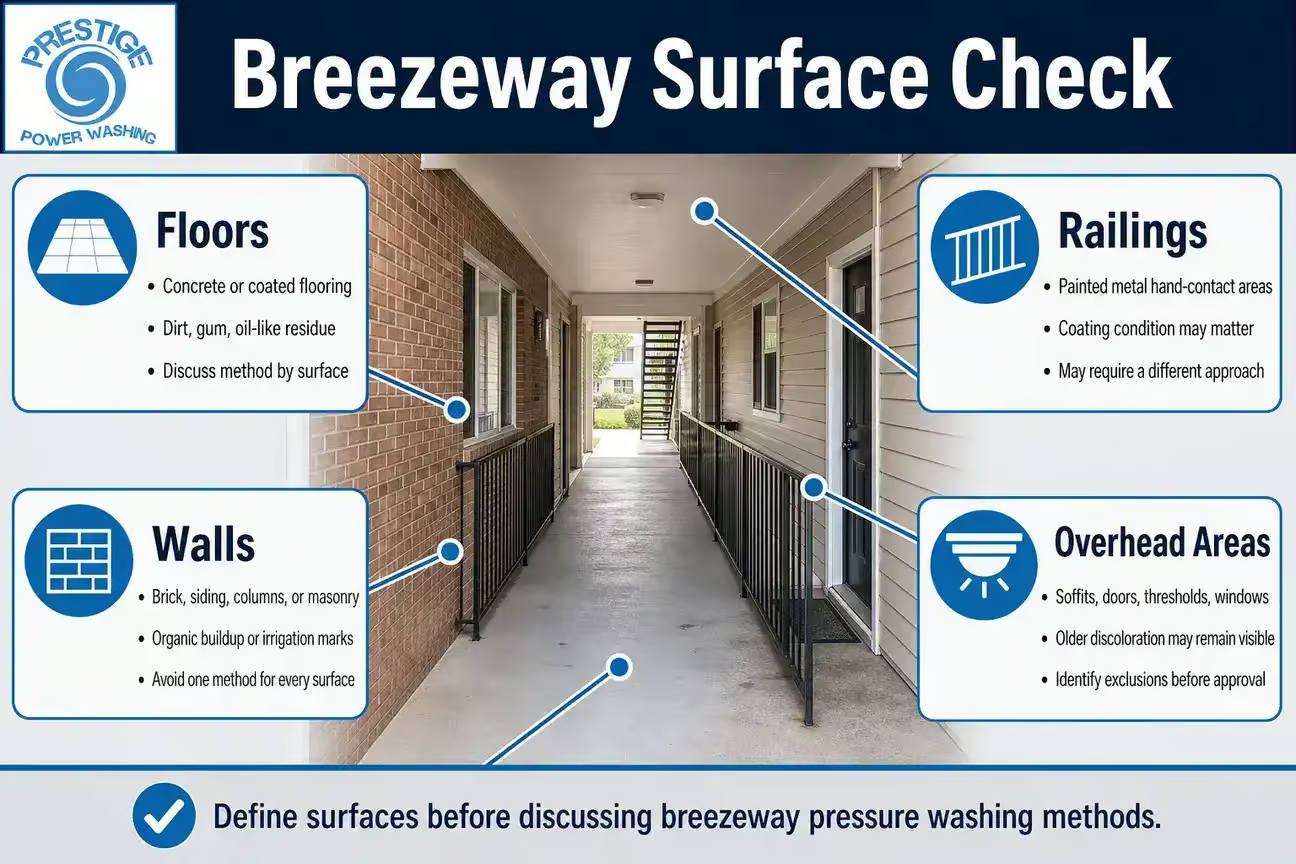
Breezeway pressure washing should be discussed by surface, not just by location. A breezeway may include concrete or coated flooring, painted railings, brick walls, siding, doors, thresholds, metal stairs, windows, columns, and overhead areas. Each surface may require a different cleaning approach or may need to be excluded from a specific method.
The estimate request should identify visible conditions without promising what the finished appearance will be. Dirt, gum, organic buildup, rust-colored marks, irrigation staining, oil-like residue, and older discoloration may respond differently. Some conditions can improve with cleaning, while others may remain visible depending on the material, age, coating, and prior maintenance.
Use a simple scope table before requesting an estimate:
| Area | Surface to identify | Condition to note | Resident access issue | Include in estimate? |
|---|---|---|---|---|
| Breezeway floor | Concrete, coating, or other hard surface | Dirt, gum, staining, algae-like buildup | Primary resident route | Yes, no, or optional |
| Railings and stairs | Metal, painted, coated, or masonry | Soil, oxidation, peeling coatings, hand-contact areas | Stair and landing access | Yes, no, or optional |
| Building exterior | Siding, brick, stucco, columns, soffits | Discoloration, dirt, organic growth, cobwebs | Windows, balconies, landscaping | Yes, no, or optional |
| Entrances | Concrete, masonry, thresholds, door surrounds | Foot traffic buildup, splash marks, gum | Leasing, delivery, and resident traffic | Yes, no, or optional |
| Sidewalks and ramps | Concrete or asphalt | Staining, debris, algae-like buildup | Accessible routes and detours | Yes, no, or optional |
This kind of table also helps separate breezeway pressure washing from broader apartment exterior cleaning. If the project includes building walls and hardscape areas, the property can ask for the scope to be organized by area or by phase.
3. Build resident access planning into the first conversation
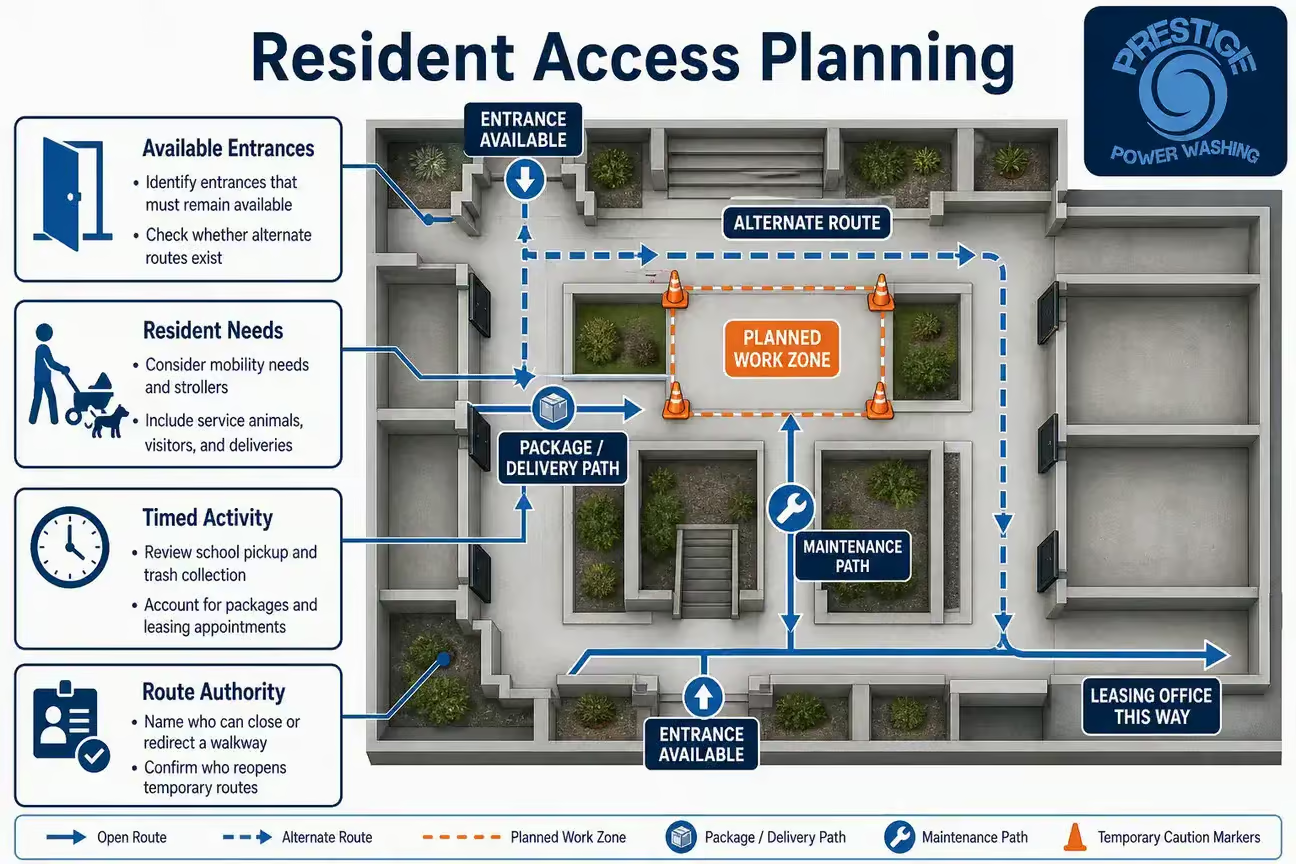
Resident access planning should happen before the property approves a cleaning date. Identify which entrances must remain available, whether alternate routes exist, and who has authority to temporarily close, redirect, or reopen a walkway. If an entrance is the only practical route for certain residents, that should be discussed before work is scheduled.
Good resident access planning considers mobility needs, strollers, service animals, deliveries, visitors, emergency access, maintenance traffic, and parking. It also considers time-sensitive activity such as school pickup, trash collection, package delivery, pool use, leasing appointments, and resident events. The plan may need to change during the work if weather, traffic, or site conditions change.
This is also where HOA cleaning plans can become more complex. An HOA board may need to notify owners, approve temporary access changes, coordinate with a management company, or answer resident questions before work begins. Clear communication helps reduce surprises, but no plan should promise that every resident will be unaffected.
4. Plan temporary signs, cones, barriers, and route markers
Temporary work-zone controls are part of the planning conversation. OSHA’s Work Zone Traffic Safety guidance says that work zones need traffic controls identified by signs, cones, barrels and barriers, and it also states that drivers, workers on foot, and pedestrians must be able to see and understand proper routes. For an apartment property, that supports a practical discussion about signs, cones, alternate routes, and who monitors changing conditions.
OSHA also states in Directive CPL 02-01-054 that construction areas shall be posted with legible traffic signs at points of hazard. Apartment cleaning is not the same as a road construction project, and this article is not making a property-specific legal determination. The useful takeaway is simple: temporary route changes should be visible and understandable.
Ask where signs can be placed without blocking sidewalks, ramps, doors, or accessible paths. Decide whether the property has approved barricades, cones, or message boards. Clarify who will move signs as the work zone changes and who will remove them when access resumes. Resident access planning works better when signage is part of the scope, not an afterthought.
5. Review drainage and wash-water conditions early
Drainage deserves attention before estimating and before scheduling. Breezeways, sidewalks, stairs, and entry pads may slope toward storm drains, landscaped beds, ponds, streams, parking lots, or low points. The property should identify nearby drains and sensitive areas so the contractor can evaluate site conditions and discuss the approach before work begins.
North Carolina DEQ’s technical guidance says, “Vehicle pressure washing wash water is a wastewater, and discharge to surface waters through storm drains is not authorized by any NPDES stormwater permit.” The same DEQ guidance advises that property managers should check with local government because some jurisdictions may require a permit. This is why drainage notes should be part of apartment exterior cleaning requests in Raleigh and nearby Triangle communities.
The EPA’s NPDES Stormwater Program provides broader stormwater-program context, but local requirements can vary by municipality, utility, property design, and discharge point. Do not assume a universal rule covers every site condition. Ask how drainage conditions will be evaluated, who will confirm local requirements when needed, and what areas may need special attention.
6. Choose a sequence that matches the property layout
A practical sequence may be building-by-building, breezeway-by-breezeway, entrance-by-entrance, or zone-based. The right discussion depends on property layout, surface conditions, weather, access, drainage, and confirmed scope. A small garden-style community may plan differently than a larger multi-building property with multiple levels and shared amenities.
When vertical exterior surfaces are included, sequence matters. In some situations, it may make sense to address upper or vertical surfaces before lower walking areas so rinse water does not affect recently cleaned hardscape. In other situations, access or drainage may change the order. The point is to discuss the order before the project starts, not to assume every building can be handled the same way.
For breezeway pressure washing, high-traffic corridors may need a different plan from quieter corridors. Leasing-office entrances, package rooms, mail areas, trash routes, pool gates, and maintenance zones may need separate coordination. The property representative and contractor should also decide how completed zones will be checked before residents are directed back through them.
7. Decide when HOA cleaning plans need phases
HOA cleaning plans often benefit from phasing when multiple buildings, courtyards, clubhouses, sidewalks, and shared entrances are involved. Phasing can help the board or management company communicate with smaller groups of residents at a time. It can also make it easier to compare priority areas, optional areas, and future work.
Phasing should not be presented as a promise that the project will cost less, finish faster, or avoid every inconvenience. It is a planning tool. The property might phase by building, by side of the community, by breezeway level, by high-priority entrances, or by surface type. Each option has tradeoffs for access, communication, and scheduling.
For HOA cleaning plans, decide who approves each phase and who answers resident questions. Some communities require board approval, management-company approval, vendor documentation, or advance notices. If the property requires insurance documentation or other vendor paperwork, ask about the process without assuming any contractor credential, coverage, or bonding unless it has been verified directly.
8. Prepare a complete estimate request
A complete request helps the provider understand the project before discussing availability. Include the property name, address, main contact, on-site contact, number of buildings, number of breezeway levels, requested areas, surface types, photos, drainage concerns, water-access notes, gate or key instructions, preferred work windows, blackout dates, and communication requirements.
If the property wants optional line items, say so. For example, the manager may want a base scope for breezeways and entrances, an optional scope for sidewalks, and another optional scope for building exterior cleaning. This makes apartment exterior cleaning easier to compare without treating every surface as one undefined task.
Resident access planning details should be included with the estimate request. Note required notices, door hangers, email alerts, staff escorts, delivery routes, trash pickup times, school-bus paths, pool access, and any areas that cannot be closed without management approval. If the property wants separate pricing for phases, buildings, or priority zones, mention that before the site review or estimate discussion.
9. Confirm the commercial scope before approving work
Before approving work, ask what is included, what is excluded, which surfaces require a different method, and which areas are subject to site conditions. Confirm whether the request is primarily building and breezeway cleaning, broader commercial pressure washing, concrete and asphalt cleaning, or a combination. This helps avoid misunderstandings between the property manager, HOA board, residents, and contractor.
Also ask what conditions may affect the expected appearance. Oil-like marks, rust-colored stains, old coatings, gum, irrigation staining, and organic buildup may not respond equally. Cleaning can improve many visible exterior conditions, but the result depends on surface type, age, previous maintenance, staining depth, and access.
Prestige Power Washing LLC is family-owned and locally operated, based in Cary, North Carolina, and founded in February 2017. Raleigh is part of the service area, not a separate branch or office. Apartment communities and HOAs should confirm availability, scope, and service details for the specific property and location before making resident notices or board commitments.
What property managers should ask before approval
The approval conversation should be specific enough that the property team can communicate clearly with residents. A vague approval such as “wash the breezeways” can leave too much room for confusion. A better approval identifies surfaces, zones, access restrictions, communication responsibilities, and scope limits.
- Which breezeways, stairwells, entrances, sidewalks, railings, and building surfaces are included?
- Which areas are excluded or need a separate estimate?
- Which surfaces may require a different cleaning method?
- What areas may need temporary route changes, signs, cones, or barriers?
- Who has authority to redirect or reopen a walkway?
- How will residents, vendors, and staff be notified?
- What alternate routes are available for residents with mobility needs?
- Where are storm drains, slopes, low points, landscaped beds, ponds, or streams?
- Who will confirm local drainage or discharge requirements when needed?
- What property access, water access, gates, keys, or escorts are required?
- What visible conditions may remain after cleaning?
- What is confirmed now, and what remains subject to site review?
These questions are useful for apartment communities, HOA boards, regional managers, and commercial-property decision-makers. They also help separate practical planning from unsupported promises. No contractor should need to promise a disruption-free project in order to provide a thoughtful plan.
How to communicate with residents before and during work
Resident communication is often the difference between an organized project and a frustrating one. The property should decide what residents need to know, when they need to know it, and where they should go if their usual route is temporarily unavailable. Notices may include expected work areas, alternate routes, wet-surface reminders, noise expectations, parking notes, package-delivery instructions, and contact information for property staff.
Use plain language. Instead of saying “Building 4 will be cleaned,” consider saying “Building 4 breezeways, stair landings, and front sidewalks are included in the planned work zone.” If a route may be redirected, describe the alternate path before the work begins. If residents should remove personal items from breezeways or entry areas, tell them what to move and by when.
Resident access planning should also account for real life. Some residents work nights. Some receive medical deliveries. Some use walkers, wheelchairs, strollers, or service animals. Some rely on package lockers or elevators. The property team is usually in the strongest position to understand those needs and communicate them to the cleaning provider.
Where drainage, access, and sequencing overlap
Drainage, access, and sequencing are connected. A sloped breezeway may drain toward a sidewalk residents need to use. A stair tower may be the only practical route to upper units. A sidewalk may also be a delivery route, emergency route, or accessible path. If the plan treats these items separately, the property may miss how one decision affects another.
For example, a property might want to clean an entrance plaza first because it is highly visible. But if that entrance is the only route to the leasing office, resident communication and route marking become more important. If the entrance also slopes toward a storm drain, drainage review becomes part of the same conversation. If package carriers use that route, delivery timing matters, too.
The practical approach is to discuss each zone as a small system: surfaces, people, water flow, traffic, and communication. This is especially useful for breezeway pressure washing because upper-level corridors, stairs, lower walkways, and adjacent entrances often affect one another.
When to use separate scopes or optional line items
Separate scopes can help a property compare needs without oversimplifying the project. A manager may request one scope for apartment breezeway cleaning, one for sidewalks and entrance pads, one for building exterior surfaces, and one for parking-related concrete or asphalt. The contractor can then discuss which services apply to which areas.
This approach can be helpful for HOA cleaning plans because boards often need to compare priorities. A board may approve common breezeways first, then review sidewalks or exterior walls later. A property manager may prioritize leasing-office access, model-unit routes, or high-traffic corridors first. Separate scopes make those discussions clearer.
Optional line items should not be used to imply absolute outcomes. They should clarify choices. If a visible condition is uncertain, ask whether it should be evaluated separately and what outcome limitations may apply. For instance, old oil staining, rust-colored marks, gum, or irrigation discoloration may need realistic expectations.
Local service context for Raleigh and the Triangle
Prestige Power Washing LLC is based in Cary and provides exterior cleaning services in Cary, Raleigh, and other verified Triangle-area communities. Cary is the only published business-address location; Raleigh and nearby communities are service areas, not branches. For apartment communities and HOAs, the important next step is to confirm service availability and scope for the specific property.
Local planning matters because property layouts vary widely across the Triangle. A Raleigh community near busy roads may have different access and vendor timing than a quieter property in another service-area community. A garden-style apartment property may need a different sequence than a building with enclosed corridors, multiple stair towers, or a heavily used leasing-office entrance.
If your property is comparing building and breezeway cleaning, commercial pressure washing, or concrete and asphalt cleaning, gather the map, photos, access notes, drainage observations, and communication requirements first. Then share those details when you get a free estimate or contact Prestige Power Washing. You can also call 919-520-4521 during published business hours to discuss next steps without assuming instant scheduling or a fixed turnaround.
Final planning checklist for a cleaner estimate conversation
Before requesting apartment breezeway cleaning, gather enough information for a surface-specific conversation. The more organized the request, the easier it is to discuss scope, sequence, access, and realistic expectations.
- Property name, address, and main management contact.
- Building numbers, breezeway levels, and a map or marked site plan.
- Requested breezeways, stairwells, landings, sidewalks, ramps, entrances, railings, and exterior walls.
- Surface types such as concrete, asphalt, brick, siding, painted metal, coatings, or masonry.
- Photos of representative areas and visible conditions.
- Drainage notes, including storm drains, slopes, low points, ponds, streams, and landscaped beds.
- Resident access planning notes, including alternate routes and areas that cannot be closed without approval.
- Delivery, trash, maintenance, school-bus, visitor, pool, and leasing-office traffic patterns.
- Preferred work windows, blackout dates, or resident-event conflicts.
- Notice requirements such as emails, door hangers, signs, or staff announcements.
- Water-access notes, gates, locks, escorts, parking limits, and loading areas.
- Questions about availability, scope, exclusions, and whether phases or optional line items make sense.
A thoughtful plan can support a smoother, more predictable conversation, but it should not be treated as a promise that residents will experience no inconvenience. The strongest plan is honest about site conditions, resident needs, access limits, drainage questions, and what still needs to be confirmed.
For Raleigh apartment communities, HOAs, and property managers, apartment breezeway cleaning is most successful as a coordinated property-maintenance discussion. Start with the map, define the scope, plan the resident routes, review drainage, and confirm the service details for your specific property before moving forward.
Frequently Asked Questions
How far in advance should residents be notified before breezeway cleaning?
The right notice period depends on the property’s policies, lease or HOA communication rules, and the areas being affected. Many managers prefer to notify residents before route changes, personal-item requests, or temporary access adjustments. Confirm the communication plan with your property team before scheduling.
What should an apartment manager include when requesting an estimate?
Include the property name, address, building count, breezeway levels, requested areas, surface types, photos, drainage notes, access restrictions, preferred work windows, and resident-notice requirements. If you want separate phases or optional line items, mention that in the request.
Is breezeway cleaning the same as commercial pressure washing?
Not exactly. Breezeway cleaning focuses on multi-unit common areas such as corridors, stairs, landings, railings, entrances, and resident routes. Commercial pressure washing is broader and may include other exterior surfaces depending on the confirmed scope.
Can residents keep using the breezeway during cleaning?
That depends on the property layout, work zone, surface conditions, and route plan. Managers should identify essential entrances and alternate routes before work begins, but no plan should promise uninterrupted access for every resident at all times.
Should sidewalks and parking-area surfaces be included with breezeways?
They can be discussed as part of the same project, but it is often clearer to separate them by scope. Breezeways, sidewalks, entrance pads, concrete, and asphalt may involve different access issues, drainage concerns, and appearance expectations.
Who is responsible for resident notices and temporary route decisions?
The property should decide who has authority to notify residents, approve temporary route changes, answer resident questions, and reopen areas. Those responsibilities should be discussed with the cleaning provider before work is approved.
Does cleaning remove every stain from breezeways and sidewalks?
No result should be assumed. Dirt and buildup can often be improved, but oil-like marks, rust-colored stains, gum, irrigation staining, old coatings, and long-term discoloration may respond differently depending on the surface and condition.
Sources
- North Carolina Department of Environmental Quality: Technical Guidance
- U.S. Environmental Protection Agency: NPDES Stormwater Program
- Occupational Safety and Health Administration: Work Zone Traffic Safety
- Occupational Safety and Health Administration: CPL 02-01-054, Inspection and Citation Guidance for Roadway and Highway Construction Work Zones