

Red clay stains on concrete driveways can often be improved by clearing loose soil, identifying where the clay is coming from, and cleaning the surface with a method matched to its condition. A pressure washer alone may remove surface mud but leave orange discoloration behind. Older, porous, cracked, sealed, or decorative concrete needs extra care, and no honest contractor can promise that every stain will disappear completely.
If your Raleigh or Cary driveway gets a new reddish band after every storm, the problem may be as much about water and bare soil as it is about cleaning. This guide explains how to tell clay from other orange stains, what to do first, when a professional cleaning makes sense, and how to reduce the chance of the stain returning. For an assessment of the driveway itself, see Prestige Power Washing LLC’s driveway pressure washing service.
Why do red clay stains on concrete driveways occur in Raleigh and Cary?
Fine reddish soil can be carried across concrete by rain, tires, shoes, pets, lawn equipment, or work around a new planting bed. When muddy water dries, loose material remains on top while fine particles can lodge in the surface texture. Concrete is not perfectly smooth; broom finishes, exposed aggregate, small pits, and aging surface wear all give soil places to collect. Repeated wetting and drying can make a faint track look like a persistent orange stain.
Think about the path the water follows. On a sloped driveway, runoff may enter at the uphill edge and spread downhill. A bare strip beside the concrete can create a narrow line along the border. A vehicle parked on unpaved ground can leave two tire tracks. Landscaping or construction work can produce a broad splash pattern. The pattern helps identify the source, which matters because a freshly cleaned driveway may discolor again after the next heavy rain if the source remains.
Orange color alone does not prove that the material is clay. Metal runoff, fertilizer granules, irrigation water, mulch, and other sources may leave similar looking marks. A stain that starts below a metal object or appears at irrigation spray points deserves a different evaluation from soil tracked out of a planting bed.
Quick identification: clay, rust, algae, oil, or something else?
Before choosing a cleaner, note when the mark appeared, whether it feels like loose grit, and what sits directly uphill or above it. These observations are more useful than buying a chemical based on color alone.
| What you see | Possible source | Useful next step |
|---|---|---|
| Orange film near bare soil or a planting bed after rain | Tracked or washed red soil | Remove loose sediment and inspect the runoff path |
| Orange spot below a metal item or along an irrigation pattern | Possible rust or water-related staining | Identify the source before selecting treatment |
| Green or dark patch in a shaded, damp area | Possible organic buildup | Assess moisture and surface condition |
| Dark, greasy spot where a car parks | Possible vehicle fluid | Address the leak and request stain-specific advice |
| Orange color across many areas after cleaning | Embedded soil, surface wear, or another discoloration | Let the surface dry and reassess before repeat treatment |
This is a visual guide, not a laboratory diagnosis. A service provider should be willing to inspect a small affected area and explain uncertainty before treating the whole driveway. If a stain follows a crack, crumbling edge, or persistent water flow, deal with the underlying surface or drainage issue as well as the appearance.
What should you do when fresh red clay lands on a driveway?
Fresh mud is generally simpler to address than repeated staining. The first aim is to remove material without spreading it over a larger area or washing sediment into a street drain. Choose a method that fits the amount of soil, your water access, and your local runoff rules.
- Find the source. Look for exposed soil, a recently disturbed bed, tire tracks, or a downhill trail from a slope. Take a photo while the path is visible after rain.
- Remove loose material. Once conditions permit, lift or sweep dirt, leaves, and grit so you do not grind them into the concrete. Collect the debris for appropriate disposal.
- Check the surface. Look for flaking, cracks, loose aggregate, a coating, or an unusual decorative finish. These conditions affect which cleaning approaches are suitable.
- Test a small area. Start with a gentle approach in an inconspicuous spot. Assess the appearance again when fully dry; wet concrete can hide remaining discoloration.
- Stop if the surface changes. If the test produces a lighter etched patch, lifts a coating, or dislodges material, avoid escalating pressure or chemical strength.
Do not sweep dry dust aggressively on a windy day or direct muddy water into a storm drain. Keep children and pets clear of cleaning work, and check product labels before using any solution. The CDC’s pressure washer safety guidance warns that the water jet can cause serious injury even when a wound initially looks minor.
Can pressure washing remove red clay stains from concrete?
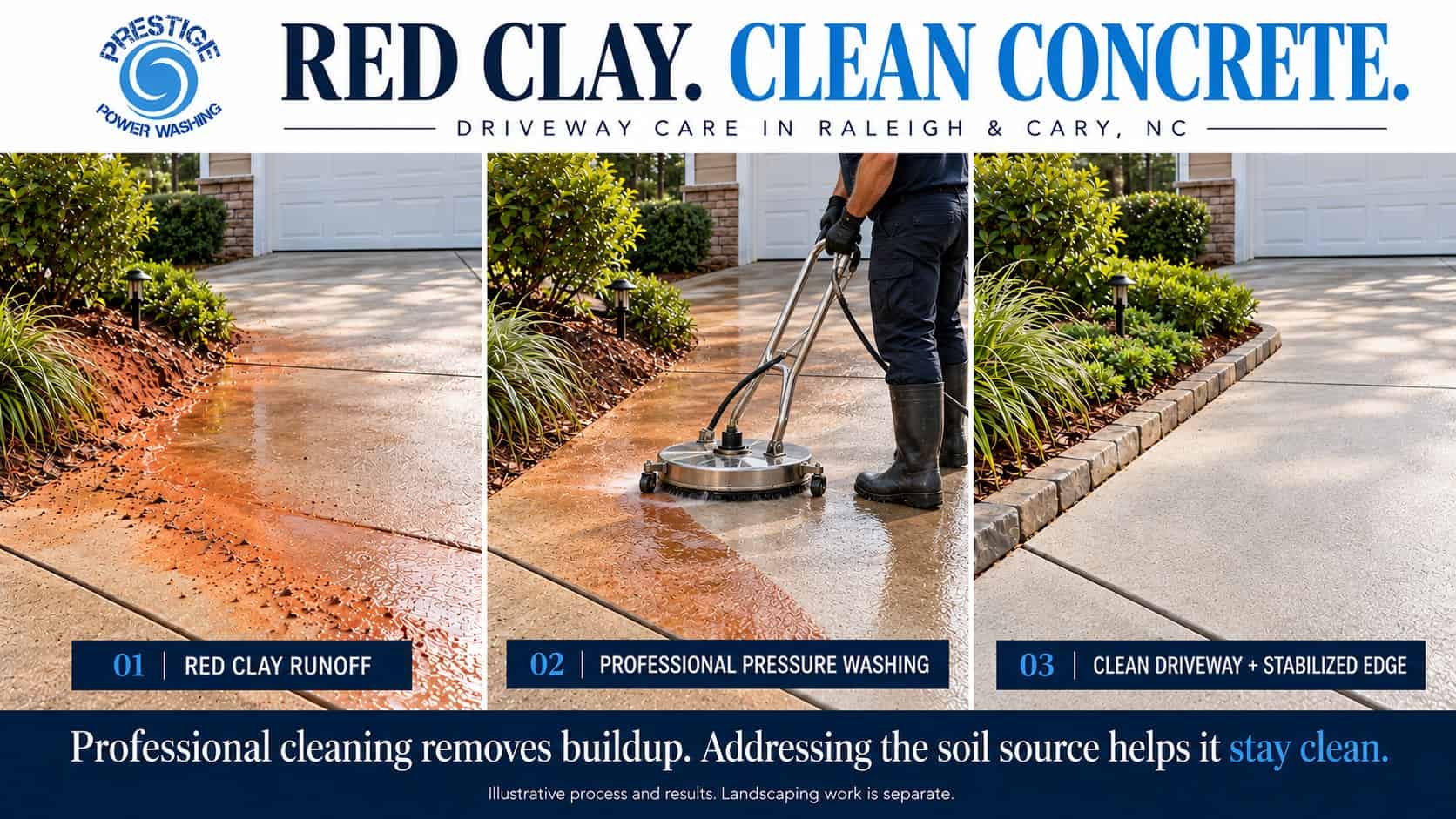
Pressure washing can remove loose red soil and much of the general surface grime that surrounds it. The result for an orange stain depends on how deeply fine particles are lodged, the age and finish of the concrete, prior cleaning, and whether the source is actually clay. A driveway can look dramatically cleaner yet retain a faint warm tint where clay has repeatedly settled.
Cleaning with more force is not always the answer. An aggressive nozzle held too close can leave visible lines or damage a worn surface. A uniform cleaning pattern and any appropriate pretreatment should be chosen after the operator looks at the concrete. If the suspected clay stain remains after a careful wash and the surface dries, the next step is reassessing the stain, not repeatedly blasting the same spot.
That distinction is particularly important for a driveway with a sealer, decorative color, exposed aggregate, repairs, scaling, or a surface that is still relatively new. A contractor should describe what can be cleaned safely and whether a test area is appropriate. Prestige’s driveway service page explains its approach to evaluating the material and condition before cleaning.
What cleaning products should you avoid guessing with?
A search for “remove red clay from concrete” turns up strong acids, bleach mixtures, and improvised recipes. Those suggestions ignore the finish, the actual stain, nearby plants, and where the rinse water goes. There is no single product that is appropriate for every driveway. An orange mark from metal or fertilizer may behave differently from muddy soil, and an old coating may respond differently from plain concrete.
Do not mix cleaning chemicals. Do not apply a strong acid because a stain looks orange. Acid exposure can affect concrete; the American Concrete Institute’s guide to protective treatments describes effects that can include surface discoloration and roughening. A homeowner should follow product labels and seek qualified advice for uncertain stains, decorative finishes, or previously sealed surfaces.
Sometimes a small test shows that a stain is too embedded for a reasonable cleaning result without unacceptable surface risk. In that case, the honest recommendation may be to stop, address the soil source, and discuss restoration or resurfacing with an appropriate concrete professional if appearance is critical. Washing cannot repair pitting, scaling, or a failed coating.
Why does a clay stain return after cleaning?
Recurring discoloration usually means the driveway is still receiving soil or sediment. A successful wash removes what was present on cleaning day; it does not change the route rainwater takes. If the surface turns orange again after every storm, walk the site during a safe, light rain or examine it immediately afterward. Look for an exposed bank, a mulch bed that overflows, a driveway shoulder that vehicles cut across, or a discharge point that carries sediment onto the concrete.
Driveway edges deserve special attention. Mud may wash over a curb where the planting bed is higher than the slab. A low spot may hold dirty water and allow fine particles to settle. Temporary construction disturbance can also persist for weeks. A small source can produce a surprisingly long stain because water carries the soil across the entire slope.
Document the pattern before scheduling cleaning. Send the provider two photos: one close shot showing the stain texture and one wide shot showing the nearby beds, grade, or road edge. This makes an estimate more useful and helps the crew distinguish a recurring soil problem from a one-time spill.
How can you prevent red clay from washing back onto concrete?
Start by keeping exposed soil in place. Stabilized planting beds, established ground cover, and attention to driveway edges may reduce the amount of loose material available to wash across the slab. A landscaping or drainage professional can advise on a persistent flow problem. Avoid redirecting water onto a neighbor’s property or toward a foundation just to keep the driveway clean.
Keep the concrete edge clear of loose soil, and watch where mower wheels or parked cars cross an unpaved area. If a construction or landscaping project exposed clay, ask the contractor how the disturbed ground will be stabilized. Sweep collected sediment before it becomes a new muddy film. Keeping gutters, downspouts, and grading in good order can help manage runoff, but a driveway wash is not a drainage repair.
A sealer may be worth discussing with a concrete specialist for some surfaces, but sealing is not a substitute for fixing a soil source and should never be presented as a guarantee against red staining. The concrete must be assessed, properly prepared, and suited to the proposed product. Prestige provides exterior cleaning; ask separately about any concrete repair, grading, or sealing work.
What does a professional assessment of a clay-stained driveway involve?
A useful assessment starts with the whole area rather than the darkest spot. The provider looks at the driveway’s material, wear, cracks, coatings, slope, surrounding landscaping, soil source, and where water can flow during cleaning. Those details shape a realistic plan and help protect adjacent garage doors, siding, and planting beds.
Explain whether the stain appeared once or comes back after rain. Mention any prior acid, bleach, rust remover, sealer, or pressure washing treatment you used. If the driveway has colored concrete, pavers, a stamped finish, loose joints, or newly placed concrete, say so up front. Old photos can show whether the mark is new or has gradually deepened.
The provider should identify which parts appear to be removable surface soil and which may be deeper discoloration or an entirely different stain. After an appropriate cleaning, inspect the result when the area is dry. A damp driveway often looks more uniform than it will a few hours later. A good result means a visibly cleaner surface achieved without sacrificing its finish, even if an old embedded mark remains.
Should you clean just the clay stain or the whole driveway?
Cleaning only a small patch may leave a bright rectangle against otherwise weathered concrete. A full driveway clean can produce a more even overall appearance when the entire surface has collected pollen, tire residue, and general grime. The correct scope depends on the size of the stain, the surrounding condition, your budget, and whether connected walkways need attention.
Ask for the scope in the estimate: Is it the whole driveway, the garage apron, the connected walk, or only one stain? Does the provider expect a visible difference between cleaned and uncleaned sections? A clear answer matters more than a generic “all stains removed” promise. If oil is also present, that is a separate stain type with different expectations; the existing oil and hydraulic fluid removal page addresses that issue.
For homeowners preparing to sell, a consistent look across the approach to the house may matter as much as the single orange mark. That can mean cleaning the adjacent walk and evaluating whether the siding also needs a full detail house wash. Keep the decision tied to what is visibly dirty rather than adding work without a reason.
When is DIY cleaning reasonable, and when should you call a professional?
Removing a small amount of loose soil from sound, uncoated concrete is a reasonable homeowner maintenance task. A stubborn orange stain over a large area, repeated runoff, an unfamiliar finish, or existing surface damage calls for more caution. Consider professional help when you cannot identify the source, do not know how to manage the rinse water, or have already tried cleaning without improvement.
Professional equipment can make broad surface cleaning more consistent, but equipment alone does not diagnose a stain. Ask how the company will protect the surface, what cleaning result is realistic, and how it will handle nearby landscaping and runoff. If a provider cannot answer those questions, seek another assessment before work begins.
Do not operate a pressure washer from a ladder or direct the jet at skin, electrical equipment, loose joints, or fragile surfaces. The CDC’s safety advice is a useful baseline for anyone considering DIY work. If runoff could reach a storm drain, ask how the work will be contained or managed under applicable local requirements; the Prestige blog also includes a guide dedicated to stormwater runoff and pressure washing in North Carolina.
How much does red clay driveway cleaning cost in Raleigh or Cary?
There is no responsible universal price for a red clay stain from a photo alone. The size of the driveway, whether it needs a full clean or a small assessment, the surface condition, accessibility, amount of other buildup, and whether a stain-specific treatment is appropriate all affect the scope. Repeated runoff can also change the recommendation: cleaning may improve today’s appearance, while separate landscaping work addresses tomorrow’s stain.
For a useful estimate, send a wide photo and a close photo, your location, the approximate driveway size, the surface type if known, and a note about when the stain appeared. Disclose any products already applied. Ask what areas are included and whether the quote assumes an improvement in appearance rather than complete removal of every embedded mark.
Prestige Power Washing LLC offers an estimate request through its contact page. You can also ask the team whether driveway cleaning should be combined with another exterior service while they are on site. The company can assess the cleaning; drainage design, concrete repair, and specialty coating decisions may require a different professional.
Where can you get help with other driveway stains?
If the mark is black and oily rather than orange and gritty, read Prestige’s oil stain service information. For general buildup, algae, and tire marks, see the driveway cleaning guide for Raleigh homeowners. A photo of the stain and its surroundings can help the team recommend the right starting point.
Request an assessment of your driveway
Red clay is a familiar problem around Raleigh and Cary, but the best cleaning approach depends on your particular concrete and the cause of the mark. Prestige Power Washing LLC can assess a stained driveway, explain which parts appear to be surface buildup, and recommend an appropriate cleaning scope. If you suspect a drainage or structural issue, arrange a separate evaluation for that problem.
Ready to discuss your driveway? Request a driveway cleaning estimate and include photos of the stain and its likely soil source. For details about the service, review driveway pressure washing in Raleigh and Cary.
Frequently asked questions about red clay stains on concrete driveways
Will rain wash red clay off a concrete driveway?
Rain may move loose mud, but it can also carry more fine soil onto the driveway and leave a new stain when the surface dries. If the orange mark reappears after storms, trace the water to its soil source instead of relying on rain to clean the concrete.
Can pressure washing completely remove old red clay stains?
Sometimes it removes the visible soil and substantially improves the stain. Older discoloration lodged in porous or worn concrete may remain. The result depends on the actual source, surface finish, stain history, and safe cleaning options; complete removal should not be guaranteed sight unseen.
Is an orange driveway stain always red clay?
No. Rust from metal, irrigation-related deposits, fertilizer, and other materials can appear orange. Check whether the mark follows a soil runoff path, tire track, metal object, or sprinkler pattern before selecting a treatment.
Can I use acid to remove a red clay mark?
Do not assume an acid is appropriate because the stain is orange. Strong chemicals can change or damage concrete and may affect nearby materials or plants. Identify the stain, check the surface and product instructions, and get qualified guidance when uncertain.
Why does the stain come back after the driveway is cleaned?
The source may still be active. Bare soil, an overflowing planting bed, vehicle tracks from an unpaved area, or runoff after rain can place fresh clay on clean concrete. Cleaning addresses existing buildup; soil stabilization or drainage work may be needed to address the cause.
Should I wash just the stain or the whole driveway?
A spot treatment may create a visibly cleaner patch than the surrounding concrete. A full driveway clean can give a more consistent appearance when there is general grime as well as clay. Ask for a scope based on your photos, driveway condition, and desired result.
Is it safe to pressure wash a sealed or decorative concrete driveway?
It depends on the finish, coating, condition, and chosen method. High pressure or the wrong cleaner may affect the appearance. Tell the cleaner about any sealer, color, or decorative treatment and request a cautious assessment or test area.
Does Prestige Power Washing LLC fix drainage or repair concrete?
This article describes the company’s driveway cleaning service. Persistent runoff, grading, cracking, and concrete repair should be evaluated by appropriately qualified professionals. Ask Prestige about the cleaning scope and arrange separate advice for any underlying site or surface issue.