
A Practical Stormwater Guide to pressure washing runoff NC
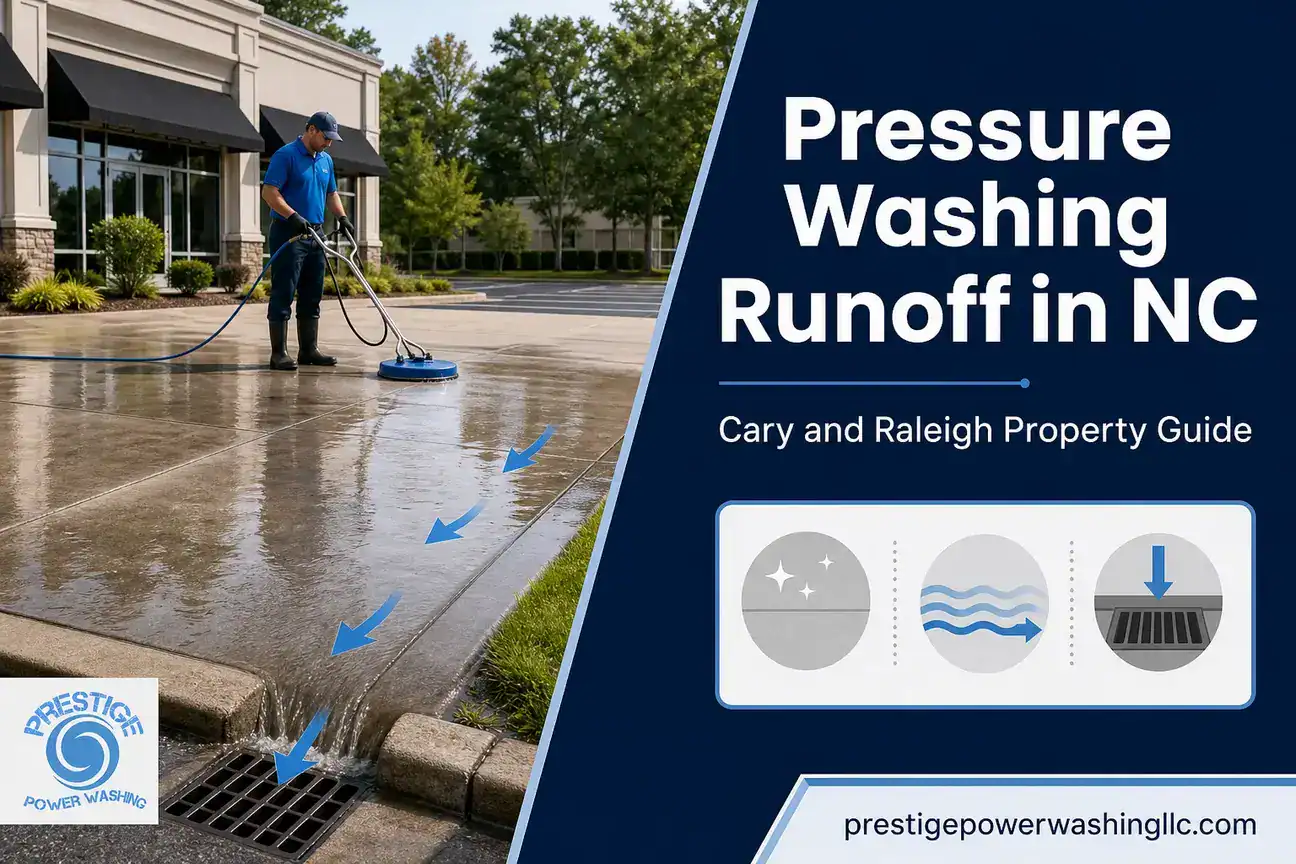
Quick Answer: pressure washing runoff NC concerns usually come down to where wash water goes after it leaves a driveway, sidewalk, building, dumpster pad, breezeway, or other exterior surface. Storm drains are generally designed for stormwater, not dirty wash water with soap, oil, sediment, grease, paint particles, or other pollutants. Property owners should ask any contractor how runoff will be evaluated, whether containment may be needed, and where wastewater may be directed based on the surface, products used, site layout, and applicable local guidance.
For property owners and managers in Cary, Raleigh, and the Triangle, this does not need to be an alarmist topic. It does need to be a practical one. A little planning before exterior cleaning can help clarify drainage paths, protect neighboring areas from unnecessary wash water, and avoid confusion about storm drains, sanitary sewer connections, and site-specific responsibilities.
If you are planning commercial exterior cleaning, apartment breezeway cleaning, driveway cleaning, or routine property maintenance, you can request a free estimate from Prestige Power Washing LLC and discuss the surfaces, drainage layout, and cleaning goals for your property.
Pressure washing runoff NC: what the phrase means
pressure washing runoff NC is a practical way to describe wash water that leaves a cleaned surface during pressure washing, power washing, or related exterior cleaning work in North Carolina. That water may be plain rinse water, or it may carry loosened dirt, sediment, algae, pollen, soap, degreaser residue, oil, grease, hydraulic fluid, paint chips, or other material from the surface being cleaned.
Stormwater runoff is different from water that goes to a sanitary sewer connection. Stormwater typically flows from paved areas, roofs, parking lots, sidewalks, curbs, gutters, and drains toward local waterways through storm drainage systems. A sanitary sewer system is different; it carries wastewater to treatment. The key runoff question for property owners is not simply “Will water be used?” but “Where will the water go, and what might it carry with it?”
That question matters on both residential and commercial properties. A homeowner may notice runoff from a driveway moving toward the street. A property manager may have water moving from a dumpster enclosure toward a nearby inlet. An HOA may have sidewalks, pool decks, mailbox areas, and common drive lanes draining in several directions. A restaurant or retail center may have grease, food residue, gum, oil, or other soils that make planning more important.
The phrase should not be treated as a shortcut for one universal rule. North Carolina properties vary by city, stormwater system, surface type, slope, soil conditions, and discharge path. Official guidance from EPA and North Carolina environmental agencies provides important principles, but site conditions and local requirements can differ.
Pressure washing stormwater basics for property owners
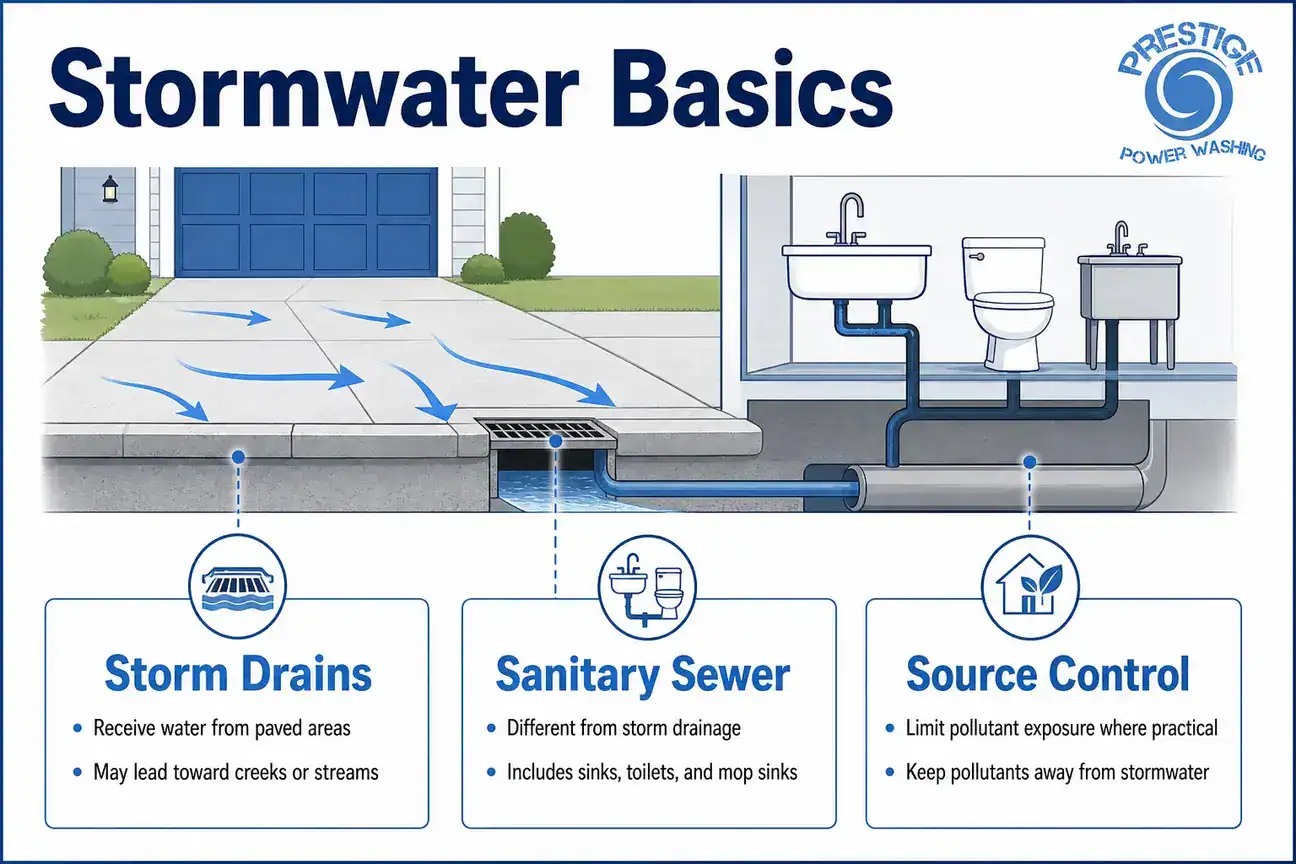
Pressure washing stormwater planning starts with one simple point: storm drains are not the same as indoor sinks, toilets, mop sinks, grease traps, or other sanitary sewer connections. Water entering a storm drain may move toward creeks, streams, lakes, or other surface waters. That is why public agencies focus on limiting pollutants that enter stormwater systems.
EPA’s NPDES Stormwater Program explains the federal framework for regulating pollutant discharges associated with stormwater. NC DEQ’s NPDES Industrial Stormwater General Permit Technical Guidance is useful because it repeatedly frames stormwater protection around practical source-control ideas: reducing pollutant exposure, keeping materials from being washed away, and using good housekeeping practices before pollutants reach runoff. Those concepts support a simple property-level takeaway: do not wait until wash water reaches a drain to start thinking about what it may carry.
NC DEQ’s NPDES Wastewater Permitting FAQs also help readers understand that wastewater and stormwater are not interchangeable categories. Wastewater may require a permitted or approved discharge path, and sanitary sewer disposal is not something to assume just because a drain exists on the property. If collected wash water may contain soap, degreaser, oil, sediment, or other pollutants, the disposal question should be confirmed with the appropriate local utility, municipality, or qualified professional before anyone treats a sanitary sewer connection as an acceptable destination.
For everyday property decisions, stormwater basics can be translated into plain language:
- Know where exterior water flows on the property.
- Identify nearby storm drains, curb inlets, drainage swales, ditches, and low areas before cleaning begins.
- Think about what is on the surface before water is applied.
- Consider whether dry cleanup, sweeping, absorbent materials, drain protection, filtering, containment, or collection may be appropriate.
- Do not assume that “outside drain” means “approved disposal point.”
- Do not assume that sanitary sewer disposal is allowed unless the connection and local permission are clear.
- Do not assume every project has the same runoff concern or the same practical solution.
A clean-looking surface can still have loose grit, pollen, algae, soil, tire residue, oil spots, or cleaning residue that changes the runoff picture. On commercial properties, the concern can be more noticeable because paved areas are larger and often drain directly to curb inlets or catch basins.
Why pressure washing runoff NC deserves attention during exterior cleaning
Exterior cleaning is meant to improve the appearance and usability of surfaces, but the wash water created during the work has to go somewhere. pressure washing runoff NC deserves attention because pressure washing can mobilize material that was sitting on the surface. That material may be minor, such as dust and pollen, or more complicated, such as oil stains, grease near a dumpster pad, or sediment from a neglected drainage area.
For homeowners, the most common concern is usually the path from a driveway, sidewalk, patio, or siding area to the street, yard, or drainage inlet. For business owners and property managers, the concern may involve parking lots, building entries, breezeways, dumpster areas, loading zones, sidewalks, and concrete pads. For HOAs and apartment communities, there may be multiple drainage points across common areas.
Runoff planning is also connected to service selection. A surface-specific cleaning approach may use pressure washing, power washing, soft washing, or a combination depending on the material and soil type. Siding, roofs, wood, concrete, brick, and asphalt are not all cleaned the same way. Matching the cleaning method to the surface can help keep the work focused rather than excessive.
Prestige Power Washing LLC provides exterior cleaning services for residential and commercial properties in the Cary and Raleigh area, with services that include pressure washing, power washing, soft washing, house washing, roof cleaning, gutter cleaning, driveway cleaning, and commercial exterior cleaning. This article is educational and should not be read as a claim that any company has a documented wastewater-control or regulatory compliance program unless that documentation is supplied and verified.
Common runoff sources around homes and commercial properties
Runoff can come from almost any exterior surface, but some areas deserve extra attention before work begins. The concern is not only the amount of water; it is also what the water touches before it leaves the work area. For runoff planning in North Carolina, that means looking at both the surface and the drainage path.
| Surface or area | Possible runoff concern | Useful planning question |
|---|---|---|
| Driveways and parking stalls | Dirt, tire residue, sediment, oil spots, and vehicle fluids may be present. | Where does water flow from the pavement, and are there storm drains nearby? |
| Sidewalks and storefront entries | Gum, spilled drinks, soil, pollen, and general foot-traffic residue may loosen during cleaning. | Can loose debris be swept or collected before washing begins? |
| Dumpster pads and loading areas | Grease, food residue, oil, sediment, and organic debris can create more complex wastewater. | Does the contractor need to evaluate containment or disposal before work? |
| Apartment breezeways | Dust, spills, tracked-in soil, algae, and debris may move toward drains or stairwells. | How will tenant access, water flow, and drainage be managed during the visit? |
| Gutters and downspouts | Leaves, sediment, roof granules, and organic buildup may discharge near landscaping or drains. | Where do the downspouts release water, and is debris removal part of the scope? |
| Building siding and exterior walls | Algae, mildew-like staining, pollen, cobwebs, and soil can rinse down to the ground. | What cleaning method is appropriate for the surface? |
This kind of planning does not mean every job is complicated. Many exterior cleaning projects are straightforward. The goal is to avoid surprises by looking at the property before the work begins and asking practical questions about slope, drains, products, soil type, and access.
Commercial pressure washing runoff and property-manager priorities
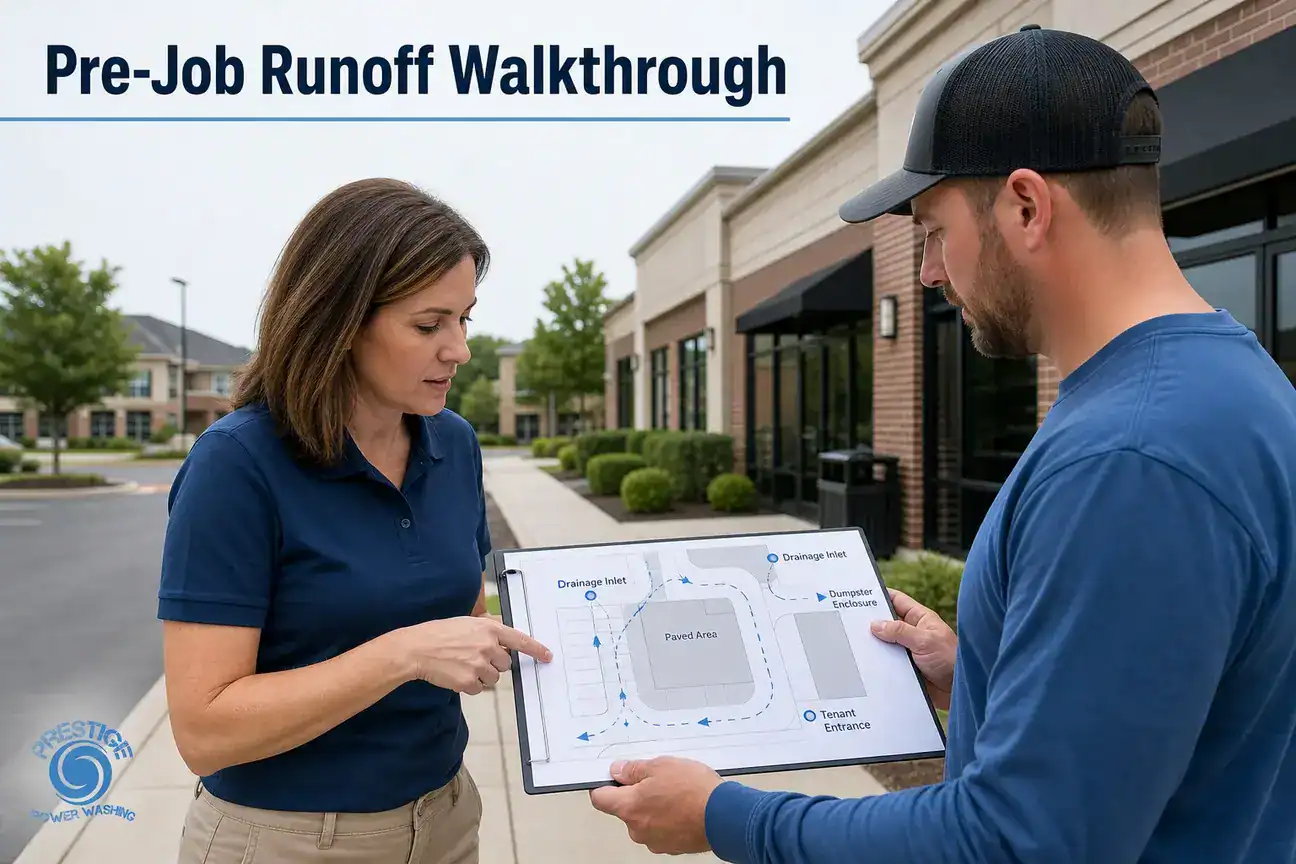
Commercial pressure washing runoff is often more complex than a small residential cleaning project because commercial properties may have larger paved areas, more vehicle traffic, dumpster enclosures, shared walkways, tenant entrances, and multiple drainage structures. Property managers are also balancing scheduling, appearance, tenant disruption, customer access, and communication with vendors.
For a retail center, office building, apartment community, or HOA, runoff planning should be part of the pre-job conversation. Ask the contractor to walk through the surfaces that need cleaning, nearby inlets, where water naturally flows, and whether any visible stains or residues change the approach. If the property has a known stormwater plan, drainage map, maintenance standard, or site rule, have that available before the work begins.
Prestige Power Washing LLC offers commercial pressure washing for exterior property needs in the Cary and Raleigh area. Commercial cleaning can include surfaces such as building exteriors, walkways, concrete, and other exterior areas, depending on the property and confirmed service scope. Because runoff concerns are site-specific, property managers should confirm the details of the project rather than assuming one procedure fits every property.
Apartment communities and breezeways
Multi-unit communities have a mix of cleaning goals: appearance, resident communication, foot traffic, water flow, and access. Breezeways can collect tracked-in dirt, pollen, spills, and debris. Stairwells and upper-level walkways may also drain in ways that are not obvious from a parking lot. A contractor should understand where water may travel before work starts.
For apartment communities, scheduling and communication matter. Residents may need to know when walkways or breezeways are being cleaned, and the property team may need to coordinate access. Prestige Power Washing LLC offers building and breezeway cleaning, but this should not be interpreted as a promise of any safety, regulatory, or inspection outcome. It is an exterior cleaning service whose scope should be confirmed for the property.
Dumpster pads, loading zones, and stained concrete
Dumpster pads and loading areas can involve more challenging soils than a typical sidewalk. Grease, food residue, oil, hydraulic fluid, sediment, and organic debris can affect how wash water should be handled. These areas are also more likely to sit near drains because they are paved service zones.
Property managers should ask about the visible condition of the area, whether dry debris should be removed first, where water flows, and whether the contractor recommends a different approach for stains, grease, or fluid residue. Prestige Power Washing LLC lists dumpster pad power washing and oil and hydraulic fluid removal among its confirmed services, but complete removal of stains or contaminants should not be assumed. Results can depend on surface age, porosity, previous treatments, and how long material has been present.
Pressure washing wastewater disposal: questions to ask before work begins
Pressure washing wastewater disposal is not a phrase most property owners use every day, but it is one of the most useful runoff topics to raise with a contractor. The goal is not to turn the estimate into a legal seminar. The goal is to understand whether the contractor has thought through the water path, the surface soils, and the difference between storm drains and approved disposal options.
Agency guidance supports several practical questions. EPA’s stormwater program focuses on pollutant discharges to waters. NC DEQ’s industrial stormwater guidance emphasizes preventing pollutants from being exposed to stormwater where practical. NC DEQ’s wastewater permitting FAQs help separate wastewater-disposal questions from stormwater questions. Together, those sources support a cautious approach when wash water could contain soap, chemicals, degreasers, oils, grease, or sediment: identify the water path first, avoid storm drains unless the situation is clearly allowed, and verify any sanitary sewer disposal option before using it.
Before scheduling exterior cleaning, ask questions like these:
- Where will wash water naturally flow from the work area?
- Are there storm drains, curb inlets, drainage ditches, swales, or creeks nearby?
- Will the work involve soap, detergent, degreaser, or another cleaning product?
- Can loose debris be swept or removed before washing starts?
- If containment is needed, what options may be practical for this site?
- If water is collected, where may it be directed or disposed of?
- Has anyone confirmed whether a sanitary sewer connection is appropriate for the collected water?
- Are there property-specific rules, tenant requirements, or local instructions the contractor should know?
- Will the contractor avoid making assumptions about drains or sewer connections without confirmation?
Those questions are especially useful for commercial properties because a site may have storm drains that look similar to other drains but lead to very different places. A property manager may also know about drainage issues, previous maintenance work, or restrictions that are not visible during a quick walkthrough.
If you are unsure how to describe your property, take photos of the surface, nearby drains, and water flow paths after rain. Then contact Prestige Power Washing with those details so the conversation can start with the right context.
NC pressure washing rules and where official guidance fits
NC pressure washing rules are not always summed up by one single webpage because the answer can depend on the property, activity, discharge, municipality, and receiving system. A practical way to think about official guidance is to treat it as a framework: storm drains are for stormwater, wastewater may require different handling, and local authorities may have instructions for specific situations.
EPA’s NPDES Stormwater Program explains the federal permitting structure for stormwater discharges associated with regulated activities. NC DEQ provides North Carolina-specific stormwater and wastewater permitting resources. Those sources help explain the broader environmental framework, but they do not automatically answer every runoff question for every driveway, apartment breezeway, restaurant pad, or retail sidewalk.
That is why this guide avoids one-size-fits-all statements. A small residential rinse job and a commercial degreasing project do not present the same runoff profile. Cleaning with plain water and cleaning with soaps or other products are also different scenarios. Public guidance places more emphasis on pollutants, exposure, discharge pathways, and approved handling when wash water contains soap, chemicals, oils, grease, sediment, or other materials that should not be carried into stormwater.
Property owners should also recognize the difference between educational discussion and a compliance promise. A contractor can discuss runoff awareness, site observations, and practical planning questions. That is not the same as providing legal advice, a regulatory determination, a permit, a certified compliance program, or an assurance that a property will meet every applicable requirement.
How stormwater runoff pressure washing planning changes by cleaning method
Stormwater runoff pressure washing planning should fit the cleaning method being used. Pressure washing, power washing, and soft washing are related, but they are not identical. The appropriate method depends on the surface, the soil type, and the cleaning goal.
Pressure washing hard surfaces
Pressure washing is commonly associated with hard exterior surfaces such as concrete, some masonry, and certain pavement areas. Because the water can loosen sediment and surface residue quickly, drainage paths should be identified before work starts. This is especially important for driveways, sidewalks, parking lots, and pads near storm drains.
For homeowners, driveway pressure washing may involve dirt, algae-like staining, tire marks, and spots from vehicles. For commercial properties, concrete and asphalt may involve more traffic residue and a larger water path. The runoff question becomes more important when visible oil, grease, or accumulated sediment is present.
Power washing and commercial paved areas
Power washing is often discussed for commercial concrete, asphalt, and exterior surfaces where a stronger cleaning approach may be considered. The same runoff principle still applies: the water path and surface soils matter. If a paved surface drains directly to a storm inlet, property managers should ask how that inlet will be considered during the project.
Prestige Power Washing LLC lists concrete and asphalt cleaning as a confirmed commercial service. That service connection is relevant for property managers researching pressure washing runoff NC, but it should not be read as a company-specific claim of wastewater containment, regulatory approval, or promised outcome.
Soft washing siding, roofs, and delicate surfaces
Soft washing is often used when lower pressure is more appropriate for a surface, such as certain siding or roof applications. Runoff planning still matters because water and cleaning solution can move down walls, across landscaping, into gutters, or toward drainage areas. Roof and gutter systems can also route water quickly to downspouts.
Prestige Power Washing LLC offers roof cleaning and exterior gutter cleaning. Roof cleaning is not roofing repair, roof replacement, or manufacturer warranty service. Gutter cleaning is an exterior cleaning service; property owners should still pay attention to where downspouts discharge and whether debris may be moved during the work.
Runoff management questions for Cary and Raleigh properties
Runoff management is most useful when it starts with the actual site. Cary is the confirmed public business address location for Prestige Power Washing LLC, and Raleigh is part of the company’s service-area market. Other Triangle communities should be treated as service areas only where the specific service and property can be confirmed, not as branch offices or storefront locations.
For a Cary or Raleigh property, start by walking the site after a rainfall. Notice whether water sheets across the driveway, flows to a curb, collects in a low spot, or enters a visible storm drain. On a commercial property, note whether downspouts tie into underground pipes, whether dumpster pads slope to an inlet, and whether sidewalks drain into landscaping or streets. These observations make contractor conversations more specific.
Next, think about the surface itself. A lightly dusty sidewalk has different runoff concerns than a dumpster enclosure with grease and debris. A driveway with an old oil stain differs from a patio with pollen and leaf residue. A breezeway with foot traffic differs from a roof with organic staining. These differences help determine what questions to ask and what cleaning method may be appropriate.
Finally, ask about documentation. Property managers may want a written scope of work, notes about areas included, and a clear understanding of what is not included. This is not the same as a regulatory certification or inspection document. It is simply good communication for a commercial property, HOA, or multi-unit community.
What to document before hiring a contractor
Good documentation makes the estimate conversation easier and reduces misunderstandings. You do not need a technical report to begin. A few clear photos and notes can help the contractor understand the property and talk through pressure washing runoff NC considerations.
Before requesting an estimate, consider collecting:
- Photos of the surfaces to be cleaned.
- Photos of nearby storm drains, curb inlets, downspouts, and drainage areas.
- Notes about visible stains, oil spots, grease, loose sediment, algae-like discoloration, or debris.
- Any known property rules about water use, drains, access, tenant notices, or service hours.
- Whether the surface is concrete, asphalt, brick, siding, wood, roofing, or another material.
- Whether the area is residential, HOA common area, apartment community, restaurant exterior, office property, or retail center.
Clear information helps the contractor recommend an appropriate method for the surface and discuss runoff considerations early. It also helps property managers compare proposals more fairly. If one contractor discusses the water path and another ignores it entirely, that difference is worth noticing.
What this guide does not claim
Because pressure washing runoff NC touches environmental and regulatory topics, it is important to be clear about what this article does not claim. This guide is educational content for property owners, not legal advice and not a compliance determination for any specific property.
This article does not claim that Prestige Power Washing LLC has a documented wastewater-control program, NPDES permit coverage, water-recovery system, or regulatory compliance certification. It also does not claim that hiring an exterior cleaning contractor ensures compliance with federal, state, or local stormwater rules.
This article does not claim that Prestige Power Washing LLC provides licensed plumbing, sewer-line repair, municipal drainage work, or camera pipe inspection. Hydro-jetting drainage cleaning, where discussed elsewhere by the company, should be treated as exterior or drainage cleaning unless current client-supplied documentation verifies additional licensing or scope.
This article does not claim NFPA 96 compliance, fire-code certification, inspection-ready hood documentation, medical-grade disinfection, pathogen control, or assured stain removal. For restaurants, commercial kitchens, healthcare-related settings, or regulated facilities, property owners should confirm requirements with qualified authorities and relevant professionals.
A practical way to move forward
The most useful approach to runoff is calm, specific, and property-based. Identify the surfaces. Look at the drainage. Think about what may be on the surface. Ask how the contractor evaluates wash water when soap, oil, sediment, or other residue may be present. Confirm the scope before work begins.
For many property owners, that conversation is enough to make exterior cleaning feel more organized. For commercial properties, it can also help align the work with tenant communication, site access, and maintenance expectations. Prestige Power Washing LLC is a family-owned and locally operated exterior cleaning business based in Cary, founded in February 2017, serving Cary, Raleigh, and verified Triangle-area communities by project and service fit.
If your property needs exterior cleaning and you want a surface-specific conversation about runoff, you can call 919-520-4521. Share photos, drainage concerns, and the surfaces you want cleaned so the discussion can focus on the right details from the start.
Frequently Asked Questions
What is stormwater runoff in the context of pressure washing?
Stormwater runoff is water that flows over exterior surfaces toward streets, drains, ditches, swales, or waterways. In pressure washing, runoff may include dirt, sediment, soap, oil, grease, or other material loosened from the surface being cleaned. That is why the water path matters.
Can pressure washing wash water go into a storm drain?
Property owners should not assume wash water can enter a storm drain. Storm drains are generally intended for stormwater, and EPA and NC DEQ guidance focuses on keeping pollutants out of those systems. If soap, chemicals, oil, grease, sediment, or dirty wash water may be involved, ask about containment, collection, filtering, or approved disposal options.
Is plain water always okay during pressure washing?
Plain water may still carry material from the surface, such as soil, sediment, pollen, algae-like buildup, or vehicle residue. The risk depends on the surface, what is being removed, where the water flows, and local requirements. A clean water source does not automatically make the runoff clean after it contacts the surface.
What should I ask a contractor about runoff control?
Ask where water will flow, whether storm drains are nearby, whether soap or degreasers may be used, whether dry cleanup should happen first, and whether containment or collection may be appropriate. For commercial properties, also ask how access, tenant communication, and drainage features will be considered.
Are commercial properties treated differently from homes?
Commercial properties often have larger paved areas, more traffic residue, dumpster pads, loading zones, and multiple drainage structures, so the runoff conversation can be more detailed. That does not mean every commercial job has the same requirements. Site layout, surface condition, soil type, and local guidance all matter.
Does hiring an exterior cleaning contractor mean stormwater compliance?
No. Hiring a contractor does not automatically mean compliance with federal, state, or local stormwater requirements. A contractor can discuss practical runoff considerations and cleaning scope, but property-specific compliance questions should be confirmed with the appropriate authority or qualified professional.
Where should North Carolina property owners look for official guidance?
EPA and NC DEQ resources are good starting points for understanding stormwater and wastewater concepts. Local municipalities may also provide instructions for pressure washing, detergents, storm drains, sanitary sewer approval, and disposal. Because requirements can vary by location and situation, property owners should check the guidance that applies to their site.