
By the Certified Technicians at Prestige Power Washing LLC
When Hydraulic Fluid Becomes an Emergency
A burst hydraulic line on a CNC machine, a leaking forklift, or a spill during equipment maintenance—these incidents happen fast. Within minutes, oil and hydraulic fluid can saturate concrete floors, migrate into storm drains, and create an environmental hazard that puts your Charlotte-area facility at risk of OSHA fines, EPA violations, and costly remediation.
For industrial facilities, manufacturing plants, warehouses, and heavy equipment operations in Mecklenburg County, the question isn’t if a hydraulic fluid spill will happen—it’s when. And when it does, you need a response team that can contain, remove, and remediate the contamination quickly, safely, and in full compliance with environmental regulations.
Our expertise in oil hydraulic fluid removal Charlotte ensures that your facility remains compliant with environmental regulations.
That’s where professional oil hydraulic fluid removal Charlotte comes in.
For reliable oil hydraulic fluid removal Charlotte, contact our team for effective services.
“A mop and some cat litter won’t cut it. Hydraulic fluid penetrates porous concrete and seeps into soil. Without proper extraction, you’re looking at long-term contamination and regulatory liability.” – The Prestige Power Washing Team
Choosing professional oil hydraulic fluid removal Charlotte is crucial for maintaining safety and compliance at your facility.
Why Hydraulic Fluid Spills Are a Serious Problem in Charlotte
Charlotte is a major manufacturing and logistics hub. From aircraft parts manufacturers in Matthews to heavy equipment rental yards in Huntersville, hydraulic systems are everywhere. When they leak, the fluid creates immediate and long-term hazards:
Implementing oil hydraulic fluid removal Charlotte can save you from lengthy legal battles.
Our services focus on oil hydraulic fluid removal Charlotte to ensure a clean environment.
- Environmental Contamination: Hydraulic oil is a petroleum product. If it enters storm drains, it violates the Clean Water Act and can result in EPA fines of $37,500+ per day.
- Concrete Damage: Oil breaks down concrete’s binding agents, causing cracking, spalling, and structural weakening over time.
- Soil Contamination: Once fluid seeps into the ground, it can require expensive excavation and remediation.
- Safety Hazards: Slippery floors increase worker injury risk. Oil-soaked dust becomes a fire hazard.
- Regulatory Non-Compliance: OSHA requires employers to maintain safe, clean work environments. Uncleaned spills can trigger violations.
Internal Link: For facilities with ongoing drainage issues, our Hydro Jetting & Drainage Cleaning service prevents oil and debris from clogging floor drains.
What is Professional Oil Hydraulic Fluid Removal?
Professional oil hydraulic fluid removal is a multi-step process that goes far beyond surface cleaning. It’s industrial spill cleanup performed by certified technicians using specialized equipment designed to extract, contain, and properly dispose of petroleum-based fluids in compliance with EPA and NCDEQ regulations.
Key Components of the Service:
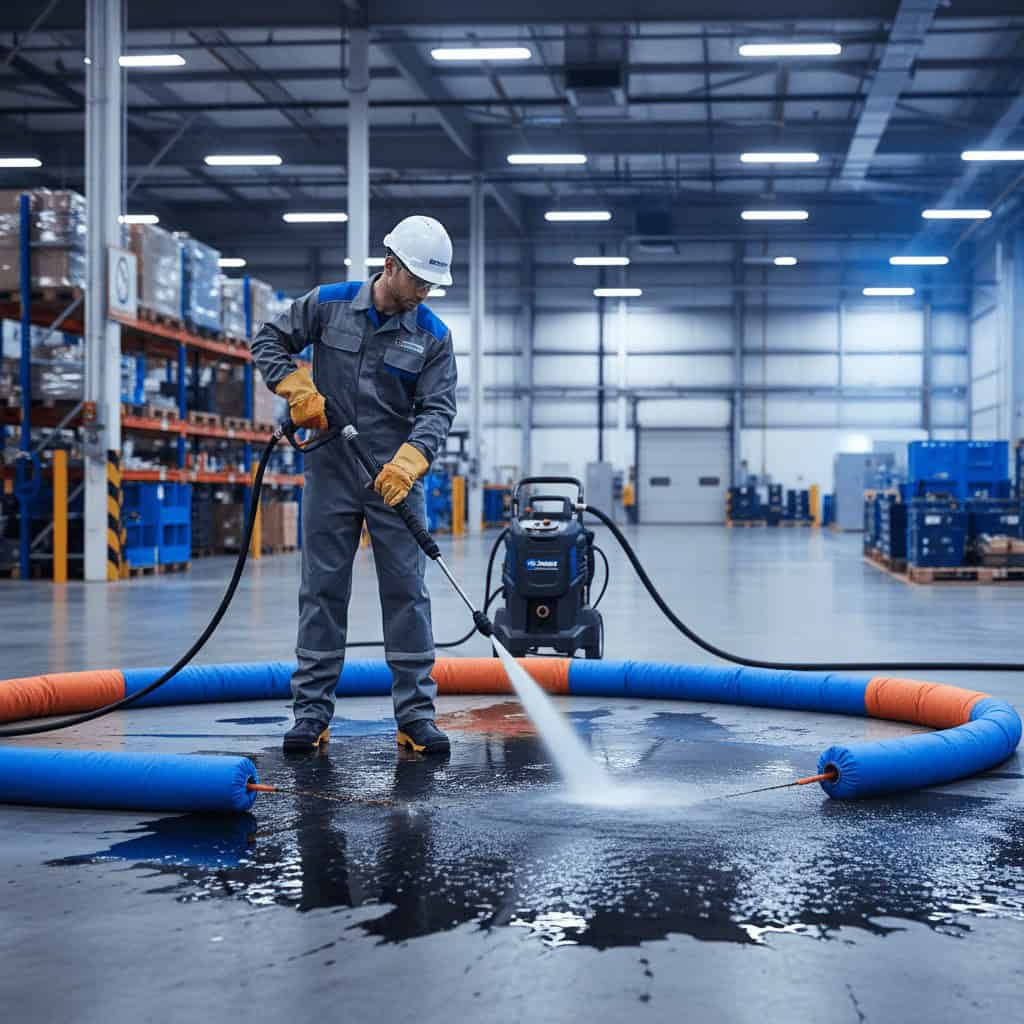
- Immediate Spill Containment: Absorbent booms and barriers prevent spread.
- Extraction & Removal: High-powered vacuums and pressure washers extract fluid from concrete pores.
- Surface Decontamination: Bioremediation agents break down remaining oil residues.
- Proper Disposal: All waste is collected, documented, and transported to licensed disposal facilities.
- Documentation: We provide spill reports and waste manifests for your regulatory compliance files.
This process ensures your Charlotte facility meets environmental compliance standards while protecting your property from long-term damage.
Where Oil Hydraulic Fluid Removal Is Essential in Charlotte
Manufacturing & Industrial Plants: CNC machines, presses, and hydraulic lifts are common spill sources.
Warehouses & Distribution Centers: Forklifts and pallet jacks leak fluid constantly, especially on busy loading docks.
Heavy Equipment Rental Yards: Maintenance bays see frequent spills during repairs and fluid changes.
Automotive Repair Shops: Hydraulic lifts and fluid reservoirs are prone to leaks.
Aircraft Maintenance Facilities: High-pressure hydraulic systems at Charlotte-Douglas International Airport and surrounding aviation hubs require specialized spill response.
When spills occur, our oil hydraulic fluid removal Charlotte services can mitigate risks effectively.
Construction Sites: Equipment servicing on-site creates contamination risks that must be managed before project closeout.
Oil hydraulic fluid removal Charlotte is essential for industries dealing with heavy machinery.
The Oil Hydraulic Fluid Removal Process: Step-by-Step
Step 1: Emergency Response & Site Assessment
Our certified team arrives within hours (often same-day) to assess the spill scope, identify the fluid type, and deploy containment measures.
Step 2: Containment & Extraction
We use industrial-grade absorbent booms to isolate the spill, then extract standing fluid with high-powered vacuum trucks. For soaked concrete, we apply emulsifiers to lift oil from pores.
Step 3: Pressure Washing & Decontamination
Hot water pressure washing (up to 3,000 PSI) removes residual oil. We use biodegradable detergents that break down petroleum without harming the environment.
Step 4: Bioremediation (if needed)
For severe contamination, we apply microbial agents that digest remaining hydrocarbons, rendering the site safe for continued use.
We provide immediate oil hydraulic fluid removal Charlotte to minimize environmental impact.
Choose our oil hydraulic fluid removal Charlotte service for comprehensive spill response.
Step 5: Waste Collection & Documentation
All contaminated materials (absorbents, soil, water) are collected in DOT-approved containers. We provide a waste manifest and spill report for your records.
Step 6: Final Inspection & Compliance Verification
We perform a black-light inspection to ensure all petroleum residues are removed, giving you regulatory confidence.
For the best oil hydraulic fluid removal Charlotte, rely on our proven methods.
Efficient oil hydraulic fluid removal Charlotte helps you maintain compliance with regulations.
Internal Link: For routine facility cleaning that prevents spills from reaching drains, see our Sanitation Services.
Professional Oil Hydraulic Fluid Removal vs. DIY Cleanup
| Aspect | Professional Service (Prestige) | DIY / In-House Attempt |
| Effectiveness | 98%: Extracts oil from concrete pores, meets EPA standards. | 40-60%: Surface cleaning leaves contamination in concrete. |
| Environmental Compliance | Full Compliance: Licensed waste disposal, spill reporting. | High Risk: Improper disposal can trigger EPA fines. |
| Safety | OSHA Certified: Technicians trained in hazmat handling. | Risk: Employees lack PPE and training; exposure hazards. |
| Cost Over Time | Lower Total Cost: Prevents fines, remediation, property damage. | Higher: Repeat cleanings, potential fines, remediation. |
| Documentation | Complete: Waste manifests, spill reports for regulators. | None: No proof of compliance if inspected. |
“One Charlotte manufacturer faced $125,000 in EPA fines after an employee dumped oily water down a storm drain. Our service would have cost $2,500 and provided full compliance documentation.” – Prestige Power Washing Team
Environmental & Regulatory Compliance: What Charlotte Facilities Must Know
Federal Regulations (EPA):
Our oil hydraulic fluid removal Charlotte experts ensure thorough cleaning and compliance.
- Clean Water Act: Discharging oil to storm drains or surface water is prohibited. Violations can cost $37,500+ per day.
- Resource Conservation and Recovery Act (RCRA): Used oil is a regulated waste. Generators must use licensed transporters and disposal facilities.
With our oil hydraulic fluid removal Charlotte service, you prevent costly fines and damages.
North Carolina Regulations (NCDEQ):
- 15A NCAC 02B: Stormwater pollution prevention requirements for industrial facilities.
- Solid Waste Management: Used oil must be managed as special waste.
OSHA Requirements:
- 29 CFR 1910.120 (Hazwoper): Employees cleaning hazardous spills must be trained.
- 29 CFR 1910.22: Workplaces must be kept clean and dry.
Internal Link: Our Oil Hydraulic Fluid Removal service page details our compliance protocols.
Why Choose Prestige Power Washing for Oil Hydraulic Fluid Removal in Charlotte?
✅ Licensed & Insured: We carry EPA-compliant waste transport licenses and $2M liability insurance.
✅ Rapid Response: 24/7 emergency spill response for Charlotte-area industrial clients.
✅ Certified Technicians: OSHA 40-hour HAZWOPER trained, with continuing education.
✅ Proper Disposal: All waste transported to NCDEQ-licensed facilities with full documentation.
✅ Advanced Equipment: Vacuum trucks, pressure washers up to 4,000 PSI, bioremediation technology.
✅ Local Expertise: We understand Charlotte’s industrial landscape, from the airport to manufacturing corridors along I-85 and I-77.
Internal Link: Learn about our full range of capabilities on our Our Services page.
Frequently Asked Questions (FAQs)
Our oil hydraulic fluid removal Charlotte team is here to assist you around the clock.
Q1: Is oil hydraulic fluid removal required by law?
Yes. OSHA requires clean work environments, and the EPA prohibits discharge of petroleum to waterways. Professional removal ensures compliance.
Q2: How quickly can you respond to a spill in Charlotte?
We offer 24/7 emergency response, typically on-site within 2-4 hours for Mecklenburg County locations.
Q3: What happens to the waste you collect?
All contaminated materials are transported to NCDEQ-licensed disposal facilities. We provide waste manifests for your records.
The need for oil hydraulic fluid removal Charlotte cannot be overstated in industrial settings.
With our oil hydraulic fluid removal Charlotte service, you get peace of mind.
Remember, proactive oil hydraulic fluid removal Charlotte can save you time and money.
Contact us today for your oil hydraulic fluid removal Charlotte needs; we are ready to help.
Q4: Can you clean hydraulic fluid from asphalt?
Yes, but asphalt is porous. We use hot water pressure washing and emulsifiers, though some staining may remain. Concrete yields better results.
Q5: Do you handle small spills (e.g., 5 gallons)?
Absolutely. No job is too small. Even minor spills require proper documentation and disposal to avoid compliance issues.
Q6: What’s the average cost for oil hydraulic fluid removal in Charlotte?
Small spills (5-20 gallons) typically range from $800-$1,500. Larger industrial spills can be $3,000-$8,000 depending on volume and contamination depth. We provide free on-site estimates.
Our comprehensive approach to oil hydraulic fluid removal Charlotte guarantees satisfaction.
Q7: Can hydraulic fluid damage my concrete floor permanently?
Yes. If left untreated, it breaks down concrete’s binding agents, leading to spalling and cracks. Prompt removal prevents structural damage.
For all your concerns regarding oil hydraulic fluid removal Charlotte, we are just a call away.
For effective oil hydraulic fluid removal Charlotte, trust our certified technicians.
Choose our trusted oil hydraulic fluid removal Charlotte service to protect your environment.
For fast and reliable oil hydraulic fluid removal Charlotte, reach out today!
Q8: Are your technicians certified for industrial spill cleanup?
Yes. All technicians hold OSHA 40-hour HAZWOPER certification and receive annual refresher training.
Protect Your Charlotte Facility Today
Don’t let a hydraulic fluid spill become an environmental disaster. Whether it’s a small leak or a major industrial spill, Prestige Power Washing LLC has the expertise, equipment, and certifications to handle it safely and legally.
Contact us now for a free on-site assessment and quote
Join many satisfied clients who have chosen oil hydraulic fluid removal Charlotte from us!
Internal Links:
- Learn about our comprehensive Sanitation Services
- Discover our Hydro Jetting & Drainage Cleaning solutions
- Explore all our capabilities on Our Services
Sources & References
1. OSHA – Hazardous Waste Operations and Emergency Response
Training requirements for employees involved in spill cleanup.
https://www.osha.gov/laws-regs/regulations/standardnumber/1910/1910.120
2. OSHA – Walking Working Surfaces Standard
Requires workplaces to be kept clean and dry to prevent slip hazards.
https://www.osha.gov/laws-regs/regulations/standardnumber/1910/1910.22
3. North Carolina Department of Environmental Quality (NCDEQ) – Solid Waste Section
Regulations for used oil management and disposal in North Carolina.
https://deq.nc.gov/about/divisions/waste-management4. Charlotte-Mecklenburg Storm Water Services – Illicit Discharge
Local regulations prohibiting discharge of pollutants to storm drains.
https://charlottenc.gov/StormWater/Pages/Illicit-Discharge.aspx
We specialize in oil hydraulic fluid removal Charlotte to protect your assets and the environment.
Our commitment to oil hydraulic fluid removal Charlotte ensures your facility’s safety.
Leave A Comment